General formula for lenses without spherical abberation

Click For Summary
SUMMARY

The discussion centers on the publication by Rafael G. González-Acuña and Héctor A. Chaparro-Romo titled "General formula for bi-aspheric singlet lens design free of spherical aberration," published in Appl. Opt. 57, 9341-9345 (2018). The authors present an analytic expression that addresses the design of lens surfaces to eliminate spherical aberration, a significant advancement over previous numerical approximations. Participants express enthusiasm for the formula's utility and note the potential for simplification through symbol replacement. Access to the full publication remains a barrier for some users, limiting their ability to fully engage with the content.

PREREQUISITES
  • Understanding of lens design principles
  • Familiarity with spherical aberration concepts
  • Knowledge of bi-aspheric lens configurations
  • Basic mathematical skills for manipulating equations
NEXT STEPS
  • Research the implications of spherical aberration in optical systems
  • Explore advanced lens design software tools
  • Study the derivation of bi-aspheric lens formulas
  • Access the full publication through academic databases or libraries
USEFUL FOR

Optical engineers, physicists, and lens designers seeking to enhance their understanding of lens design and eliminate spherical aberration in optical applications.

Messages
37,402
Reaction score
14,234
TL;DR
Solution to a long-standing problem: How to make lenses without spherical abberation?
Publication: Rafael G. González-Acuña and Héctor A. Chaparro-Romo, "General formula for bi-aspheric singlet lens design free of spherical aberration," Appl. Opt. 57, 9341-9345 (2018)
Open access preprint: arXiv

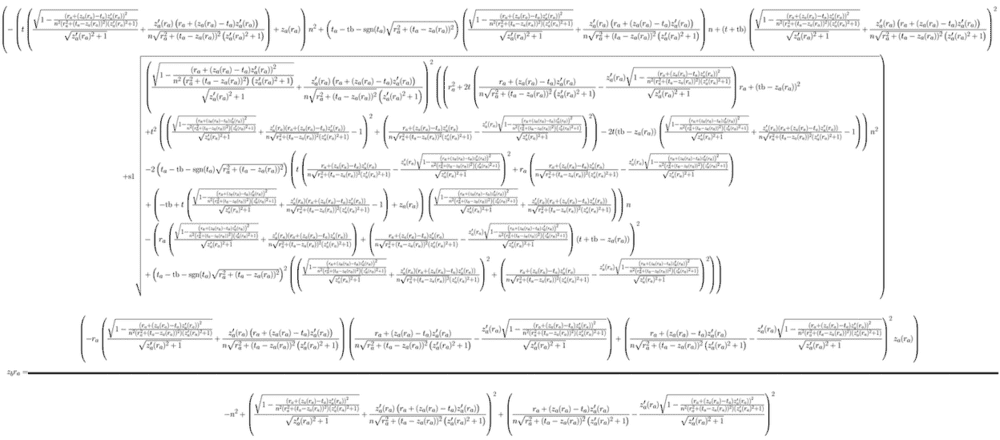
Given one surface of a lens, how does the other surface has to look like to avoid spherical abberation? A question as old as the design of lenses. Computers found numerical approximations but an analytic expression is new. Just use this handy formula:
formula.png
 
  • Haha
Likes   Reactions: lekh2003
Physics news on Phys.org
Wow this is quite cool. It’s funny how there are still physics problems hanging out there that have been pretty much forgotten except by those in the field.
 
Very handy, indeed :D My hat's off to whomever typed that out, holy mother of ..
 
If you look into the expression there are many repeated elements. Replace them by other symbols and the equation gets more handy already. The preprint doesn't have the formula and I don't have access to the full publication (not even the usual approaches work) so the image is all I have.
 
  • Like
Likes   Reactions: Keith_McClary