General formula for lenses without spherical abberation

Click For Summary

Discussion Overview

The discussion revolves around the design of bi-aspheric singlet lenses that are free of spherical aberration, referencing a publication that presents a general formula for this purpose. Participants explore the implications of the formula and the historical context of the problem within lens design.

Discussion Character

  • Exploratory, Technical explanation, Conceptual clarification

Main Points Raised

  • One participant references a publication that proposes a new analytic expression for lens design to avoid spherical aberration, contrasting it with numerical approximations previously used.
  • Another participant expresses enthusiasm about the ongoing relevance of such physics problems, suggesting they are often overlooked outside the field.
  • A third participant appreciates the formula's utility and acknowledges the effort involved in its derivation.
  • One participant notes the presence of repeated elements in the expression and suggests that substituting symbols could simplify the equation, although they lack access to the full publication for further details.

Areas of Agreement / Disagreement

The discussion does not present a consensus, as participants express varying levels of access to the formula and differing perspectives on its implications and usability.

Contextual Notes

Limitations include the lack of access to the full publication for some participants, which may affect their understanding and ability to engage with the formula in detail.

Messages
37,445
Reaction score
14,313
TL;DR
Solution to a long-standing problem: How to make lenses without spherical abberation?
Publication: Rafael G. González-Acuña and Héctor A. Chaparro-Romo, "General formula for bi-aspheric singlet lens design free of spherical aberration," Appl. Opt. 57, 9341-9345 (2018)
Open access preprint: arXiv

Given one surface of a lens, how does the other surface has to look like to avoid spherical abberation? A question as old as the design of lenses. Computers found numerical approximations but an analytic expression is new. Just use this handy formula:
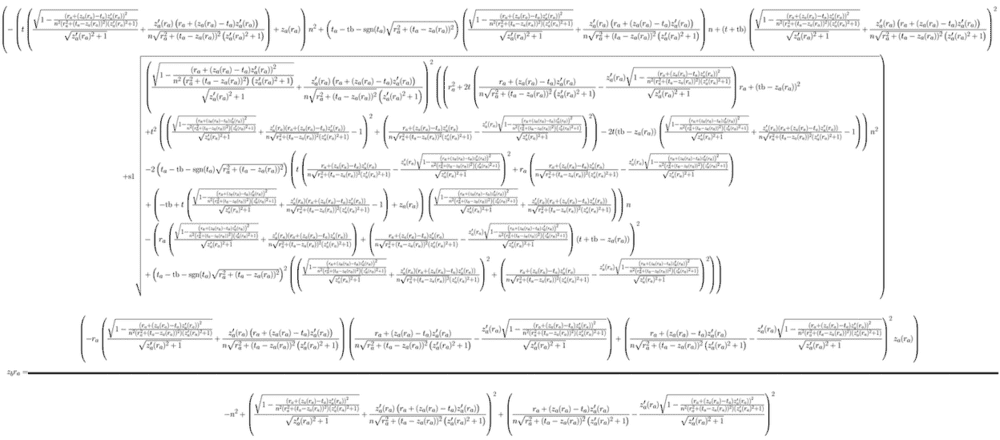
formula.png
 
  • Haha
Likes   Reactions: lekh2003
Physics news on Phys.org
Wow this is quite cool. It’s funny how there are still physics problems hanging out there that have been pretty much forgotten except by those in the field.
 
Very handy, indeed :D My hat's off to whomever typed that out, holy mother of ..
 
If you look into the expression there are many repeated elements. Replace them by other symbols and the equation gets more handy already. The preprint doesn't have the formula and I don't have access to the full publication (not even the usual approaches work) so the image is all I have.
 
  • Like
Likes   Reactions: Keith_McClary