Graduate Generalized free fields as dark matter?

Click For Summary
SUMMARY

The discussion centers on the potential modeling of dark matter using generalized free fields, as suggested by @vanhees71. It references Ray Streater's work in "Outline of axiomatic relativistic quantum field theory" (Rep. Prog. Phys. 1975 38 771-846), which highlights the absence of particles in generalized free fields with continuous Källén-Lehmann weight functions. The conversation explores the implications of these fields on dark matter and the challenges of coupling them to the standard model or general relativity, ultimately questioning their viability as dark matter candidates.

PREREQUISITES
  • Understanding of S-matrix elements in quantum field theory
  • Familiarity with Källén-Lehmann weight functions
  • Knowledge of generalized free fields and their properties
  • Basic concepts of Lagrangian formulations in physics
NEXT STEPS
  • Research the implications of generalized free fields in quantum field theory
  • Study the coupling of quantum fields to the standard model
  • Examine the role of unparticles in dark energy models
  • Explore the mathematical framework of Wightman functions and their deformations
USEFUL FOR

Physicists, researchers in quantum field theory, and anyone interested in theoretical models of dark matter and dark energy.

Peter Morgan
Gold Member
Messages
314
Reaction score
125
@vanhees71 reminds us that
vanhees71 said:
The only interpretation of particles is in terms of asymptotic free states, and the observable predictions are in S-matrix elements.
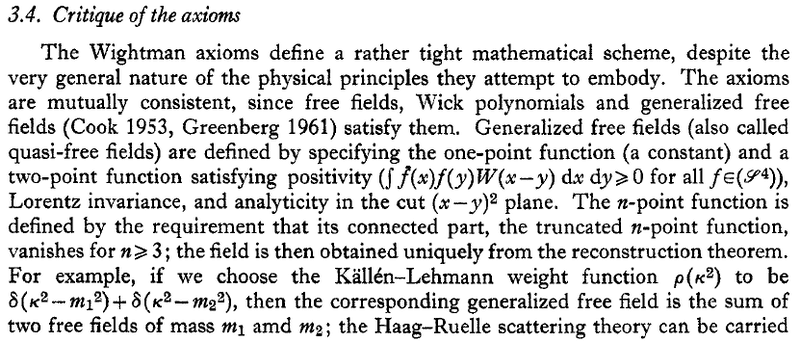
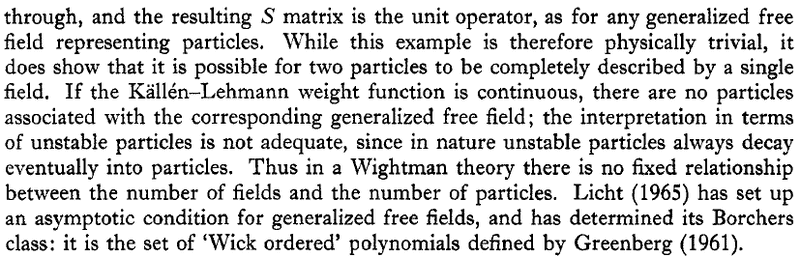
which suggests something I've wondered about for a while, whether dark matter might be adequately modeled by generalized free fields, which do not have asymptotic free states. Ray Streater, in Rep. Prog. Phys. 1975 38 771-846, "Outline of axiomatic relativistic quantum field theory" has this account:

upload_2018-4-6_7-43-55.png

upload_2018-4-6_7-44-18.png


[I'd be pleased to know of a clear, more recent reference.]
The really pertinent phrase is "If the Källén-Lehmann weight function is continuous, there are no particles
associated with the corresponding generalized free field". Such a free field clearly exhibits different translation/mass properties than a free field that has a singular mass distribution, and yet as far as local properties of such a generalized free field are concerned, we can introduce a mass distribution that is as close to singular as we like, so that the local behavior, out to many light years, say, would be identical. Of course although we only compute the S-matrix between states at asymptotic separation, we in fact only measure the distribution of events in detectors in high energy experiments at separations up to a few meters (up to hundreds of kilometers for the outliers, neutrinos).
What studies are there of such a suggestion in the dark matter literature?
Is my understanding that unparticles have been suggested (but not successfully) as a model for dark energy correct?
 

Attachments

  • upload_2018-4-6_7-43-55.png
    upload_2018-4-6_7-43-55.png
    61.9 KB · Views: 629
  • upload_2018-4-6_7-44-18.png
    upload_2018-4-6_7-44-18.png
    43.5 KB · Views: 565
Last edited by a moderator:
Physics news on Phys.org
Why should generalized free fields describe dark matter? Speculating in the dark about the dark leads nowhere.
 
  • Like
Likes dextercioby and Peter Morgan
A. Neumaier said:
Why should generalized free fields describe dark matter? Speculating in the dark about the dark leads nowhere.
I believed I was asking whether anyone has considered whether this speculation might make contact with experiment at least far enough for it to be published. I'm also happy enough to think about the consequences of generalized free fields (and whatever deformations might be introduced thereof) purely as mathematics, which might or might not lead to some connection with local experimental data.
Thanks for your "Introduction to coherent spaces" paper and its pursuants, BTW. Nice math: I like the finite control it emphasizes instead of axiomatically insisting on infinite-dimensional representations of the Poincaré group as a starting point (of course I do: you'll find the same concern, but more implicitly, in the emphasis on manifest invariance under the Poincaré group instead of on representation in my arXiv:1709.06711).
 
Peter Morgan said:
consequences of generalized free fields (and whatever deformations might be introduced thereof) purely as mathematics
Generalized free fields have no Lagrangian formulation. Hence it is completely unclear how to couple them to the standard model or to general relativity. But coupled to nothing they cannot affect anything, hence cannot be dark matter.
 
  • Like
Likes Peter Morgan
A. Neumaier said:
Generalized free fields have no Lagrangian formulation. Hence it is completely unclear how to couple them to the standard model or to general relativity. But coupled to nothing they cannot affect anything, hence cannot be dark matter.
Right. I'm more engaged in constructing deformations of free field Wightman functions, possibly including generalized free fields, what Haag (page 61 of LQP, 2nd Ed.) more-or-less calls a "nonlinear program", for which, speaking loosely, I take Lagrangian methods to produce an asymptotic expansion. In a nonlinear program, coupling, not being presented as an asymptotic expansion, does not take the same form as in a Lagrangian approach. I'm trying to move in different circles, as it were. Whether I will produce anything interesting to anyone else before I die is a question, of course, but semper memento vivere.
 

Similar threads

  • · Replies 4 ·
Replies
4
Views
2K
  • · Replies 4 ·
Replies
4
Views
3K
  • · Replies 31 ·
2
Replies
31
Views
4K
  • · Replies 11 ·
Replies
11
Views
3K
  • · Replies 20 ·
Replies
20
Views
4K
  • · Replies 13 ·
Replies
13
Views
3K
  • · Replies 87 ·
3
Replies
87
Views
8K
  • · Replies 4 ·
Replies
4
Views
3K
  • · Replies 22 ·
Replies
22
Views
4K
  • · Replies 2 ·
Replies
2
Views
3K