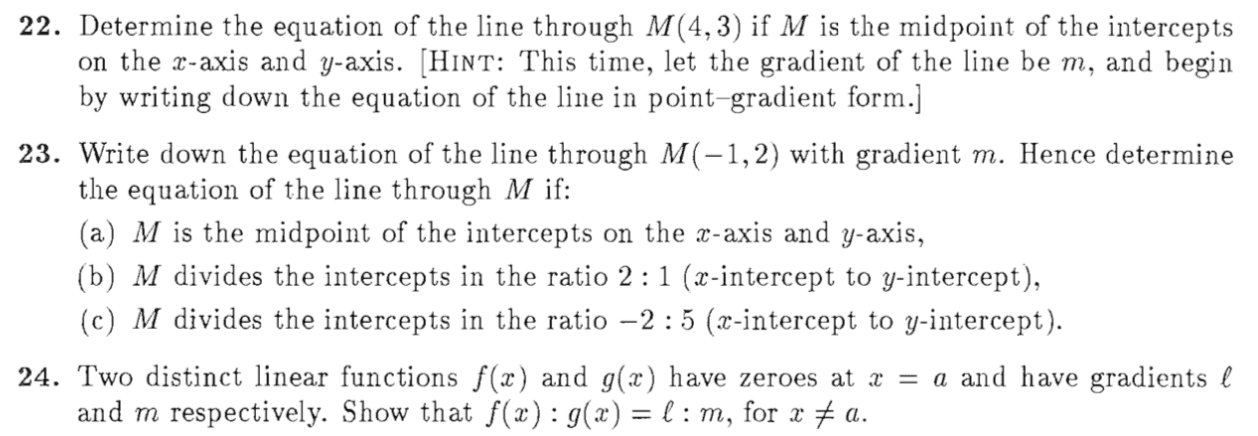
For question 22, we can let the $y$-intercept be $(0,\,a)$ and $x$-intercept be $(b,\,0)$. Since we are told $M(4,\,3)$ is the midpoint of the intercepts, we have
To follow up, once we have the $x$- and $y$ intercepts, we know the gradient, $m=-\dfrac{y\text{-intercept}}{x\text{-intercept}}=-\dfrac{6}{8}=-\dfrac{3}{4}$.
Therefore, taking $m=-\dfrac{3}{4}$ and the point $(8,\,0)$, we find that the point=gradient form of the straight line is:
Problem 23 asks you to, first, write the general equation for a line through the point (-1, 2) with gradient m. I don't know what form you have learned as the general equation for a line through (a, b) with gradient m. One is [tex]\frac{y- b}{x- a}= m[/tex]. Another is y- b= m(x- a) which you can get by multiplying both sides of the first by x- a. Here a= -1 and b= 2. so y- 2= m(x+ 1) or y= m(x+1)+ 2 or y= mx+ m+ 2..
The problem then asks you to find the equation of the specific line when (-1, 2) is "the midpoint of the intercepts with the x and y axes". y- 2= m(x+ 1) "intercepts" the y-axis where x= 0. That is y- 2= m(1) so y= m+ 2. The y-intercept is (0, m+2). It intercepts the x- axis where y= m(x+ 1)+ 2= 0. m(x+ 1)= -2. x+1= -2/m, x= -1- 2/m. The x-intercept is (-1-2/m, 0). The midpoint is (-1/2-1/m, m/2+ 1). You want -1/2- 1/m= -1 and m/2+ 1= 2. Of course, that is asking for one value to satisfy two differential equations. In general we cannot do that but from m/2+ 1= 2 we have m/2= 1 and then m= 2. Putting that into -1/2- 1/m= -1 we get -1/2- 1/2= -1 which is a true statement! The line we want is y= 2(x+ 1)+ 2= 2x+ 4.
ChecK: The line y= 2x+ 4 has x-intercept (0, 4) and y-intercept (-2, 0). The midpoint is ((-2+ 0/2, (4+ 0)/2)= (-1, 2).