Kekeedme
- 21
- 11
- TL;DR
- I have two questions concerning treatment of the single-mode solution to Maxwell's equation presented in Gerry and Knight's. Namely, where does the expression for the amplitude of the electric field comes from, and secondly how did they handle the integral over dV in the classical E-M Hamiltonian that contains the V^-1 term, without it blowing up.
In the book, they present the solution to the maxwell equation for a wave propagating in 1-D. My only issue is determining where the specific expression for the amplitude of the electric field comes from. Their solution is:
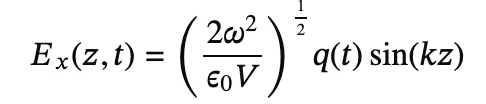
Even if we use the classical energy in the field and equate it to the single-photon energy (ignoring zero point) as such:
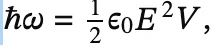 we'd get 𝜔 inside the parentheses not 𝜔^2? Can someone help shed some light please?
Secondly, when we go from:
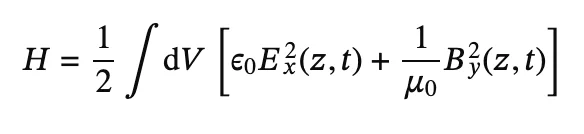
to:
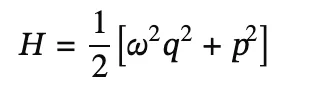
I understand what they are trying to get, the only thing that trips me up is I don't see how they handled the integral, seeing that you have to integrate over d𝑉/𝑉 because of the coefficient in front (mentioned above in the amplitude ). What am I missing please?
Thank you!
Even if we use the classical energy in the field and equate it to the single-photon energy (ignoring zero point) as such:
Secondly, when we go from:
to:
I understand what they are trying to get, the only thing that trips me up is I don't see how they handled the integral, seeing that you have to integrate over d𝑉/𝑉 because of the coefficient in front (mentioned above in the amplitude ). What am I missing please?
Thank you!