liometopum
- 126
- 24
In preparing a post for the globular cluster thread, I found reference to "High Velocity Globular Cluster One, or HVGC-1. This is the first globular cluster discovered to have been ejected by the interaction of two massive black holes.
http://hvgc-1/
A Globular Cluster Toward M87 with a Radial Velocity < -1000 km/s: The First Hypervelocity Cluster
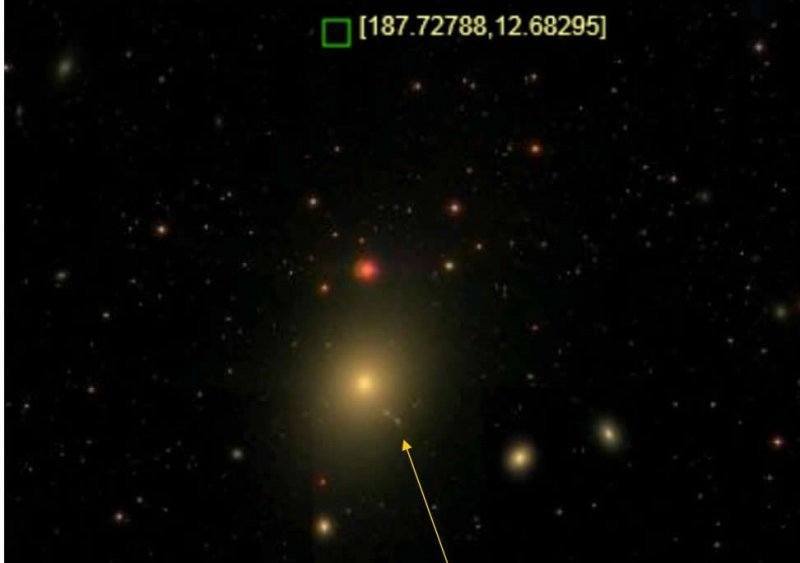
I couldn't find a real image of HCGC-1 and M87 together, so I went and got one, and wanted to share it with all of you..
The location of HCGC-1 is RA 187.72791°, DEC +12.68295°.
Using the tools provided by Galaxy Zoo, and specifically at http://skyserver.sdss.org/dr12/en/tools/chart/navi.aspx
plug in the coordinates and you get the hit.
Notice the small image to the right. Click on "Explore" which is underneath it.
Then look at the far left column and click on "SIMBAD". Here you will see that this is the globular cluster we are after, known by its other name, H74808.
Use the back arrow key (top left) and then click on the image.
You can scale out by clicking on the "minus" sign, and soon you bring M87 into the picture.
And here it is. The yellow arrow points to M87's famous jet.
The explanation for why the globular cluster is escaping M87, and even the Virgo cluster, is not for sure.
In any case, this image shows how far away HVGC-1 is from M87. And we can get this image using tools from the Galaxy Zoo. I hope you like it!
http://hvgc-1/
A Globular Cluster Toward M87 with a Radial Velocity < -1000 km/s: The First Hypervelocity Cluster
I couldn't find a real image of HCGC-1 and M87 together, so I went and got one, and wanted to share it with all of you..
The location of HCGC-1 is RA 187.72791°, DEC +12.68295°.
Using the tools provided by Galaxy Zoo, and specifically at http://skyserver.sdss.org/dr12/en/tools/chart/navi.aspx
plug in the coordinates and you get the hit.
Notice the small image to the right. Click on "Explore" which is underneath it.
Then look at the far left column and click on "SIMBAD". Here you will see that this is the globular cluster we are after, known by its other name, H74808.
Use the back arrow key (top left) and then click on the image.
You can scale out by clicking on the "minus" sign, and soon you bring M87 into the picture.
And here it is. The yellow arrow points to M87's famous jet.
The explanation for why the globular cluster is escaping M87, and even the Virgo cluster, is not for sure.
In any case, this image shows how far away HVGC-1 is from M87. And we can get this image using tools from the Galaxy Zoo. I hope you like it!
Last edited by a moderator: