Undergrad Gravity inside an exponential mass disk

Click For Summary
SUMMARY

This discussion focuses on understanding gravity within an exponential axisymmetric mass disk with no thickness. The participant explores gravitational forces using linear superposition, referencing models such as the Mestel disk and the Kuzmin model. Key insights include the gravitational force being less than that predicted by the shell theorem and the gravitational field intensity being greater than the force from mass within a radius r. The discussion emphasizes the use of Green's function to solve the Newtonian field equation for this specific mass distribution.

PREREQUISITES
  • Understanding of gravitational forces and field theory
  • Familiarity with the concepts of mass density and surface density
  • Knowledge of the Laplace operator and Green's functions
  • Basic principles of axisymmetric mass distributions
NEXT STEPS
  • Study the Mestel disk and Kuzmin model for gravitational potential solutions
  • Learn about Green's functions in the context of gravitational fields
  • Investigate the implications of the shell theorem on gravitational forces
  • Explore numerical methods for simulating gravitational fields in axisymmetric systems
USEFUL FOR

Physicists, astrophysicists, and students studying gravitational theory, particularly those interested in mass distributions and gravitational field calculations in disk-like structures.

independentphysics
Messages
26
Reaction score
2
I am trying to understand gravity inside an exponential axysymmetric mass disk with no thickness.

I know there are exact solutions for this case, such as the Mestel disk or the Kuzmin model, but I want to work out a simpler solution.

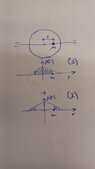
I am approaching the subject by linear superposition. For a mass m inside the disk at a distance r from the center, the gravitational force experienced by the mass m can be divided into the force from the mass M(r) inside the radius r (1), and the force from the mass outside r (2) (see attached image). Due to symmetry, I restrict the solution to a unique axis.

My understanding is that the total gravitational force experienced by the mass m pointing towards the center to the disk, is smaller than the one applying shell theorem (a spherically symmetric body affects external objects gravitationally as though all of its mass were concentrated at a point at its center). Also, it is smaller than the gravitational forced experienced only by the mass inside the radius r (case (1)).

What about gravitational field intensities? My understanding is that the gravitational field intensity at a distance r is bigger than just for case (1). Is it also bigger than for the case of all the mass of the disk concentrated at a point?
 

Attachments

  • MicrosoftTeams-image (1).jpg
    MicrosoftTeams-image (1).jpg
    11 KB · Views: 131
Physics news on Phys.org
Curve in your figure seems linear not exponential to me. Could you give us formula of ##\rho(r)## ?
 
anuttarasammyak said:
Curve in your figure seems linear not exponential to me. Could you give us formula of ##\rho(r)## ?
It is certainly not. I dont care much about the form of surface density (linear or exponential) as long as it is not a solid disk (which is a completely different case of study).
 
independentphysics said:
I am trying to understand gravity inside an exponential axysymmetric mass disk with no thickness.
I am not good at getting meaning of your "exponential asymmetric" and "surface density".
 
  • Like
Likes PhDeezNutz and Dale
anuttarasammyak said:
I am not good at getting meaning of your "exponential asymmetric" and "surface density".
Exponential decay of mass density from center.
Axisymmetric disk (not elliptical disk)
Surface density = mass density function, since I consider no thickness mass/distance^2
 
Thanks. So I assume the setting as
\int_0^R \sigma(r) 2 \pi r dr = M
where
\sigma(r)=\sigma(0)e^{-\alpha r/R}
\alpha= -\log \frac{\sigma(R)}{\sigma(0)}
R is radius of thin disk, M is its mass.
 
Then just use the Green's function of the Laplace operator to solve the Newtonian field equation,
$$-\Delta \Phi=-4 \pi \gamma \rho=-4 \pi \gamma \sigma \delta(x_3),$$
leading to
$$\Phi=-\gamma \int_{K_r} \mathrm{d}^2 f' \frac{\gamma \sigma(\vec{r}')}{|\vec{r}-\vec{r}'|}.$$
 
  • Love
Likes malawi_glenn
anuttarasammyak said:
Thanks. So I assume the setting as
\int_0^R \sigma(r) 2 \pi r dr = M
where
\sigma(r)=\sigma(0)e^{-\alpha r/R}
\alpha= -\log \frac{\sigma(R)}{\sigma(0)}
R is radius of thin disk, M is its mass.
Yes.
 
vanhees71 said:
Then just use the Green's function of the Laplace operator to solve the Newtonian field equation,
$$-\Delta \Phi=-4 \pi \gamma \rho=-4 \pi \gamma \sigma \delta(x_3),$$
leading to
$$\Phi=-\gamma \int_{K_r} \mathrm{d}^2 f' \frac{\gamma \sigma(\vec{r}')}{|\vec{r}-\vec{r}'|}.$$
I am solving it through superoposition. Isnt there a more simple way to do it?
 
  • #12
Not only inside disk and outside ring of your suggestion, but decomposition to the inifinitesimal rings seem to work.

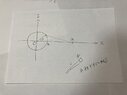
On X-Y plane there is a ring of radius r centered on Origin. Gravity potential at (x,0) is
d\phi(x:r,\sigma)=-Gr\ dr\ \sigma \int_0^{2\pi}[r^2 \sin^2\theta+(x-r\cos\theta)^2]^{-1/2}d\theta
where ##\sigma## is surface density of mass. x<r, x=r and x>r work. Gravity potential of disk which consists of the rings is geiven by superposition,i.e.,
\phi(x)=\int_{r=0}^{r=\infty} d\phi(x:r,\sigma(r))
I am afraid there is no simpler way as you expect so.
 
Last edited:
  • #13
anuttarasammyak said:
Not only inside disk and outside ring of your suggestion, but decomposition to the inifinitesimal rings seem to work.

On X-Y plane there is a ring of radius r centered on Origin. Gravity potential at (x,0) is
d\phi(x:r,\sigma)=-Gr\ dr\ \sigma \int_0^{2\pi}[r^2 \sin^2\theta+(x-r\cos\theta)^2]^{-1/2}d\theta
where ##\sigma## is surface density of mass. x<r, x=r and x>r work. Gravity potential of disk which consists of the rings is geiven by superposition,i.e.,
\phi(x)=\int_{r=0}^{r=\infty} d\phi(x:r,\sigma(r))
I am afraid there is no simpler way as you expect so.
If it is axisymmetric, why bother with angles?
 
  • #14
Disance to the observing point depends on the angle. After integration the result contanins no angle parameter because of symmetry.
 

Attachments

  • 2023-06-04 09.28.57.jpg
    2023-06-04 09.28.57.jpg
    32.5 KB · Views: 122
  • #15
independentphysics said:
The Kuzmin model is just one of many. If you want more precise approximations, there are many more for thickened disks. Im just looking for a more simple one than Kuzmin.
The Kuzmin model is very simple, because one simply makes an ansatz for the gravitational potential. It's just a solution of the Laplace equation with two "mirror charges", i.e., and a singularity along the ##xy## plane
$$\Phi(\vec{r})=\begin{cases} -\frac{G M}{|\vec{r}+a \vec{e}_z|} & \text{for} \quad z>0, \\ -\frac{GM}{|\vec{r}-\vec{a} \vec{e}_z|} & \text{for} \quad z<0. \end{cases}$$
It fufills indeed ##\Delta \Phi=0## for all ##\vec{r}## not on the ##xy## plane, along which it has a singularity, which is calculated in the quoted link. The source is
$$\rho(\vec{r})=\Delta \Phi(\vec{r})=\frac{M a}{2 \pi \sqrt{x_1^2+x_2^2+a^2}}\delta(z),$$
i.e., a surface-mass density,
[EDIT: Typo corrected]
$$\sigma(\vec{r})=\frac{M a}{2 \pi \sqrt{x_1^2+x_2^2+a^2}}.$$
 
Last edited:
  • Like
Likes independentphysics
  • #16
vanhees71 said:
The Kuzmin model is very simple, because one simply makes an ansatz for the gravitational potential. It's just a solution of the Laplace equation with two "mirror charges", i.e., and a singularity along the ##xy## plane
$$\Phi(\vec{r})=\begin{cases} -\frac{G M}{|\vec{r}+a \vec{e}_z|} & \text{for} \quad z>0, \\ -\frac{GM}{|\vec{r}-\vec{a} \vec{e}_z|} & \text{for} \quad z<0. \end{cases}$$
It fufills indeed ##\Delta \Phi=0## for all ##\vec{r}## not on the ##xy## plane, along which it has a singularity, which is calculated in the quoted link. The source is
$$\rho(\vec{r})=\Delta \Phi(\vec{r})=\frac{M a}{2 \pi |x_1^2+x_2^2+a^2}\delta(z),$$
i.e., a surface-mass density,
$$\sigma(\vec{r})=\frac{M a}{2 \pi |x_1^2+x_2^2+a^2}.$$
What is the gravitational field intensity in the Kuzmin model in terms of r?
 
Last edited:
  • #17
It's just the gradient of the potential,
$$\vec{g}(\vec{r})=-\vec{\nabla} \Phi(\vec{r})=\begin{cases} -\frac{GM}{|\vec{r}+a \vec{e}_z|^3} (\vec{r}+a \vec{z}) &\text{for} \quad z>0, \\
-\frac{GM}{|\vec{r}-a \vec{e}_z|^3} (\vec{r}-a \vec{z}) & \text{for} \quad z<0.\end{cases}$$
 

Similar threads

  • · Replies 16 ·
Replies
16
Views
1K
  • · Replies 5 ·
Replies
5
Views
4K
  • · Replies 3 ·
Replies
3
Views
2K
  • · Replies 7 ·
Replies
7
Views
2K
  • · Replies 31 ·
2
Replies
31
Views
2K
  • · Replies 19 ·
Replies
19
Views
2K
Replies
2
Views
2K
  • · Replies 11 ·
Replies
11
Views
2K
  • · Replies 2 ·
Replies
2
Views
7K