Groombridge 34: Summoning Geek Superheroes

  • Thread starter Thread starter Ralph Rotten
  • Start date Start date
Click For Summary

Discussion Overview

The discussion revolves around the Groombridge 34 star system, focusing on the logistics of living in a metal-poor environment and the implications for space travel and exploration. Participants explore various aspects of the system, including solar wind barriers, the viability of spacecraft, and the potential for life on moons orbiting planets in this binary red dwarf system.

Discussion Character

  • Exploratory
  • Technical explanation
  • Conceptual clarification
  • Debate/contested

Main Points Raised

  • One participant questions the difficulty of bridging the solar-wind barrier between the two stars and whether the solar wind from dim red dwarfs would pose a significant issue.
  • Another participant seeks clarification on what is meant by "bridge," suggesting it may refer to spacecraft passage through the solar wind.
  • Concerns are raised about the stability of orbits of planets within the system.
  • A participant discusses the practical implications of solar wind density, suggesting that it would be negligible for spacecraft like Voyager.
  • There is speculation about the effects of a more powerful star system on spacecraft, including potential turbulence or EMP effects.
  • One participant reflects on the challenges of naming star systems after obscure astronomers and compares it to naming continents after lesser-known map-makers.
  • Another participant expresses curiosity about the potential for life in a system with a nearby star and the implications of lower gravity and metal scarcity for rocket construction.
  • Discussion includes references to science fiction works that explore similar themes of metal-poor cultures and space exploration.

Areas of Agreement / Disagreement

Participants express a range of views on the implications of solar wind and the feasibility of life in the Groombridge 34 system. There is no consensus on the specific challenges posed by the solar wind or the effects of different star types on spacecraft.

Contextual Notes

Participants note limitations regarding the assumptions about solar wind density and the characteristics of the stars involved, as well as the speculative nature of life in a metal-poor environment.

Who May Find This Useful

Readers interested in science fiction, astrophysics, and the exploration of hypothetical star systems may find this discussion relevant.

Ralph Rotten
Messages
39
Reaction score
10
Summary: Summoning all geek superheroes with knowledge of the Groombridge 34 star system.

Allow me to introduce myself: I am an author from Tucson, Arizona.
I am currently researching for my next novel that revolves around the Groombridge34 star system (binary red dwarfs orbiting at 147AU from each other.)

The beings in this story live on a moonmoon that orbits a rocky giant that orbits the larger of the 2 stars. A large (5x) planet has been confirmed at this location, but for gravitational purposes I decided to have them evolve on the moonmoon, just because I like saying moonmoon.

I bet Mila Jovovich would sound cool saying moonmoon. She'd be all like "Multipass-moonmoon."
Mmmmm. Mila.
What was I talking about?

Anyhow, I wanted to start this thread to not only introduce myself, but open up a discussion about the logistics of living in a metal-poor star system where your closest neighbor is only 147AU away.
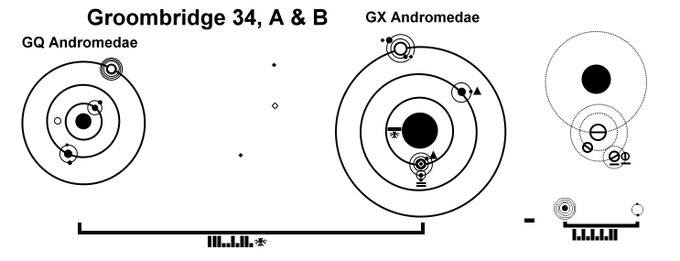
D4W7h09UwAE1B-m?format=jpg&name=small.jpg
 
Physics news on Phys.org
One of the questions I have about this star system is how difficult would it be to bridge the solar-wind barrier between them. Seems like if they enter in the middle and follow the flow, they should be okay.

How much effort would it be to bridge the gap? Would a pair of dim red dwarfs create enough solar wind to even be an issue?

D4ShqAVU4AAkVLw?format=jpg&name=small.jpg
 
Ralph Rotten said:
"Multipass-moonmoon."
Love it. I already want to see the movie.
Ralph Rotten said:
how difficult would it be to bridge the solar-wind barrier between them.
What do you mean by bridge? Do you mean pass through it in a spacecraft ?

Edit: I would worry about the stability of the orbits of those planets.
 
  • Like
Likes   Reactions: Ralph Rotten
Hi, Ralph Rotten. Welcome to PF!

Ralph Rotten said:
How much effort would it be to bridge the gap? Would a pair of dim red dwarfs create enough solar wind to even be an issue?
It's still solar wind. It's counted in atoms per cubic centimetre worth of material. For practical purposes (such as flying a space ship) it's excellent vacuum. Check out other figures in that paper you took the one above from. They show proton densities/number densities/particle number densities - which are all the same thing.
 
  • Like
Likes   Reactions: Ralph Rotten
Don't mean to derail anything, but what are the odds of continuing to name an entire star system after an obscure 19th century astronomer?

Come to think of it, though; about as possible as us naming two continents after the first name of a map-maker no one ever heard of. ;)
 
  • Like
Likes   Reactions: Klystron
So from a practical perspective, would one of our probes, like Voyager, be able to survive passing through the divide? These are some pretty dim stars; they're only 12LY away and cannot be seen with the naked eye. Would these stars even create enough photonic activity to be viable at 72AU?
 
Or would the issue be more like an EMP wave? (Passing between the two stars)
 
Ralph Rotten said:
Summary: (binary red dwarfs orbiting at 147AU from each other.)[...]
The beings in this story live on a moonmoon that orbits a rocky giant that orbits the larger of the 2 stars. A large (5x) planet has been confirmed at this location,
[...]
discussion about the logistics of living in a metal-poor star system where your closest neighbor is only 147AU away.
From a SF veiwpoint light metal space cultures should be doable. We face similar advantage / obstacles exploring the outer reaches of our Solar system where stony moons of gas giants contain water, as do Oort objects.

Chip Samuel Delany creates an interesting moon city on the eponymous "Triton " including discussion of light and heavy metal cultures in 20th C. science fiction.

[from wikipedia:...] Delany has said that Trouble on Triton was written partly in dialogue with Ursula K. Le Guin's anarchist science fiction novel The Dispossessed, whose subtitle was An Ambiguous Utopia.[1] It is also loosely linked to other books by him (particularly Neveryóna) in its references to "the modular calculus", a vaguely described future mathematics that would analyze ...
 
  • Like
Likes   Reactions: Ralph Rotten
Ralph Rotten said:
So from a practical perspective, would one of our probes, like Voyager, be able to survive passing through the divide? These are some pretty dim stars; they're only 12LY away and cannot be seen with the naked eye. Would these stars even create enough photonic activity to be viable at 72AU?
At 72 AU the 'gap' would still have solar wind density many times lower than what's present at 1 AU. So no problems at all.
 
  • Like
Likes   Reactions: Ralph Rotten
  • #10
I'm curious, if these were more powerful stars, how would that gap manifest itself, in practical terms? Would it be like space-turbulence, river rafting, or some kind of EMP effect? If you flew a modern spacecraft through a much more powerful gap, how would you feel it?
 
  • #11
I'm guessing the only effect would be higher background radiation.
 
  • #12
Interesting.

I have been trying to get my mind to imagine life in a system where the nearest star is only 2 light days away.
These are metal-poor stars, but a much lower escape velocity than our own star. The beings in the story come from a 1/3rd gravity moonmoon to the big rocky planet orbiting the larger star. So it's easier for them to get into space, but harder because of limited metal.

Which makes me ask: If you were in a metal-poor star system, what else could you make rockets out of?