Solving H2/Pd/C Reduction for #5 & #6 Questions

  • Context: Chemistry 
  • Thread starter Thread starter duchuy
  • Start date Start date
  • Tags Tags
    Pd Reduction
Click For Summary
SUMMARY

This discussion focuses on the reduction of pi bonds to sigma bonds using H2/Pd/C and its implications for ketal groups in organic synthesis. It is established that H2/Pd/C does not react with acyclic aliphatic ketals or non-activated esters under standard conditions. The conversation highlights the importance of avoiding water during cyclization reactions and suggests using trans-esterification or saponification to facilitate ester formation while managing by-products effectively.

PREREQUISITES
  • Understanding of hydrogenation reactions, specifically H2/Pd/C applications.
  • Knowledge of ketal and acetal chemistry, including their reactivity.
  • Familiarity with trans-esterification and saponification processes.
  • Basic principles of organic synthesis and reaction mechanisms.
NEXT STEPS
  • Research the mechanisms of H2/Pd/C hydrogenation and its limitations with esters and ketals.
  • Study the principles of trans-esterification and its role in organic synthesis.
  • Explore the use of Dean-Stark apparatus in removing water during Fischer esterification.
  • Investigate alternative methods for deprotecting ketals and acetonides in organic reactions.
USEFUL FOR

Chemistry students, organic chemists, and researchers involved in synthetic organic chemistry who are looking to deepen their understanding of hydrogenation and esterification reactions.

duchuy
Messages
79
Reaction score
3
Homework Statement
Find the mechanism
Relevant Equations
x
Hi,
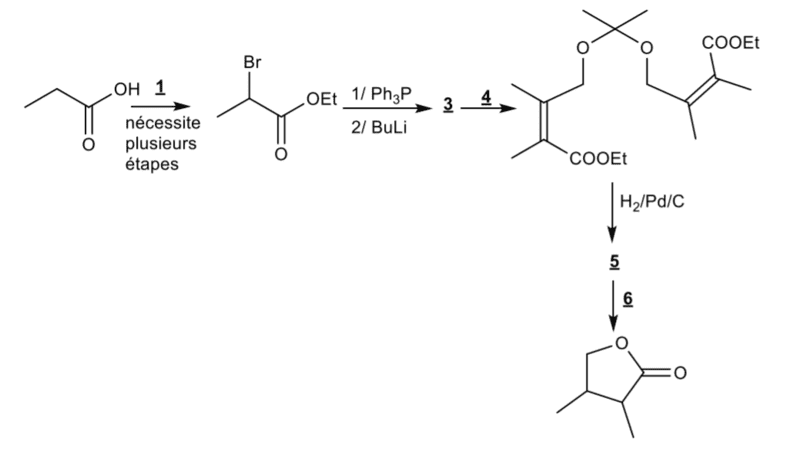
I'm trying to solve the number 5 and 6. Now I'm wondering what happens when I add H2/Pd/C on the 4th (after the question 4) molecule. I know that it will reduce pi bonds to sigma bonds, but will it affect the cetal group? Because if it does't I'm not quite sure that I'll be able to do the exercice with the steps given. My solution :
After adding Hd/Pd/C :
1) H+/H20, I will form 2 alcohol molecules (with the ester group) and acetone
2)Saponification : NaOH : Here I'm turning ester to carboxylate
3Intramolecular esterification : H+/H20 : I have to reacidify my environement in order to perform the esterification.

This would take 3 steps, while I only have step to do this (if H2/pd/C doesn't interact with the ketal group.
And if H2/Pd/C does give me my alcohol, it would also take me 2 extra steps to form my lactone.
Please help me find the solution for this.

By the way, what are the groups that H2 reduce?
I know that they reduce alcyne, alcene, cetone, aldehyde, ... the rest google is giving me mixed answers.
So what about : Nitrile, imine, carboxylic acid, ester, RCOCl, and acid anhydride?

Thank you so so much for your help!
1640759073551.png
 
Physics news on Phys.org
Unless you have an activated ester, or use high pressure and temperature, consider esters non-reactive to Pd/C hydrogenation. Acyclic aliphatic ketals are also non-reactive to Pd/C hydrogenation.

There is more than one way to deprotect ketals/acetonides. Remember if we have a carboxylic acid in 5 the cyclization reaction will produce a molecule of water…. and we don’t want water in this step. Think in terms of trans-esterification.
 
Last edited:
chemisttree said:
Unless you have an activated ester, or use high pressure and temperature, consider esters non-reactive to Pd/C hydrogenation. Acyclic aliphatic ketals are also non-reactive to Pd/C hydrogenation.

There is more than one way to deprotect ketals/acetonides. Remember if we have a carboxylic acid in 5 the cyclization reaction will produce a molecule of water…. and we don’t want water in this step. Think in terms of trans-esterification.
chemisttree said:
Unless you have an activated ester, or use high pressure and temperature, consider esters non-reactive to Pd/C hydrogenation. Acyclic aliphatic ketals are also non-reactive to Pd/C hydrogenation.

There is more than one way to deprotect ketals/acetonides. Remember if we have a carboxylic acid in 5 the cyclization reaction will produce a molecule of water…. and we don’t want water in this step. Think in terms of trans-esterification.

Ok I see, but from what I see from writing the reaction, is that if I were to do transesterification to from 5 to 6 in acidic conditions, that would be a totally reversible reaction and how could I ensure the formation of the cycle? Since I can't use an excess of reactants right? Unless I remove the alcohol at the end?
But if I were to do saponification in order to do Fischer's esterification, I could easily remove water at the end and ensure the formation of the cycle by using a Deanstark or may be ZnCl2 no?
 
Dean-Stark in a single step?
 
chemisttree said:
Dean-Stark in a single step?
I would make my reaction in a Deanstark for the final fischer esterification? I honestly don't know, I'm just doing chemistry on paper I really don't have much lab experience. But what do you think about my proposition?
 
Why I wrote, “Dean stark in a single step?” …
You want aqueous acid to deprotect the ketal and then turn around and do an internal transesterification in the absence of water… in one step.
 
chemisttree said:
Why I wrote, “Dean stark in a single step?” …
You want aqueous acid to deprotect the ketal and then turn around and do an internal transesterification in the absence of water… in one step.
Oooh ok I see thank you so so much you're absolutely amazing
 

Similar threads

  • · Replies 1 ·
Replies
1
Views
3K
  • · Replies 4 ·
Replies
4
Views
2K