Half-face traversal on general polyhedra

  • Context: Graduate 
  • Thread starter Thread starter Estanho
  • Start date Start date
  • Tags Tags
    General Graphs Mesh
Click For Summary

Discussion Overview

The discussion revolves around the traversal of faces in general polyhedra using a half-edge data structure for numeric simulation. Participants explore the possibility of representing face traversal as a Hamiltonian cycle and the implications of Grinberg's Theorem on this topic.

Discussion Character

  • Exploratory
  • Technical explanation
  • Debate/contested
  • Mathematical reasoning

Main Points Raised

  • One participant is developing a data structure for 3-D meshes that can represent any polyhedron and is seeking a linear complexity algorithm for traversing faces using half-edge operations.
  • Some participants suggest that Grinberg's Theorem might be relevant to the discussion, particularly regarding Hamiltonian cycles in polyhedra.
  • There is a proposal to prove whether all polyhedra contain a Hamiltonian cycle on their faces, with uncertainty expressed about the applicability of planar graph properties to polyhedra.
  • Another participant shares their experience with a software called Stella4D, which can convert planar graphs into polyhedra and generate new polyhedra based on topology.
  • Details about the input format and features of Stella4D are discussed, including its ability to create regular and irregular faces based on vertex indices.
  • A participant expresses interest in the software but notes financial constraints as a student.
  • Reference is made to a local professor's work on sculptures representing seven-dimensional spaces, linking it to the broader theme of polyhedral representation.

Areas of Agreement / Disagreement

Participants express varying viewpoints on the applicability of Grinberg's Theorem and the existence of Hamiltonian cycles in polyhedra. There is no consensus on whether all polyhedra can have their face connectivity mapped to a planar graph, and the discussion remains unresolved regarding the existence of Hamiltonian paths for all polyhedra.

Contextual Notes

Limitations include the uncertainty about the relationship between polyhedra and planar graphs, as well as the complexity of proving the existence of Hamiltonian cycles in all polyhedra.

Estanho
Messages
14
Reaction score
2
Hi,
I'm developing a data structure to represent 3-D meshes for numeric simulation. I want those meshes to be able to handle any type of polyhedron (not only the classic tetra and hexahedron). The best data structure that I could find was one based on half-edges (or darts), such as this one: https://www.cse.msu.edu/~ytong/papers/halfFace.pdf

The problem is, I want to be able to traverse the faces that compose a given polyhedron, such that this path could be represented as a Hamiltonian cycle on a graph whose nodes are the faces of the polyhedron, and the edges are the face-face connectivity within the polyhedron.

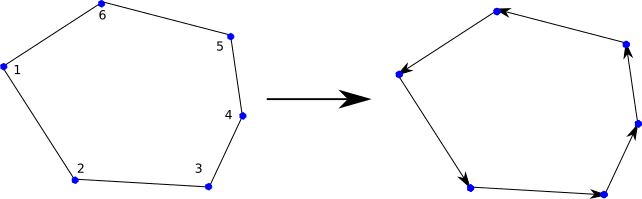
The 2-D counterpart would be a half-edge, which is trivial to traverse as in a Hamiltonian cycle if the graph nodes and edges are the same as the original polygon. All you have to do is follow the half-edges:
ham01.png


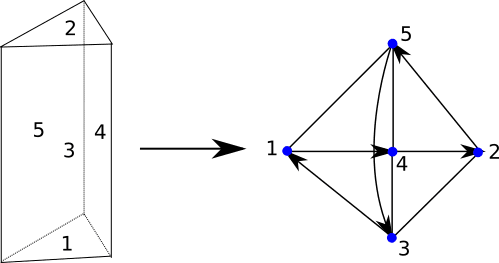
But this doesn't seem to be easy when dealing with faces (or half faces). I don't even know if there will be a hamiltonian path of the faces for every possible polyhedron. And determining those is not easy and hard to keep in memory pre-processed. Here's an example for a prism:
ham02.png


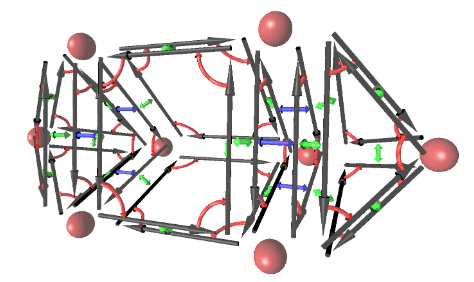
The paper presents a common half-edge, half-face structure to store topological information. This structure allows for some operations (combinatorial maps) on each half-edge: ##\beta_1##, ##\beta_2##, and ##\beta_3##. Those maps are depicted below:
halfedge.png

Here, ##\beta_1## is red, ##\beta_2## is green, and ##\beta_3## is blue. So, as you can see, if you apply ##\beta_1## you will get the adjacent half-edge within the same half-face, if you apply ##\beta_2## you will get the adjacent half-edge on an adjacent half-face within the same polyhedron, and if you apply ##\beta_3## you will get the adjacent half-edge on the opposite half-face, from a adjacent polyhedron.

In short, my question is, is there a fast (i.e. with linear complexity) algorithm to traverse all the faces of a given polyhedron using those three operations? It would be sufficient to get just one half-edge for each half-face within the polyhedron, since traversing it is trivial by repeatedly using ##\beta_1##.

Until now, it seems my best bet is a graph-search algorithm, which is way too heavy for my needs.
 
Physics news on Phys.org
haruspex said:
Does Grinberg's Theorem help? https://en.wikipedia.org/wiki/Grinberg's_theorem
It could be interesting to proof if all polyhedra contain a hamiltonian cycle on its faces. This theorem can be applied to planar graphs, I'm not sure also if every possible polyhedron can have its faces connectivities mapped to a planar graph. I couldn't think of a counter example, though.
 
Estanho said:
It could be interesting to proof if all polyhedra contain a hamiltonian cycle on its faces. This theorem can be applied to planar graphs, I'm not sure also if every possible polyhedron can have its faces connectivities mapped to a planar graph. I couldn't think of a counter example, though.
Clearly every polyhedron can be flattened out into a planar graph. Just pick one face to be the exterior.
Every 3-connected planar graph can be formed into a polyhedron.
 
haruspex said:
Clearly every polyhedron can be flattened out into a planar graph. Just pick one face to be the exterior.
Every 3-connected planar graph can be formed into a polyhedron.
Oh, of course. I guess I missed my geometry classes.
I will try to work this out. Thanks.
 
Hi, bit late, but couldn't resist commenting on this. I was interested to see Grinberg's theorem, which I wasn't aware of. The wikipedia page shows an example of a non-Hamiltonian graph, so I wondered what this would look like in 3D as a polyhedron. As it happens I wrote a program called Stella4D which can help with this sort of thing. Here's a picture of the model I came up with.
NonHamiltonian.jpg
 
  • Like
Likes   Reactions: Estanho
That's cool. If I understand correctly, you wrote a software to convert from a planar graph into a polyhedron? What language did you use?
 
Estanho said:
That's cool. If I understand correctly, you wrote a software to convert from a planar graph into a polyhedron? What language did you use?
I wrote a program called Stella4D (http://www.software3d.com/Stella.php) for investigating polyhedra and 4D polytopes (it's commercial software FYI). It has a little-known feature to build new polyhedra using a spring-relaxation system, from a description of its topology alone. I used it originally to generate many of Stella's built-in polyhedra, such as the Johnson solids and near misses. You specify all the faces, based on vertex indices (which you assign arbitrarily), which can be a bit tedious, but it's good for things that can't easily be made other ways. In fact I just created a better realisation of the above non-Hamiltonian graph. This one has all regular 9-gons and 8-gons. Only the pentagons remain irregular:

NonHamiltonian.jpg


Here's the input I used for Stella4D:

h ~6 (0 1 2 3 4 5 6 7 8)
(9 26 41 42 43 44 27 10)
(21 20 35 36 37 38 39 22)
(15 14 29 30 31 32 33 16)
(0 8 25 26 9) (8 7 23 24 25) (7 6 21 22 23)
(6 5 19 20 21) (5 4 17 18 19) (4 3 15 16 17)
(3 2 13 14 15) (2 1 11 12 13) (1 0 9 10 11)
(25 24 40 41 26) (23 22 39 40 24)
(19 18 34 35 20) (17 16 33 34 18)
(13 12 28 29 14) (11 10 27 28 12)
(40 39 38 42 41) (34 33 32 36 35) (28 27 44 30 29)
(45 43 42 38 37) (45 37 36 32 31) (45 31 30 44 43)

The "h" means the model is convex, so an initial parse is done where extra springs are used to expand the graph like a balloon.
The "~6" means that all faces with 6 or less sides are irregular, so in this case the 8- and 9-gons are made regular.
Each face is define inside parentheses. The vertex indices can be seen below:

NonHamiltonianGraph.gif


Stella4D can also print out unfolded nets to cut out and glue together, so I might make one in paper. It's an interesting polyhedron.

Oh, and Stella4D was written in C++ using OpenGL for graphics.
 
Last edited:
Got it. Nice piece of software, congratulations. I don't have dollars to spare right now since I'm a mere MSc student but I might look forward to buying it in the future.
 
  • Like
Likes   Reactions: Robert Webb
  • #10
Also, your work reminds me of one other from a professor of my local University. He works with these so-called UNIVs, which are sculptures representing seven-dimensional spaces.
You can see his phd thesis here: https://arxiv.org/pdf/math/0305058.pdf
 

Attachments

  • 10898313_871947412826076_874961220093577158_n.jpg
    10898313_871947412826076_874961220093577158_n.jpg
    48.3 KB · Views: 581

Similar threads

  • · Replies 3 ·
Replies
3
Views
3K