Help to find asymptotic solution of linear ode

  • Context: MHB 
  • Thread starter Thread starter flanker
  • Start date Start date
  • Tags Tags
    Linear Ode
Click For Summary
SUMMARY

The discussion centers on finding asymptotic solutions for ordinary differential equations (ODEs) using the inverse Laplace transform. The user expresses difficulty in applying the inverse Laplace transform to their analytical solutions due to complexity. A method involving the Laplace transform is outlined, where $Y_1(s)$ represents the Laplace transform of $y_1(x)$, leading to a formulation for $y_1$ using hyperbolic functions. The conversation highlights the challenges of applying inverse Laplace transforms to complicated initial answers derived from ODEs.

PREREQUISITES
  • Understanding of ordinary differential equations (ODEs)
  • Familiarity with Laplace transforms and their properties
  • Knowledge of hyperbolic functions, specifically $\cosh$ and $\sinh$
  • Experience with inverse Laplace transforms and their applications
NEXT STEPS
  • Research methods for approximating solutions to ODEs
  • Study the application of inverse Laplace transforms in solving complex equations
  • Explore numerical techniques for solving ODEs when analytical solutions are impractical
  • Learn about the properties and applications of hyperbolic functions in differential equations
USEFUL FOR

Mathematicians, engineers, and students working with differential equations, particularly those seeking to understand asymptotic solutions and the application of Laplace transforms in complex scenarios.

flanker
Messages
4
Reaction score
0
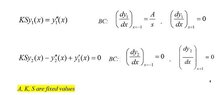
I have a trouble with ODE, I try to find asymptotic solution for odes which presented in pics. But I can’t. Please introduce a method which I solve these equations. I can solve these equations analytically but after solution, inverse Laplace transform must apply to find final answer. In analytical solution inverse Laplace transform near to impossible. Since I want a way to approximate analytical solution to these equations afterwards I can apply inverse Laplace transform to find final answer.
thanks
View attachment 5647
 

Attachments

  • 2s.jpg
    2s.jpg
    12.8 KB · Views: 123
Physics news on Phys.org
flanker said:
I have a trouble with ODE, I try to find asymptotic solution for odes which presented in pics. But I can’t. Please introduce a method which I solve these equations. I can solve these equations analytically but after solution, inverse Laplace transform must apply to find final answer. In analytical solution inverse Laplace transform near to impossible. Since I want a way to approximate analytical solution to these equations afterwards I can apply inverse Laplace transform to find final answer.
thanks

Hi flanker! Welcome to MHB! ;)

Suppose $Y_1(s)$ is the Laplace transform of $y_1(x)$, then from the tables, we can see:
\begin{array}{lll}KSy_1 &= y_1'' & \text{Initial equation}\\
KS Y_1&= s^2 Y_1 - sy_1(0)-y_1'(0) & \text{Laplace transform} \\
Y_1 &= \frac{sy_1(0)+y_1'(0)}{s^2-KS} & \text{Solve for }Y_1 \\
Y_1 &= y_1(0)\frac{s}{s^2-KS} + y_1'(0)\frac{1}{s^2-KS} & \text{Prepare for Inverse Laplace transform}\\
y_1 &= y_1(0) \cosh(x\sqrt{KS}) + y_1'(0) \sinh(x\sqrt{KS}) & \text{Inverse Laplace transform}
\end{array}
Now we can fill in the boundary conditions to find $y_1(0)$ respectively $y_1'(0)$.
 
Thank you very much dear for your kindly attention to my question. but I applied a laplace transform to a PDE for x then these equation are producted. I must solve these equations and apply the inverse laplace transform to find final answer. But the initial answer of these equations are too complicated that I can't apply inverse laplace transform.:(
 
flanker said:
Thank you very much dear for your kindly attention to my question. but I applied a laplace transform to a PDE for x then these equation are producted. I must solve these equations and apply the inverse laplace transform to find final answer. But the initial answer of these equations are too complicated that I can't apply inverse laplace transform.:(

There seems to be some misunderstanding.
It doesn't make sense to me to apply an inverse laplace transform to the solution of these ODE's.

Anyway, the inverse Laplace transform of for instance $\cosh(x\sqrt{KS})$ is $\frac 12\delta(t-\sqrt{KS}) + \frac 12\delta(t+\sqrt{KS})$.

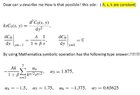
Maybe you can provide the initial answer that an inverse laplace transform should be applied to?
And perhaps the original problem?
 
Dear sir can u give your mail which i want to send u an article
 
How about attaching it to this thread?
 

Attachments

  • 1.jpg
    1.jpg
    32.4 KB · Views: 112

Similar threads

  • · Replies 1 ·
Replies
1
Views
2K
  • · Replies 3 ·
Replies
3
Views
3K
  • · Replies 6 ·
Replies
6
Views
2K
  • · Replies 7 ·
Replies
7
Views
3K
  • · Replies 2 ·
Replies
2
Views
3K
  • · Replies 3 ·
Replies
3
Views
3K
  • · Replies 8 ·
Replies
8
Views
2K
  • · Replies 1 ·
Replies
1
Views
2K
  • · Replies 2 ·
Replies
2
Views
3K
  • · Replies 4 ·
Replies
4
Views
3K