High School Help turning 2 sentences into a flow chart of actions

  • Thread starter Thread starter Spinnor
  • Start date Start date
  • Tags Tags
    Flow Turning
Click For Summary
SUMMARY

This discussion centers on the requirements for spousal consent when selecting annuity options in retirement plans. Specifically, it clarifies that if an individual chooses annuity option (3) and designates their spouse as the beneficiary, spousal consent is not required. The conversation highlights two scenarios where spousal signatures are mandatory: selecting options (1) or (4) or designating a non-spouse beneficiary. The importance of understanding these requirements is underscored by referencing legal cases that have impacted spousal benefits.

PREREQUISITES
  • Understanding of annuity options in retirement plans
  • Familiarity with beneficiary designation processes
  • Knowledge of spousal consent laws in the U.S.
  • Awareness of potential legal implications regarding pension benefits
NEXT STEPS
  • Research the implications of choosing different annuity options in retirement plans
  • Learn about the legal requirements for beneficiary designations in the U.S.
  • Explore case studies on spousal consent and pension benefits
  • Investigate best practices for financial planning regarding retirement benefits
USEFUL FOR

Individuals navigating retirement planning, financial advisors, and anyone involved in beneficiary designations and spousal consent issues in pension plans.

Spinnor
Gold Member
Messages
2,227
Reaction score
419
Maybe not the right sub-forum?

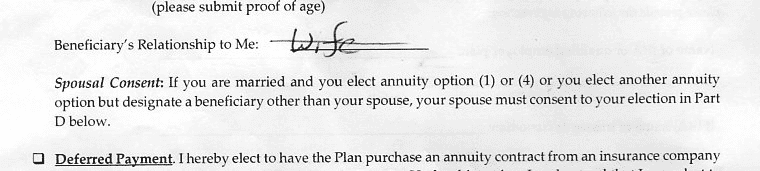
I have a form to complete in which 2 sentences need to be converted into a flow chart of action which I think I understand but maybe I don't and would appreciate your consideration. Please consider the following scanned passage starting at Spousal Consent,
1581603562398.png


It says, "If you are married and you elect annuity option (1) or (4) ..." this is not true, as I choose option (3), so we can ignore this first part. Continue reading the above passage with the first part of the passage removed because it does not apply to me. It would then read, "If you are married and you elect another annuity option..." this part is true but the next part is false, "... but designate a beneficiary other than your spouse..." that part is not true as I have designated my wife as my beneficiary, it continues, "..., your spouse must consent to your election in Part D below."

Bottom line, if I designate a beneficiary other than my wife she must consent and sign part D, but this is not the case so her signature is not needed?

Thanks for any help.
 
Physics news on Phys.org
There are two choices that require your wife’s signature:

1) if you are married and you select options 1 or 4 then your wife must sign in part D.

2) if you are married and you select some other option and your wife is not the beneficiary then your wife must sign in part D.

It looks like these choices cover cases where you wife won’t get your pension and so because of that your wife must sign to agree that’s okay with her.

i would have thought the choices would be more gender neutral using spouse instead of wife.

in the US, there have been cases where the wife accidentally lost the pension benefits of her husband because he chose the wrong option.

in one case, a woman had designated her sister as beneficiary when she first got her job and then some time later got married and many decades later she died having never changed the beneficiary. The sister got it all and the husband nothing And the sister didn’t share it. Laws were enacted to require spousal notification to prevent this from happening.
 
  • Like
Likes Spinnor
Thank you, looks like I got it right, secretary in charge insisted wife needed to sign.

I read a financial advice column where the wife says I want a divorce, the guy then cashes his life insurance and signs over his pension benefits to his mother and then kills himself. Lawyers were the only winners. Be really nice to your spouse and learn when to take the higher road and shut up.
 
If there are an infinite number of natural numbers, and an infinite number of fractions in between any two natural numbers, and an infinite number of fractions in between any two of those fractions, and an infinite number of fractions in between any two of those fractions, and an infinite number of fractions in between any two of those fractions, and... then that must mean that there are not only infinite infinities, but an infinite number of those infinities. and an infinite number of those...

Similar threads

  • · Replies 8 ·
Replies
8
Views
806
  • · Replies 1 ·
Replies
1
Views
3K
  • · Replies 19 ·
Replies
19
Views
8K
Replies
3
Views
2K
Replies
2
Views
3K
  • · Replies 2 ·
Replies
2
Views
10K
  • · Replies 110 ·
4
Replies
110
Views
24K
  • · Replies 6 ·
Replies
6
Views
3K
  • · Replies 2 ·
Replies
2
Views
4K
  • · Replies 2 ·
Replies
2
Views
2K