Help with Banked turns - Physics

Click For Summary
Understanding banked turns involves recognizing that the net force must direct towards the center of the circle for a vehicle to maintain constant speed. In the absence of friction, only two forces act on the car, which must combine to create a horizontal force. When navigating a banked road, the normal force acts perpendicularly to the surface, with its sine component contributing to the horizontal force needed to prevent slipping outward. The banking angle enhances safety at high speeds by allowing the normal force and friction to provide the necessary centripetal acceleration. Mastering these concepts is crucial for solving problems related to banked turns in physics.
fvalentin
Messages
1
Reaction score
0
So I'm having a hard time understanding baked turns involving roads. Mainly I'm confused on how to derive the friction force into the x and y components and why it turns be like so. I also am confused about when i encounter a problem that involves friction in banked turns like in the picture below. Ignore the coefficient of friction; I'm just trying to understand the physics of it.
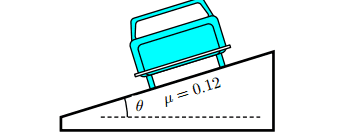
phy 3.png
 
Physics news on Phys.org
Welcome to PF;
The key to these problems is to realize that, in order to go around the circle at a constant speed, the net force must point directly towards the center of the circle.
If there is no friction, then there are only twp forces on the car.
Therefore these must sum to a single force pointing horizontally to the right (in the pic).
You can add vectors head-to-tail.
 
when car goes on a banked road, the normal reaction is perpendicular to the road. On breaking up the components, u get the sine component of the normal reaction in the horizontal direction.this is what balances the tendency of the body to slip outwards. Banking makes the bend more safe to traverse at high speed, as NsinA and the friction supply the essential centripetal acceleration for balancing the tendency of slipping which is radially outwards.

"A" is the banked angle.
 
I do not have a good working knowledge of physics yet. I tried to piece this together but after researching this, I couldn’t figure out the correct laws of physics to combine to develop a formula to answer this question. Ex. 1 - A moving object impacts a static object at a constant velocity. Ex. 2 - A moving object impacts a static object at the same velocity but is accelerating at the moment of impact. Assuming the mass of the objects is the same and the velocity at the moment of impact...

Similar threads

  • · Replies 1 ·
Replies
1
Views
1K
  • · Replies 1 ·
Replies
1
Views
3K
  • · Replies 4 ·
Replies
4
Views
2K
  • · Replies 3 ·
Replies
3
Views
2K
  • · Replies 12 ·
Replies
12
Views
3K
Replies
1
Views
4K
  • · Replies 3 ·
Replies
3
Views
3K
  • · Replies 5 ·
Replies
5
Views
3K
  • · Replies 12 ·
Replies
12
Views
2K
  • · Replies 2 ·
Replies
2
Views
2K