Help with IPTA Gravitational Waveforms Detected

Click For Summary

Discussion Overview

The discussion revolves around the detection of specific types of gravitational waveforms by the International Pulsar Timing Array (IPTA). Participants explore the characteristics of these waves, particularly focusing on low-frequency waves and their potential correlation with gamma-ray bursts. The conversation includes technical aspects of waveform detection and the nature of gravitational waves.

Discussion Character

  • Exploratory
  • Technical explanation
  • Debate/contested

Main Points Raised

  • One participant inquires about the existence of low-frequency gravitational waves detected by IPTA, specifically those triggered at minimum amplitude.
  • Another participant questions the distinction between minimum and maximum amplitude in the context of tensor waves and challenges the feasibility of isolating individual signals from a stochastic background.
  • A participant seeks clarification on how gravitational waves propagate and expresses uncertainty about the physical representation of the waveforms discussed.
  • There is confusion regarding the description of the graphs, particularly the representation of time-of-flight and its implications for wave behavior.
  • Some participants provide information about how IPTA measures variations in pulsar pulse timing, emphasizing the source of signals from pulsars rather than quasars.

Areas of Agreement / Disagreement

Participants express differing views on the nature of gravitational wave detection and the characteristics of the waveforms in question. There is no consensus on the specific types of waves detected or the interpretation of the graphs presented.

Contextual Notes

Participants note limitations in understanding the physical quantities represented in the graphs and the implications of time-of-flight measurements. The discussion reflects uncertainty regarding the detection mechanisms and the nature of gravitational waves.

Sware
Messages
10
Reaction score
0
Hi All. I am interested in finding out if the International Pulsar Timing Array team have detected specific waveform types. The waves I am particularly interested in (if they exist) would be low frequency and would be triggered at a minimum amplitude. Example below:
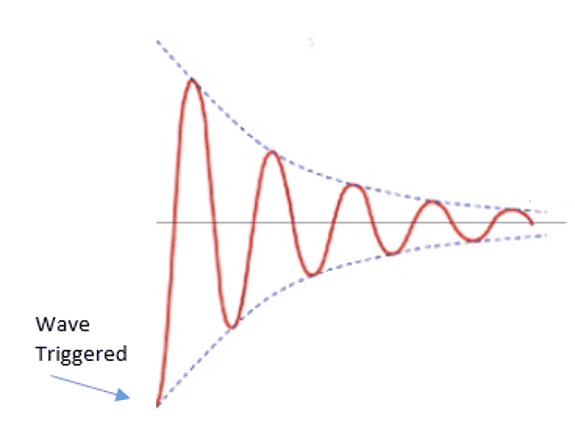
1688202741257.png

There may be waves detected which are triggered at a maximum amplitude but the amplitude of these waves (if they exist at all) would be much smaller and would be very rare, compared to the waves triggered at a minimum amplitude. Example below:
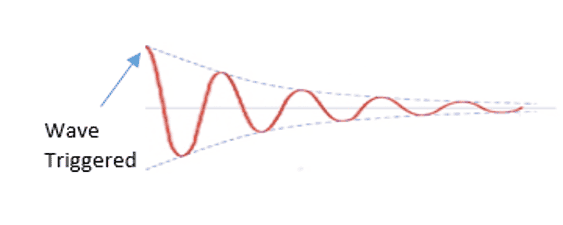
1688202783746.png

I would also be interested if these types of waves were correlated with gamma ray bursts. Where the wave was triggered ¼ wavelength before the start of the first visible gamma ray pulse.
NOTE: These waves would not be detected by LIGO/VIRGO ground based detectors.
Thanks in advance for any help with this query.
 
Space news on Phys.org
I'm unclear on your distinction between minimum and maximum amplitude. What physical quantity is represented on the vertical axis (I assume the horizontal axis is time)? How do you know that detection isn't triggered at some other random point on the waveform; e.g., when the wave amplitude passes through zero?
 
Is there a meaningful distinction between "maximum" and "minimum" for a tensor wave? What's maximum stretch in one direction will be minimum in the orthogonal direction.

What's been detected is described as a stochastic background. Can you even pull individual signals out of that? If they could, I think they'd have been able to rule out primordial gravitational waves as a source.
 
Hi Guys @ Renormalize. Sorry I was unclear. I am trying to find out if any waves of the general shape in the graphs have been detected by IPTA. The X axis is indeed time and the y axis would also be time of flight of the pulse from the quasar. How it maps to real world physical quantity is not clear yet. How do gravity waves propagate? Maybe it equates to the density of spacetime?
Why isn't the detection triggered at any other point? I am not looking at waves which are triggered at any other point. I only want to see if waves of the type in the graphs above exist. I suppose they would be triggered at the minimum timing pulse flight time of the pulsar, or the maximum flight time of the timing pulse. I am not looking at chirp wave forms which are detected by LIGO and VIRGO as black holes/neutron stars spiral in and merge.

@Ibix - Again, I am looking to see if that specific type of wave is detected, not the general background of gravity waves.
Thanks for feedback both.
 
Sware said:
The X axis is indeed time and the y axis would also be time of flight of the pulse from the quasar.
I don't understand this description. Your graphs depicts the ##y##-amplitude oscillating with time between a max and a min. Saying ##y## represents "the time-of-flight of the wave from the quasar" means the wave is speeding-up and slowing-down over the course of one graph cycle. And how is the time since the wave was emitted even measured? Shouldn't the graph simply show a straight line of positive slope, as befits a wave propagating at the speed of light?
 
Last edited:

Similar threads

  • · Replies 9 ·
Replies
9
Views
2K
  • · Replies 5 ·
Replies
5
Views
2K
  • · Replies 0 ·
Replies
0
Views
1K
  • · Replies 9 ·
Replies
9
Views
2K
  • · Replies 9 ·
Replies
9
Views
3K
  • · Replies 2 ·
Replies
2
Views
2K
  • · Replies 1 ·
Replies
1
Views
4K
  • · Replies 7 ·
Replies
7
Views
2K
  • · Replies 21 ·
Replies
21
Views
2K
  • · Replies 4 ·
Replies
4
Views
2K