SUMMARY
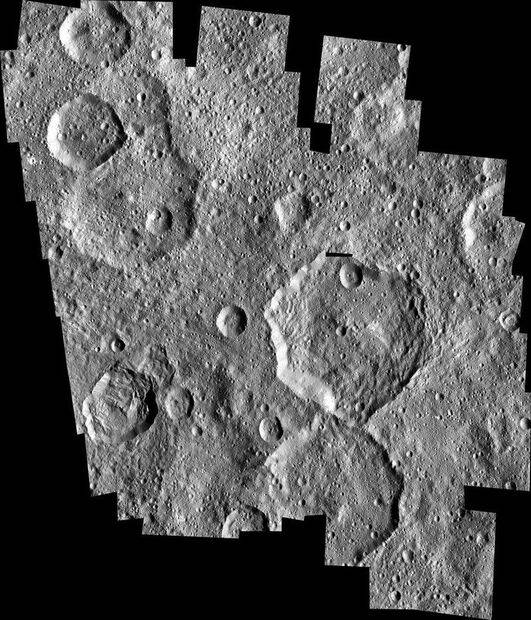
The discussion centers on the phenomenon of hexagonal craters observed on various airless celestial bodies, including the Moon, Mercury, Ceres, Mars, and Mimas. Participants explore the consensus explanation that hexagonal shapes result from the deflection of impact-generated pressure waves along pre-existing fracture systems in the crust. While most craters are circular, the presence of polygonal craters prompts further investigation into their formation mechanisms. The conversation also touches on the lack of laboratory evidence for creating hexagonal craters through impact simulations.
PREREQUISITES
- Understanding of impact crater formation processes
- Familiarity with planetary geology and tectonic activity
- Knowledge of fracture mechanics in solid materials
- Basic principles of kinetic energy and impact dynamics
NEXT STEPS
- Research "Impact Crater Formation Mechanisms" for deeper insights
- Explore "Fracture Mechanics in Geology" to understand crustal behavior
- Investigate "Polygonal Craters on Celestial Bodies" for case studies
- Study "Laboratory Simulations of Impact Events" for experimental approaches
USEFUL FOR
Astronomers, planetary geologists, and researchers interested in impact dynamics and the geological features of airless bodies in the solar system will benefit from this discussion.