Discussion Overview
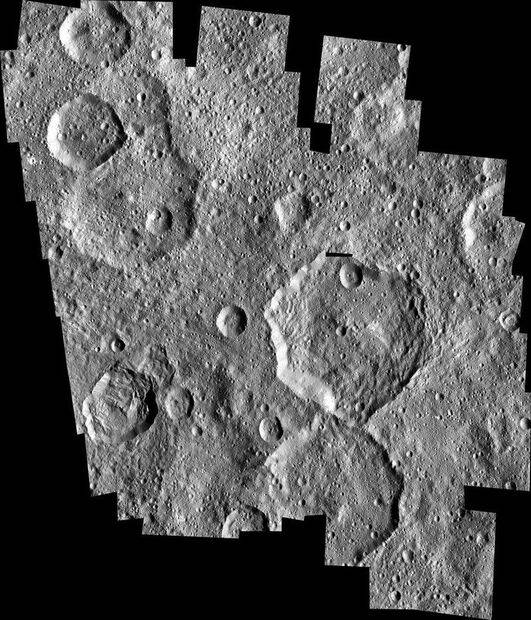
The discussion revolves around the occurrence of hexagonal craters on airless rocky worlds and moons, exploring the reasons behind their shapes and the implications of such formations. Participants share observations, propose explanations, and question existing theories related to impact cratering and geological processes.
Discussion Character
- Exploratory
- Debate/contested
- Technical explanation
- Mathematical reasoning
Main Points Raised
- Some participants note the prevalence of hexagonal and polygonal craters on various celestial bodies, including the Moon, Mercury, and Ceres.
- One participant suggests that the shape of hexagonal craters may result from the deflection of impact-generated pressure waves along a regional fracture system.
- Another participant questions the validity of existing explanations for hexagonal craters, citing a lack of consensus on the mechanisms involved.
- There is mention of two proposed mechanisms for polygonal craters: one related to the excavation flow tearing the target along pre-existing fractures, and another during the modification stage involving slumping along fractures.
- Some participants express skepticism about the existence of hexagonal fault patterns on Earth and the applicability of laboratory evidence to support claims about hexagonal craters.
- Concerns are raised about the feasibility of conducting laboratory tests to replicate the conditions necessary for creating hexagonal craters, with some suggesting alternative methods like using large explosions.
Areas of Agreement / Disagreement
Participants do not reach a consensus on the reasons for the formation of hexagonal craters, with multiple competing views and uncertainties remaining throughout the discussion.
Contextual Notes
Some participants highlight the limitations of existing explanations, noting the absence of lab demonstrations for creating hexagonal craters and the challenges in replicating impact conditions accurately.