High school physics problem sheets and tests

  • Thread starter Thread starter Oldteacher
  • Start date Start date
  • Tags Tags
    Physics
Click For Summary
SUMMARY

The discussion centers on a retired physics teacher offering pre-made problem sheets and tests accumulated over 40 years of teaching physics and AP physics. The materials include approximately 20 folders containing 50 to 100 sheets each, covering a range of topics from mechanics to electromagnetism. The teacher emphasizes the importance of practice problems, immediate feedback through answer keys, and the use of formula lists to enhance student learning and engagement. The materials are available for free to any interested teachers, with the intention of preserving the resources rather than discarding them.

PREREQUISITES
  • Understanding of basic physics concepts and terminology
  • Familiarity with AP Physics curriculum standards
  • Knowledge of effective teaching strategies for problem-solving
  • Ability to create or adapt educational materials for diverse learning levels
NEXT STEPS
  • Explore methods for creating effective practice problem sheets in physics
  • Research the benefits of immediate feedback in educational settings
  • Learn about the AP Physics exam structure and content requirements
  • Investigate strategies for teaching complex physics topics to diverse student groups
USEFUL FOR

This discussion is beneficial for physics educators, both new and experienced, who are looking for ready-made teaching resources, as well as those interested in enhancing their instructional methods in physics education.

Oldteacher
Messages
3
Reaction score
8
I'm a retired physics teacher who taught physics and AP physics for maybe 40 years. I saved my problem sheets and tests. If you are a beginning (or experienced) teacher and need pre-made problems and tests I'll send you mine. I'll wait a few months for a reply, then to the dumpster they go. Reply to [Personal e-mail address redacted by the Mentors]
 
Last edited by a moderator:
Science news on Phys.org
Welcome to PF. Folks can reply to you via PM or here in this thread.
 
To: OP
It is so great that you have been imparting knowledge, character norturing, and impacting positively the lives of many. I admire your contributions. Kudos.
 
  • Like
Likes TSny and berkeman
Oldteacher said:
I saved my problem sheets and tests. If you are a beginning (or experienced) teacher and need pre-made problems and tests I'll send you mine.
How many pages is this? Are you able to scan them so you have soft copies? Or are they already in PDF or another format?
 
berkeman said:
How many pages is this? Are you able to scan them so you have soft copies? Or are they already in PDF or another format?
Background to how this material was used. The school I taught in was a working-class suburb. Students ranged from average to an occasional brilliant student. Most years I had a few exchange students from foreign countries who were always excellent. The biggest difference from most schools was that a much greater percentage of students took physics than in most schools. So I made the practice material and exams have mostly basic material with a few challenging problems for the best students. Feedback from students who took college physics indicated they were well-prepared.

How I taught. 1) Introductory lecture, introduction of terms, formulas, what the variables stood for, simple plug-in problems we worked together. 2) Work problems, work problems, work problems. Problem sheets of increasing difficulty until most students were on board. 3) Harder and multi-step problems. 4) The day prior to the test, a “practice test”. 5) The actual exam. Toward the end of my career I knew what the common errors would be and told the students what to be extra careful with.

Course content I taught in the traditional order. First semester – mechanics. Second semester – heat, light, electricity, waves, etc. Early in my career I spent a week on basic trigonometry at the beginning of first semester as most students had not yet had trig. Later I eliminated this because math was taught better and faster by math teachers. I included a few “weird” topics that are often left out of an introductory course: planetary motion, rotary motion with rotational inertia, liquids (density, Bernoulli equation, etc.) photoelectric effect, electromagnetism. Some topics I included just because they interested me and some because they were included in an annual physics contest at the University of Alabama where I sometimes took my best students. I seldom got to every topic but always included all the mechanics topics.

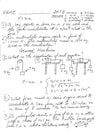
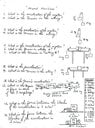
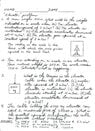
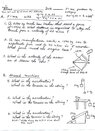
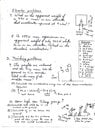
I will attach a few scans of material from one topic for anyone to see if it is usable. There is too much to scan the whole lot. I’ll just ship it to whomever wants it. There are about 20 folders, each folder for one physics topic. In each folder are maybe 50 to 100 sheets of problems and tests. Most with answers. The simple drawings and cursive writing may not appeal to many. The variables in the formulas may use different letters and symbols than you use. But physics is physics.. The problems vary from very easy to pretty hard.

If you want these I will box them up and mail them to you.

I'm getting ready to post this message and the forum software shrank the scans. If you open them up and zoom maybe you can read them better.
 

Attachments

  • F=ma introductory problems.jpg
    F=ma introductory problems.jpg
    51.3 KB · Views: 115
  • F=ma Atwood machine practice.jpg
    F=ma Atwood machine practice.jpg
    51.2 KB · Views: 116
  • F=ma elevator problems.jpg
    F=ma elevator problems.jpg
    63.4 KB · Views: 144
  • F=ma paactice test page 1.jpg
    F=ma paactice test page 1.jpg
    49.6 KB · Views: 129
  • F=ma practice test page 2.jpg
    F=ma practice test page 2.jpg
    52.1 KB · Views: 183
  • Like
Likes rsk, vanhees71, gmax137 and 2 others
A couple of things to add...
  • I found that having an answer key on the practice problem sheets is a real plus. It provides immediate feedback to the student that he is learning and accomplishing. If he doesn't solve the problem correctly he can immediately ask me or another student for help. It is fun for the student to solve a hard problem and get immediate feedback. Every now and then in class I would hear a student exclaim, "Yes !" after they worked a hard problem and verified their answer.
  • Memorizing formulas: Early in my career I made the students memorize the formulas. Later I quit this and printed a list of useful formulas at the top of the test. Why? Rote memorization will turn a student off quickly. The time is better spent with more practice and reasoning out harder problems. The AP exams provide a formula list. If a formula temporarily escapes your mind or you want to verify a seldom-used formula, you can do this. If you don't know the material a formula list won't help you anyway. Lastly, a high-class student would rather do poorly on a test than cheat, while the cheaters will use their crib sheet with no qualms whatsoever. Providing a formula list evens the playing field. It's your class. Set the policy you wish. One other thing, I did ask them to know their trig functions and formulas by heart. Indian chief Sohcahtoa helped them. I stole this from a math teacher. .[ sine = opposite / hypotenuse. etc. ]
 
  • Like
Likes vanhees71 and berkeman

Similar threads

  • · Replies 7 ·
Replies
7
Views
5K
  • · Replies 8 ·
Replies
8
Views
3K
  • · Replies 15 ·
Replies
15
Views
5K
  • · Replies 39 ·
2
Replies
39
Views
11K
Replies
2
Views
2K
  • · Replies 5 ·
Replies
5
Views
5K
  • · Replies 5 ·
Replies
5
Views
2K
  • · Replies 102 ·
4
Replies
102
Views
7K
  • · Replies 7 ·
Replies
7
Views
7K
  • · Replies 15 ·
Replies
15
Views
5K