How Can a Dot Product Result in a 3x3 Matrix?

Click For Summary
The discussion centers on how a dot product can yield a 3x3 matrix when dealing with basis vectors defined as 1x3 matrices. Participants clarify that the inner product of three vectors results in a matrix containing all possible combinations of their dot products, leading to nine entries in total. The confusion arises from the notation used in the book, where lower indices represent columns and upper indices represent rows. It is emphasized that the basis vectors are not 1x3 matrices themselves but rather individual vectors, and the matrix representation of the inner product is consistent across dimensions. Ultimately, understanding the relationship between the basis vectors and their inner products resolves the confusion.
Waxterzz
Messages
82
Reaction score
0
Hi all,

tyfAGOW.jpg


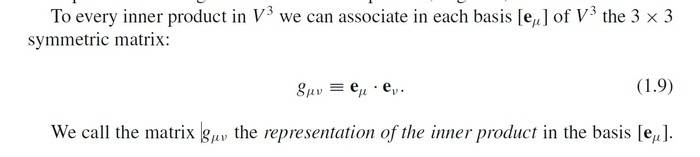
The basis vectors are defined as 1x3 matrices, how can the result be a 3x3 matrix?

How can the result of a dot product be a 3x3 matrix, I'm stumbled, how can I evaluate this?

A inner product returns a scalar, and now it returns a 3x3 matrix, please help.

Thanks.
 
Physics news on Phys.org
Waxterzz said:
Hi all,

tyfAGOW.jpg


The basis vectors are defined as 1x3 matrices, how can the result be a 3x3 matrix?

How can the result of a dot product be a 3x3 matrix, I'm stumbled, how can I evaluate this?

A inner product returns a scalar, and now it returns a 3x3 matrix, please help.

Thanks.
You have 9 dot products.
You have a term ##g_{\mu\nu}## for all the possible combinations of ##\mu, \ \nu##. That's 3*3.

The 3*3 matrix is :
##\begin{pmatrix}
e_1\cdot e_1 & e_1\cdot e_2 & e_1\cdot e_3\\
e_2\cdot e_1 & e_2\cdot e_2 & e_2\cdot e_3\\
e_3\cdot e_1 & e_3\cdot e_2 & e_3\cdot e_3
\end{pmatrix}##
 
Apparently I have never heard of a matrix of an inner product.


Should I follow this?
 
Samy_A said:
You have 9 dot products.
You have a term ##g_{\mu\nu}## for all the possible combinations of ##\mu, \ \nu##. That's 3*3.

The 3*3 matrix is :
##\begin{pmatrix}
e_1\cdot e_1 & e_1\cdot e_2 & e_1\cdot e_3\\
e_2\cdot e_1 & e_2\cdot e_2 & e_2\cdot e_3\\
e_3\cdot e_1 & e_3\cdot e_2 & e_3\cdot e_3
\end{pmatrix}##
But in the book they define lower indices as the number of colums, so I thought it were two 1x3 matrices?
 
Waxterzz said:
But in the book they define lower indices as the number of colums, so I thought it were two 1x3 matrices?
An inner product associates a pair of vectors with a scalar (and has a number of properties that I won't write down here).
So with a basis of 3 vectors, you can associate 3*3 inner products, and that gives you the matrix I posted above.
I don't know about the notation in your book, but in the image you posted it is clearly stated that ##e_1, e_2, e_3## form a basis, thus each of them is a vector. Their respective inner products is a perfectly well defined scalar.

I only watch the beginning of the video, but yes, the matrix representation of a inner product she is computing is the same concept as the one in your book. She uses a somewhat different notation, though.
 
So suddenly the lower indices represent columns in the case of μ and rows in the case for ν? And it's just plain matrix multiplication.
First thing Samparlis did was define this in the book:

nIX9L4j.jpg
 
Waxterzz said:
So suddenly the lower indices represent columns in the case of μ and rows in the case for ν? And it's just plain matrix multiplication.
First thing Samparlis did was define this in the book:

nIX9L4j.jpg

So when I saw eu and ev I thought two 1x3 matrices, since see notation above, which is not right, right?
 
So my error is, I don't understand the notations? Lower indices are not always columns?If he defines the upper indices as rows and columns lower indices why isn't itguv = eu . ev

instead of writing everything lower index
 
Waxterzz said:
So my error is, I don't understand the notations? Lower indices are not always columns?
Forget the notation for a moment. (I'm looking at the book right now, trying to understand it.)
More important: do you understand how the combination of a basis (3 vectors) and an inner product leads to the definition of the matrix representation of that inner product?
 
  • #10
Samy_A said:
Forget the notation for a moment. (I'm looking at the book right now, trying to understand it.)
More important: do you understand how the combination of a basis (3 vectors) and an inner product leads to the definition of the matrix representation of that inner product?
Apparently not, but in the video I posted it is defined as 2x2 matrices and I don't have an example for a 3x3 matrix.

I have notion of Linear Algebra, never encountered matrix representation of an inner product.
 
  • #12
Waxterzz said:
So suddenly the lower indices represent columns in the case of μ and rows in the case for ν? And it's just plain matrix multiplication.
First thing Samparlis did was define this in the book:

nIX9L4j.jpg
##e_1, e_2, e_3## are (basis) vectors. They are not 1*3 matrices. The 1*3 matrix is ##(e_1, e_2, e_3)##, the matrix consisting of the three vectors taken together.
Waxterzz said:
Apparently not, but in the video I posted it is defined as 2x2 matrices and I don't have an example for a 3x3 matrix.

I have notion of Linear Algebra, never encountered matrix representation of an inner product.
There is nothing very difficult with this notion.
If you get it in two dimensions, it is conceptually the same in 3 or 4 or 10 dimensions.

Waxterzz said:
If he defines the upper indices as rows and columns lower indices why isn't itguv = eu . ev

instead of writing everything lower index
He defines ##g_{\mu\nu}## as the inner product of the vectors ##e_\mu## and ##e_\nu##.
 
  • #13
So what he meant is

e1
e2 times e1 e2 e3
e3

and ordinary matrix multiplication?
 
  • #14
Waxterzz said:
So what he meant is

e1
e2 times e1 e2 e3
e3

and ordinary matrix multiplication?
You can represent it this way. Just keep in mind that ##e_1,e_2,e_3## are themselves vectors, not scalars. And that the "product" of two vectors is the inner product.
 
  • #15
Samy_A said:
You can represent it this way. Just keep in mind that ##e_1,e_2,e_3## are themselves vectors, not scalars. And that the "product" of two vectors is the inner product.
To come back on my question.

Part of the confusion arose, because I've forgotton or looked over the meaning of the ≡ character. They were referring to the elements of the matrix. Stupid of me, but it's clear now.
 

Similar threads

Replies
4
Views
4K
Replies
16
Views
2K
  • · Replies 4 ·
Replies
4
Views
3K
  • · Replies 12 ·
Replies
12
Views
3K
  • · Replies 7 ·
Replies
7
Views
3K
  • · Replies 1 ·
Replies
1
Views
1K
  • · Replies 7 ·
Replies
7
Views
4K
  • · Replies 8 ·
Replies
8
Views
4K
  • · Replies 17 ·
Replies
17
Views
2K
  • · Replies 21 ·
Replies
21
Views
3K