How can I find the CDF and PDF of Y?

Click For Summary

Discussion Overview

The discussion revolves around finding the cumulative distribution function (CDF) and probability density function (PDF) of the random variable Y, defined as Y = e^(-X), where X is a uniform(0,1) random variable. Participants explore the mathematical derivation of these functions and clarify the implications of the transformation on the range of Y.

Discussion Character

  • Mathematical reasoning
  • Technical explanation
  • Debate/contested

Main Points Raised

  • One participant expresses confusion about the range of Y, suggesting it is (1, 1/e), but notes that Y is not an increasing function, complicating the determination of the CDF and PDF.
  • Another participant proposes a method to find the CDF, stating P(Y
  • A later reply questions whether the CDF would be 0 for y < 1 and 1 for y > 1/e, indicating a lack of clarity on this aspect.
  • Some participants agree that the CDF is equal to 0 at y = 1/e and 1 at y = 1, and is increasing in between, while also noting that the density of Y is zero outside the interval [1/e, 1].
  • One participant confirms that the PDF, 1/y, integrates to 1 over the interval from 1/e to 1, supporting the validity of the proposed functions.

Areas of Agreement / Disagreement

There is some agreement on the behavior of the CDF and PDF, particularly regarding their values at specific points and the general shape of the functions. However, there remains uncertainty about the exact behavior of the CDF for values outside the interval [1/e, 1], and participants express differing views on the implications of the transformation.

Contextual Notes

Participants have not fully resolved the implications of the transformation on the range of Y, and there are unresolved questions about the behavior of the CDF for values less than 1 and greater than 1/e. The discussion also reflects a dependence on the definitions and properties of the uniform distribution and the exponential function.

Jonobro
Messages
7
Reaction score
0
Problem

Let X be a uniform(0,1) random variable, and let Y=e^−X.
Find the CDF of Y.
Find the PDF of Y.
Find EY.

Relevant Equations
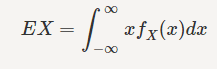
5b04f0e6f9.png

http://puu.sh/kAVJ8/0f2b1e7b22.png


My attempt at a solution

If I solve for the range of y I get (1, 1/e), but because Y is not an increasing function, my second bound is smaller than my first. I am really confused as to how I would be able to solve for the CDF and PDF in this case... Any help would be greatly appreciated.
 
Last edited by a moderator:
Physics news on Phys.org
To get CDF:
P(Y&lt;y)=P(e^{-X}&lt;y)=P(-X&lt;lny)=P(X\ge -lny)=1+lny
PDF = \frac{1}{y}
 
This is very helpful. Thanks. However, would the CDF be 0 for y < 1 and 1 for y > 1/e? This part does not really make sense.
 
Mathman's formula is pretty clear for the cdf. It is equal to 0 at y=1/e, and 1 at y=1, and increasing in between.
 
RUber said:
Mathman's formula is pretty clear for the cdf. It is equal to 0 at y=1/e, and 1 at y=1, and increasing in between.
... which is just what we expect since X certainly lies between 0 and 1, hence Y = exp(-X) lies between 1/e and 1. The density of Y is zero left of 1/e and right of 1. And in between it's the derivative of mathman's cumulative distribution function, hence 1/y.

Check: 1/y integrates to 1 when you integrate it from 1/e to 1
 
  • Like
Likes   Reactions: Greg Bernhardt

Similar threads

  • · Replies 3 ·
Replies
3
Views
2K
  • · Replies 4 ·
Replies
4
Views
2K
  • · Replies 8 ·
Replies
8
Views
2K
  • · Replies 9 ·
Replies
9
Views
2K
Replies
4
Views
3K
  • · Replies 6 ·
Replies
6
Views
5K
  • · Replies 16 ·
Replies
16
Views
3K
  • · Replies 2 ·
Replies
2
Views
3K
  • · Replies 6 ·
Replies
6
Views
2K
  • · Replies 1 ·
Replies
1
Views
2K