How can I solve the equation x-esin(x)=4?

  • Context: Undergrad 
  • Thread starter Thread starter PainterGuy
  • Start date Start date
Click For Summary
SUMMARY

The equation x - e*sin(x) = 4 does not have a closed-form solution, as confirmed by the discussion participants. Instead, solutions can be expressed using special functions like the Lambert W function, which allows for implicit representation rather than explicit solutions. While some equations, such as x + 3*sin(x) = 0, may yield trivial solutions, this is not applicable to all similar equations. Historical attempts by mathematicians like Newton highlight the complexity of finding solutions to such transcendental equations.

PREREQUISITES
  • Understanding of transcendental equations
  • Familiarity with the Lambert W function
  • Basic knowledge of numerical methods for root-finding
  • Concept of Euler's number (e) and its applications
NEXT STEPS
  • Research the properties and applications of the Lambert W function
  • Learn about numerical methods such as Newton's method for solving equations
  • Explore transcendental equations and their characteristics
  • Study examples of equations with known analytic solutions
USEFUL FOR

Mathematicians, students studying calculus or numerical analysis, and anyone interested in solving complex equations involving transcendental functions.
PainterGuy
Messages
938
Reaction score
73
Hi,

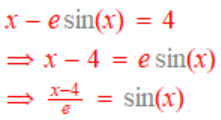
How can I solve the following equation analytically or symbolically? "e" is Euler's number. Instead of "4", you could use the letter "c" for a constant. Could you please help me? Thank you.

1592724497505.png
 
Physics news on Phys.org
You can't.

The long answer: There is no closed form for solutions to equations like that. The same problem appears for x+ex=c and similar. There are functions defined as "let y be the solution to this problem" (like the Lambert W function, you can express x in terms of these functions, but that is not really an answer.

In some cases there are analytic solutions that can be found (e.g. x+3sin(x)=0 has a trivial solution), but that doesn't work in general.
 
  • Like
Likes   Reactions: PainterGuy and jedishrfu

Similar threads

  • · Replies 1 ·
Replies
1
Views
549
  • · Replies 3 ·
Replies
3
Views
3K
  • · Replies 4 ·
Replies
4
Views
2K
  • · Replies 10 ·
Replies
10
Views
2K
  • · Replies 2 ·
Replies
2
Views
3K
  • · Replies 5 ·
Replies
5
Views
3K
  • · Replies 2 ·
Replies
2
Views
2K
  • · Replies 3 ·
Replies
3
Views
3K
  • · Replies 7 ·
Replies
7
Views
4K
  • · Replies 2 ·
Replies
2
Views
4K