How do I go about calculating the expected profit/winning per play of this game

  • Context: High School 
  • Thread starter Thread starter hamza2095
  • Start date Start date
  • Tags Tags
    Game Per
Click For Summary
SUMMARY

This discussion focuses on calculating the expected profit per play of a game designed for a Data class, which involves three rounds with varying probabilities of winning. The game requires a $20 entry fee, with probabilities of winning $10 and $100 in subsequent rounds. Participants concluded that the expected profit for the game operators is approximately -$17.08 per play after correcting for double counting and ensuring that all probabilities sum to 1. A Monte Carlo simulation is recommended for further validation of the calculations.

PREREQUISITES
  • Understanding of expected value calculations in probability
  • Familiarity with Monte Carlo simulation techniques
  • Knowledge of basic probability theory, including probability distributions
  • Ability to create and interpret probability charts
NEXT STEPS
  • Learn how to implement a Monte Carlo simulation using Python or R
  • Study the principles of probability distributions and their applications in game design
  • Explore advanced expected value calculations for multi-stage games
  • Research techniques for validating probability models and outcomes
USEFUL FOR

Game designers, data analysts, and students studying probability and statistics who are interested in calculating expected outcomes and profits in gaming scenarios.

hamza2095
Messages
28
Reaction score
1
I designed this game for my Data class but I'm having a lot of trouble calculating the expected profit per play of this game. We have taken up examples involving lottery tickets in which you have to calculate the profit and winning per ticket bought but I can't seem to apply the same concepts to my game due to the various stages and rules.

This is how the games goes

You pay $20 to start and there are three rounds

Round 1: There is a 1/2 chance you win and move on, and a 1/2 chance you lose

Round 2: There is a 2/6 chance you move on to the next round, and 1/6 chance you win $10 AND move on. (3/6 chance you lose and get nothing)

Round 3: There is 1/12 chance you win $100, and if you lose you get nothing

Here is my attempt at it
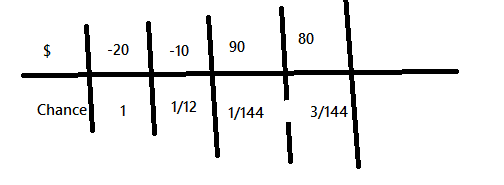
Izn2V.png

After multiplying every correlating x and y value i get E(X) = -18.5, meaning the profit the ones running the game make is $18.5

Help is greatly appreciated!
 
Physics news on Phys.org
He best way to check something like this is to run a Monte Carlo simulation with a million trials or so.
 
It would help if you labeled the columns so that it is clear what series of results each represents. I am not sure what the 3'rd column ( -10, 1/12 ) represents. They should all be labeled so you can check that all the possibilities are accounted for exactly once.
 
hamza2095 said:
Here is my attempt at it

You should do an analysis where the probabilities of the possible outcomes add up to 1.

List all the different experiences a player may have and the probability of each of those experiences. Those probabilities should add up to 1 if you have made a complete list.
 
hamza2095 said:
I designed this game for my Data class but I'm having a lot of trouble calculating the expected profit per play of this game. We have taken up examples involving lottery tickets in which you have to calculate the profit and winning per ticket bought but I can't seem to apply the same concepts to my game due to the various stages and rules.

This is how the games goes

You pay $20 to start and there are three rounds

Round 1: There is a 1/2 chance you win and move on, and a 1/2 chance you lose

Round 2: There is a 2/6 chance you move on to the next round, and 1/6 chance you win $10 AND move on. (3/6 chance you lose and get nothing)

Round 3: There is 1/12 chance you win $100, and if you lose you get nothing

Here is my attempt at it

Izn2V.png

After multiplying every correlating x and y value i get E(X) = -18.5, meaning the profit the ones running the game make is $18.5

Help is greatly appreciated!

There an obvious mistake, in that the probability of winning $100 should be twice that of winning $110. You have it as three times.

I also think you may be double counting the $10 win.

It's better to keep the losses out of it. Just calculate the expected winnings per game. Then subtract this from the $20 stake.
 
PeroK said:
There an obvious mistake, in that the probability of winning $100 should be twice that of winning $110. You have it as three times.

I also think you may be double counting the $10 win.

It's better to keep the losses out of it. Just calculate the expected winnings per game. Then subtract this from the $20 stake.
Thank you. I made a chart saying there is a (1/2)(1/6) = 1/12 chance to win $10, and that there is a (1/2)(3/6)(1/12) = 1/48 chance to win $100

after multiplying the prizes and subtracting the starting fees ($20) I got $-17.083333 per play.
 
  • Like
Likes   Reactions: FactChecker
hamza2095 said:
Thank you. I made a chart saying there is a (1/2)(1/6) = 1/12 chance to win $10, and that there is a (1/2)(3/6)(1/12) = 1/48 chance to win $100

after multiplying the prizes and subtracting the starting fees ($20) I got $-17.083333 per play.
That's what I got also.
 

Similar threads

  • · Replies 4 ·
Replies
4
Views
1K
  • · Replies 8 ·
Replies
8
Views
3K
  • · Replies 1 ·
Replies
1
Views
2K
  • · Replies 9 ·
Replies
9
Views
5K
  • · Replies 12 ·
Replies
12
Views
3K
  • · Replies 3 ·
Replies
3
Views
2K
  • · Replies 6 ·
Replies
6
Views
2K
  • · Replies 2 ·
Replies
2
Views
7K
  • · Replies 5 ·
Replies
5
Views
2K
  • · Replies 8 ·
Replies
8
Views
2K