nycmathguy
How Do Limits Behave for Piecewise Functions at Specific Points?
- Thread starter nycmathguy
- Start date
Join the discussion
Registration is free. Start your own thread to ask a follow-up.
30 replies · 4K views
Physics news on Phys.org
Discussion
Mentor
- 38,154
- 10,762
Plot some points. What are f(0), f(1/4), f(1/2), f(2), f(2.5), etc.?nycmathguy said:Homework Statement:: Investigate each limit.
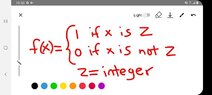
Relevant Equations:: See attachment for function.
Investigate each limit.
See attachment.
1. lim f(x) x→2
2. lim f(x) x→1/2
I don't understand this piecewise function.
Also, you've posted a few threads just now with little or no work shown. That's a violation of forum rules. You have to show some effort. You have the formula for the function -- sketch a graph of it.
Homework Helper
- 6,002
- 2,629
Focus at an interval [n,n+1] where n is an integer. Answer the following questions to help you understand how this function goes
1) What is f(n)
2) What is f(n+1)
3) What is f(x) for every ##x\in(n,n+1)## for example for x=(2n+1)/2 the midpoint of n and n+1.
1) What is f(n)
2) What is f(n+1)
3) What is f(x) for every ##x\in(n,n+1)## for example for x=(2n+1)/2 the midpoint of n and n+1.
nycmathguy
Sorry but I don't get it. Still lost.Delta2 said:Focus at an interval [n,n+1] where n is an integer. Answer the following questions to help you understand how this function goes
1) What is f(n)
2) What is f(n+1)
3) What is f(x) for every ##x\in(n,n+1)## for example for x=(2n+1)/2 the midpoint of n and n+1.
Homework Helper
- 6,002
- 2,629
what is f(1) and f(2) equal to for example? Hint: 1 and 2 are integers
Homework Helper
- 6,002
- 2,629
The definition of the function f(x) tells you that f(x)=1 if x is integer and f(x)=0 if x is not integer.
nycmathguy
Delta2 said:The definition of the function f(x) tells you that f(x)=1 if x is integer and f(x)=0 if x is not integer.
I say for (1), the answer is 0.
The answer for (2) is 1.
Yes?
Homework Helper
- 6,002
- 2,629
Νο, ##f(n)=f(n+1)=1## for all integers n. The function definition tells us that f(x)=1 if x is integer.nycmathguy said:I say for (1), the answer is 0.
The answer for (2) is 1.
Yes
nycmathguy
For (1), x tends to an integer. Thus, then f(x) = 1.Delta2 said:Νο, ##f(n)=f(n+1)=1## for all integers n. The function definition tells us that f(x)=1 if x is integer.
For (2), x tends to a rational number. Thus, f(x) = 0.
Homework Helper
- 6,002
- 2,629
Yes but as x tends to an integer, it passes from all sorts of rationals and irrationals (from the left and right of integer) for which f(x)=0.
nycmathguy
What about the following two cases using the same attachment?Delta2 said:Νο, ##f(n)=f(n+1)=1## for all integers n. The function definition tells us that f(x)=1 if x is integer.
Investigate each limit.
1. lim f(x) x→3
2. lim f(x) x→0
For (1), x tends to an integer. Thus, f(x) = 1.
For (2), x tends to 0, which is not an integer.
Thus, f(x) = 1.
Yes?
Homework Helper
- 6,002
- 2,629
If I give you the following definition for f:
f(1)=f(0)=1
f(x)=0 for all x inbetween 0 and 1.
Then what do you think is the ##\lim_{x\to 0} f(x)## (or ##\lim_{x\to 1} f(x)##..
f(1)=f(0)=1
f(x)=0 for all x inbetween 0 and 1.
Then what do you think is the ##\lim_{x\to 0} f(x)## (or ##\lim_{x\to 1} f(x)##..
Homework Helper
- 6,002
- 2,629
For both cases the limit is 0. (0 is an integer btw).nycmathguy said:What about the following two cases using the same attachment?
Investigate each limit.
1. lim f(x) x→3
2. lim f(x) x→0
For (1), x tends to an integer. Thus, f(x) = 1.
For (2), x tends to 0, which is not an integer.
Thus, f(x) = 1.
Yes?
nycmathguy
nycmathguy said:Homework Statement:: Investigate each limit.
Relevant Equations:: See attachment for function.
Investigate each limit.
See attachment.
1. lim f(x) x→2
2. lim f(x) x→1/2
I don't understand this piecewise function.
Can you elaborate a little more?Delta2 said:If I give you the following definition for f:
f(1)=f(0)=1
f(x)=0 for all x inbetween 0 and 1.
Then what do you think is the ##\lim_{x\to 0} f(x)## (or ##\lim_{x\to 1} f(x)##..
It's just not sinking in. In fact, Sullivan stated in his book that this is considered a challenging problem.
Homework Helper
- 6,002
- 2,629
hm ok let me see
If I tell you that f(x)=0 for all x then what is the ##\lim_{x\to 0} f(x)##.
If I tell you that f(x)=0 for all x then what is the ##\lim_{x\to 0} f(x)##.
Homework Helper
- 6,002
- 2,629
I think you are confusing the ##\lim_{x\to x_0}f(x)## with the ##f(x_0)##. These two are equal only if the function f is continuous at ##x_0##. But in this problem here we have to deal with a function f that is not continuous at every integer.
nycmathguy
In that case, it is 0.Delta2 said:hm ok let me see
If I tell you that f(x)=0 for all x then what is the ##\lim_{x\to 0} f(x)##.
Homework Helper
- 6,002
- 2,629
Correct now let's say I tweak the function and the function f is now f(x)=0 for all x EXCEPT for x=0 which I define to be f(0)=1. Do you think that the above limit changes or remains the same?nycmathguy said:In that case, it is 0.
nycmathguy
You said except for x = 0. I say the limit is 1?Delta2 said:Correct now let's say I tweak the function and the function f is now f(x)=0 for all x EXCEPT for x=0 which I define to be f(0)=1. Do you think that the above limit changes or remains the same?
Homework Helper
- 6,002
- 2,629
Nope it isn't 1. What is f(x) equal to ,as x tends to 0, for example what is f(0.5), f(0.4), f(0.3) , f(0.2) and so on..nycmathguy said:You said except for x = 0. I say the limit is 1?
nycmathguy
So, f(every decimal number you listed) = 0 because decimal numbers are rational and rational numbers are not integers.Delta2 said:Nope it isn't 1. What is f(x) equal to ,as x tends to 0, for example what is f(0.5), f(0.4), f(0.3) , f(0.2) and so on..
Homework Helper
- 6,002
- 2,629
That's correct. So what conclusion can you make from this? where does f(x) tend to as x tends to 0?nycmathguy said:So, f(every decimal number you listed) = 0 because decimal numbers are rational and rational numbers are not integers.
nycmathguy
So, f(x) tends to 0 as x-->0.Delta2 said:That's correct. So what conclusion can you make from this? where does f(x) tend to as x tends to 0?
Homework Helper
- 6,002
- 2,629
yes and this is true regardless of what value we choose to give to f(0). As long as f(x)=0 for all ##x\neq 0## .nycmathguy said:So, f(x) tends to 0 as x-->0.
nycmathguy
Trust me, I plan to journey through calculus l,ll, and lll. We will see limit questions up the wall.Delta2 said:yes and this is true regardless of what value we choose to give to f(0). As long as f(x)=0 for all ##x\neq 0## .
Homework Helper
- 6,002
- 2,629
Just to check your understanding, if i tell you f(x)=5 for all ##x\neq 0## and f(0)=10, what is the limit of f(x) as x tends to 0?
nycmathguy
This one is tricky.Delta2 said:Just to check your understanding, if i tell you f(x)=5 for all ##x\neq 0## and f(0)=10, what is the limit of f(x) as x tends to 0?
I say the limit is 5.
Mentor
- 38,154
- 10,762
No. f(x) = 1 if x is an integer, but for all other numbers, f(x) = 0.nycmathguy said:For (1), x tends to an integer. Thus, then f(x) = 1.
The question is asking about ##\lim_{x \to 2} f(x)##, not f(x). Even though f(2) = 1, ##\lim_{x \to 2} f(x)## is some other value.
Again, no.nycmathguy said:For (1), x tends to an integer. Thus, f(x) = 1.
First off, 0 is an integer. Second, you're again not distinguishing between function values (e.g. f(0)) and values of the limit. Here the limit expression is ##\lim_{x \to 1/2} f(x)##, which just happens to be the same as f(1/2).nycmathguy said:For (2), x tends to 0, which is not an integer.
Thus, f(x) = 1.
Most "decimal" numbers are not rational (e.g., ##\pi \approx 3.141592## and ##\sqrt 2 \approx 1.414##), and some rational numbers are integers (e.g., 2/1, 6/2, and so on).nycmathguy said:So, f(every decimal number you listed) = 0 because decimal numbers are rational and rational numbers are not integers.
Delta2 said:Just to check your understanding, if i tell you f(x)=5 for all x≠0 and f(0)=10, what is the limit of f(x) as x tends to 0?
Right, but it's not tricky if you understand the idea of what a limit means.nycmathguy said:This one is tricky.
I say the limit is 5.
nycmathguy
Ok. There are many more limits coming our way in time. This is just the beginning of the long journey.Mark44 said:No. f(x) = 1 if x is an integer, but for all other numbers, f(x) = 0.
The question is asking about ##\lim_{x \to 2} f(x)##, not f(x). Even though f(2) = 1, ##\lim_{x \to 2} f(x)## is some other value.
Again, no.
First off, 0 is an integer. Second, you're again not distinguishing between function values (e.g. f(0)) and values of the limit. Here the limit expression is ##\lim_{x \to 1/2} f(x)##, which just happens to be the same as f(1/2).
Most "decimal" numbers are not rational (e.g., ##\pi \approx 3.141592## and ##\sqrt 2 \approx 1.414##), and some rational numbers are integers (e.g., 2/1, 6/2, and so on).
Right, but it's not tricky if you understand the idea of what a limit means.
Mentor
- 38,154
- 10,762
So make sure you understand the difference between, say, ##f(c)## and ##\lim_{x \to c} f(x)##. For a continuous function f, they will be the same, but not necessarily so for discontinuous or piecewise-defined functions.nycmathguy said:Ok. There are many more limits coming our way in time.
Similar threads
- roam
- · Replies 9 ·
- Calculus and Beyond Homework Help
- Replies
- 9
- Kate2010
- · Replies 4 ·
- Calculus and Beyond Homework Help
- Replies
- 4
- armis
- · Replies 6 ·
- Precalculus Mathematics Homework Help
- Replies
- 6