How Do You Calculate the Area of a Triangle Using the 0.5*b*h Formula?

  • Thread starter Thread starter phospho
  • Start date Start date
  • Tags Tags
    Area Triangle
Click For Summary

Homework Help Overview

The discussion revolves around calculating the area of a triangle using the formula 0.5*b*h. Participants are exploring the correct application of this formula and the definitions of base and height in the context of a specific triangle.

Discussion Character

  • Conceptual clarification, Assumption checking

Approaches and Questions Raised

  • Participants discuss their methods for determining the base and height of the triangle, with some questioning the accuracy of these measurements. There is also a focus on the distinction between the median and the altitude of the triangle.

Discussion Status

The conversation is ongoing, with participants providing insights into the definitions of triangle components and how they relate to the area calculation. There is an acknowledgment of misunderstandings regarding the use of the formula and the geometric properties involved.

Contextual Notes

Some participants express uncertainty about their calculations and the definitions of terms like median and altitude, indicating a need for clarification on these concepts.

phospho
Messages
250
Reaction score
0
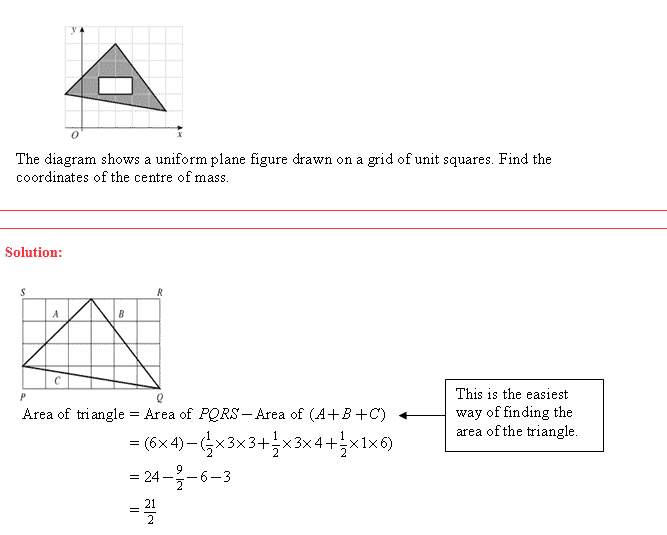
Could anyone tell me how they found the area of the triangle?
f4YHe.png


When I try to use 0.5*b*h I get 10.64483443, not 10.5
 
Physics news on Phys.org
They subtracted the areas of the three right triangles outside the given triangle from the area of the rectangle.

How did you calculate b and h for the triangle? I'm guessing you did it wrong.
 
LCKurtz said:
They subtracted the areas of the three right triangles outside the given triangle from the area of the rectangle.

How did you calculate b and h for the triangle? I'm guessing you did it wrong.

I found the midpoint of the two bottom verticies of the triangle, then found the length from that midpoint to the top vertex and used that as the height. The length of the two bottom vertices I used as the base.

I see what they done now, thanks, but is how could I have done using the b*h*0.5?
 
phospho said:
I found the midpoint of the two bottom verticies of the triangle, then found the length from that midpoint to the top vertex and used that as the height. The length of the two bottom vertices I used as the base.

I see what they done now, thanks, but is how could I have done using the b*h*0.5?

You mean "did".

The line from the midpoint of a side to the opposite vertex is a median. Medians are not generally perpendicular to the side, so its length is not the height of the triangle.

To do it that way you would have to find where the line from the vertex perpendicular to the other side intersects the other side and use that line (called the altitude) for the height.
 
LCKurtz said:
You mean "did".

The line from the midpoint of a side to the opposite vertex is a median. Medians are not generally perpendicular to the side, so its length is not the height of the triangle.

To do it that way you would have to find where the line from the vertex perpendicular to the other side intersects the other side and use that line (called the altitude) for the height.

apologies for my bad grammar.

thanks for helping.
 

Similar threads

  • · Replies 9 ·
Replies
9
Views
4K
  • · Replies 5 ·
Replies
5
Views
2K
  • · Replies 9 ·
Replies
9
Views
2K
Replies
6
Views
2K
  • · Replies 8 ·
Replies
8
Views
2K
Replies
3
Views
2K
  • · Replies 15 ·
Replies
15
Views
3K
  • · Replies 40 ·
2
Replies
40
Views
5K
  • · Replies 14 ·
Replies
14
Views
3K
Replies
3
Views
2K