How Do You Calculate the Minimal Path Sum in Coordinate Geometry?

  • Context:
  • Thread starter Thread starter Albert1
  • Start date Start date
Join the discussion
Registration is free. Ask a follow-up in this thread, or start your own.
2 replies · 1K views
Albert1
Messages
1,221
Reaction score
0
P=(3,7),Q=(1,5) ,A=(x,0),B=(0,y)

if k=minimum(PA+AB+BQ)

find: x+y+k
 
Mathematics news on Phys.org
[sp]

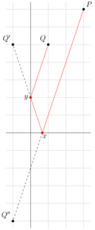
Let $Q'$ be the reflection of $Q$ in the $y$-axis and let $Q''$ be the reflection of $Q'$ in the $x$-axis. The shortest distance between $P$ and $Q''$ is the straight line between them. The shortest path between $P$ and $Q$ (via $A$ and $B$) is obtained by reflecting parts of that line in the axes, as appropriate (the red path in the diagram). The length $k$ of the path is the same as the distance from $P$ to $Q''$, which is $4\sqrt{10}.$ The point $A$ is at $(2/3,0)$ and $B$ is at $(0,2)$. So $x+y+k = 4\sqrt{10} + \frac83$.[/sp]
 

Attachments

  • reflections.png
    reflections.png
    4.4 KB · Views: 93
Opalg said:
[sp]
https://www.physicsforums.com/attachments/2267​

Let $Q'$ be the reflection of $Q$ in the $y$-axis and let $Q''$ be the reflection of $Q'$ in the $x$-axis. The shortest distance between $P$ and $Q''$ is the straight line between them. The shortest path between $P$ and $Q$ (via $A$ and $B$) is obtained by reflecting parts of that line in the axes, as appropriate (the red path in the diagram). The length $k$ of the path is the same as the distance from $P$ to $Q''$, which is $4\sqrt{10}.$ The point $A$ is at $(2/3,0)$ and $B$ is at $(0,2)$. So $x+y+k = 4\sqrt{10} + \frac83$.[/sp]
your answer is correct:)