How Do You Propose a Reaction Mechanism for a Multi-Step Reaction?

Click For Summary
SUMMARY

The discussion centers on proposing a reaction mechanism for a multi-step reaction involving six reactant molecules. The rate law equation derived is rate = k (B)[C]², indicating a third-order reaction with respect to the concentrations of reactants. Participants emphasize that the reaction is unlikely to occur in a single step due to the improbability of all six molecules colliding simultaneously. Various proposed mechanisms are discussed, highlighting the importance of avoiding trimolecular collisions and focusing on bimolecular or monomolecular steps to accurately reflect the kinetics of the reaction.

PREREQUISITES
  • Understanding of chemical kinetics and reaction order
  • Familiarity with rate law equations and their derivation
  • Knowledge of multi-step reaction mechanisms
  • Experience with bimolecular and monomolecular reactions
NEXT STEPS
  • Study the derivation of rate laws from proposed reaction mechanisms
  • Learn about the significance of reaction intermediates in multi-step reactions
  • Explore examples of bimolecular and monomolecular reaction mechanisms
  • Investigate the role of equilibrium in reaction mechanisms and kinetics
USEFUL FOR

Chemistry students, particularly those studying chemical kinetics and reaction mechanisms, as well as educators seeking to clarify concepts related to multi-step reactions and rate laws.

Evangeline101
Messages
112
Reaction score
5
1. Homework Statement
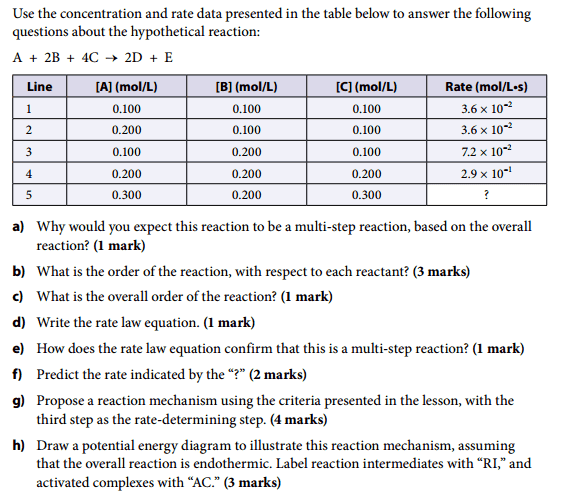
upload_2016-12-13_21-8-52.png


2. Homework Equations
rate law equation

3. The Attempt at a Solution a) I would expect this reaction to be a multi-step reaction because there are six reactant molecules, as shown in the overall chemical equation. For this reaction to be one-step, all six molecules would have to collide at the same time, with proper orientation and sufficient energy. It is extremely unlikely that this would happen.

b)

i) Comparing lines 1 and 2: Doubling the [A] does not change the rate. The reaction is zero order, with respect to [A].

ii) Comparing lines 1 and 3: Doubling the (B) causes the rate to double. The reaction is first order, with respect to (B).

iii) Comparing lines 3 and 4: Doubling the [C] causes the rate to increase four times. The reaction is second order, with respect to [C].

c) Overall, it is a third-order reaction.

d) Rate law equation is: rate = k (B)[C]2

e) The rate law equation confirms that this is a multi-step reaction because the exponents of the rate law do not match the coefficients of the hypothetical chemical equation.

f) Comparing lines 1 and 5: The (B) has been doubled, so the rate should double (first order). The [C] has been tripled, so the rate should change by a factor of 9 (second order). The rate increases twice, and then nine times, for a total increase of eighteen times. The rate is 6.5 × 10⁻¹ mol/L•s.

g) This is the part I am having trouble on. Can someone please explain how I should go about writing the reaction mechanism.

h) This part can be done once part g) is complete.Thanks.
 
Last edited:
Physics news on Phys.org
Evangeline101 said:
a) I would expect this reaction to be a multi-step reaction because there are six reactant molecules, as shown in the overall chemical equation. For this reaction to be one-step, all six molecules would have to collide at the same time, with proper orientation and sufficient energy. It is extremely unlikely that this would happen.
It is unlikely, but not impossible. The argument derived in (e) is better.
Evangeline101 said:
g) This is the part I am having trouble on. Can someone please explain how I should go about writing the reaction mechanism.
What did you try so far? You can write down some possible mechanisms ("first step: X+Y -> Z, second step: ...") and see if they fit to the reaction rates you got. If not, change them.
 
Evangeline101 said:
d) Rate law equation is: rate = k (B)[C]2

g) This is the part I am having trouble on. Can someone please explain how I should go about writing the reaction mechanism.

h) This part can be done once part g) is complete.Thanks.

Not a reaction mechanism but some reaction mechanisms. There are surely several possible. (This is just formal kinetics; if you had a proper reaction with identified molecules you would probably be able to eliminate some as chemically unreasonable.)

As you say the reaction will not happen via collision of three or more molecules. One possibility is that some of them are in (unfavourable) equilibrium with a complex, And that is the Real reactive species that goes on to react fast. So you could get started by thinking of possibilities based on that. Or then perhaps two molecules of reactant do rarely collide and react, and everything following is fast.
 
Sorry for the extremely late reply!

mfb said:
What did you try so far? You can write down some possible mechanisms ("first step: X+Y -> Z, second step: ...") and see if they fit to the reaction rates you got. If not, change them.

Here are three reaction mechanisms I came up with:

#1:

(1) A+B --> W (fast)
(2) C+W --> D+ X (fast)
(3) B + 2C --> Y (slow)
(4) C+ X + Y --> D +E (fast)

#2:

(1) A--> W (fast)
(2) C+W --> D + X (fast)
(3) B + 2C --> Y (slow)
(4) C+ X --> Z (fast)
(5) B + Y + Z --> D +E (fast)

#3:

(1) A --> W (fast)
(2) 2C + W --> D +X (fast)
(3) B + 2C --> Y (slow)
(4) B + X + Y --> D + E (fast) Are any of these correct/appropriate? Thanks.
 
All those reactions would lead to a fast production of D and deplete B and/or C before the slow reaction can happen, especially in test 2 with a lot of A present. You would get D, maybe something else, but not much E.
 
Also all of them is written involved productive trimolecular collisions, which are so rare that they never are part of a reaction mechanism you have at least to propose a multistep process that uses the same result. I think there are simpler schemes that give you the required result.

Also when you proposal scheme you should derive your rate equation (d) for it. Wwe would see what your k is it in terms of the various rate constants of your mechanism.
 
I am very confused about this subject,
Here is the section about reaction mechanisms from my lesson:

upload_2017-1-9_20-50-36.png


upload_2017-1-9_20-51-19.png


upload_2017-1-9_20-51-41.png


epenguin said:
Also all of them is written involved productive trimolecular collisions

I used the lesson as guidance, and it seems that it uses a lot of trimolecular collisions... :/
 
They are not the most likely reactions, but they work. You could change "B+Y+Z->D" to "B+Y->G, G+Z->D" for example, without a difference for the overall reaction.
 
Well I may be jumping to unwarranted conclusions, second opinions are invited, but to me what I read here of your lessons bears certain hallmarks:
No actual chemical reactions are given; (I am hard put offhand to think of one with the stoichiometry of your example);
In the illustrative example the first step is a fast irreversible reaction. So you would not have cylinder, flask or bottle or whatever of A, you would have one of W before you even mixed it with B and C;
There are trimolecular collisions which when I learned basic Chemical kinetics were considered not to happen. I have never followed particularly gas kinetics, but I doubt they have become common since then.

Taking these things altogether and the impression is that kinetics, a fairly straightforward part of the more general study of chemical mechanism (usually suggestive of possible mechanisms, and useful in ruling out other imaginable mechanisms), because it has slightly mathematical looking structure, is transformed into an artificial scholastic exercise by teachers with little contact with the practice of the subject.*

Seeing your question about three weeks ago I immediately thought of two or three mechanisms that would work which I have since forgotten. So to give you an idea possible one is:

dimerisation of C to form a small amount of dimer, fast so that it is essentially in equilibrium with monomer

2C ↔ C2 so we have essentially [C2] = (k1/k-1) [C]2

followed by slow (rate-determining) reaction of the dimer with B

C2 + B → C2B , rate = k2 [C2][ B]

After which if followed by fast steps it makes no difference to the rate equation what exactly that these are, as the rate will be

rate = (k2k1/k-1) [ B][C]2 whatever these are.

You could make some reasonable suggestions like

2 C2B → C4B2 (fast)

followed by a fast reaction to form a complex that also rapidly dissociates to final products.

C4B2 + A → C4B2A → 2D + E

Anything reasonable in these post-rate-determining stages is as good as anything else, you have no experimental evidence to distinguish different mechanisms. If you have included trimolecular reactions at this stage, you can surely re-elaborate them making extra stages so that you have only bimolecular or monomolecular ones. I expect you could find other possible mechanisms that fit the kinetics.

* I see your profile does not say where you are from, but we have had in the chemistry section quite a lot of similarly very artificial questions that originate from some kind of schools, I hope not Universities, in India. By all means play any games your teachers require but privately maybe with a pinch of salt; we here will only tell you such truth as we know.
 
Last edited:
  • Like
Likes   Reactions: Evangeline101 and mfb
  • #10
epenguin said:
* I see your profile does not say where you are from, but we have had in the chemistry section quite a lot of similarly very artificial questions that originate from some kind of schools, I hope not Universities, in India. By all means play any games your teachers require but privately maybe with a pinch of salt; we here will only tell you such truth as we know.

I am actually from Canada :) The chemistry course I am taking is a grade 12 Canadian online course...
 
  • #11
Okay, school's programmes are not necessarily above criticism. On the other hand I might be out of date, that's why I invited second opinions and still do.

I see your notes say that not more than three molecules should be Involved at any step, I always thought two.
What does three colliding all at once mean anyway? Where do you make the distinction between three at once, and two and then after a short time another? Both will give the same formal law for rates in terms of concentrations. Then the effects we will not be able to distinguish by formal kinetics as far as I can see offhand. We divided up into steps and not because of formal kinetics, but because of our other knowledge about pollution frequencies. Wherever you have a step involving reaction of three molecules in a single step, you can always propose one with two steps like I did that gives the same formal result.

I suggest you try and work out a couple of other mechanisms that would give you your [ B][C]2 law.
 

Similar threads

  • · Replies 3 ·
Replies
3
Views
2K
Replies
7
Views
2K
  • · Replies 6 ·
Replies
6
Views
2K
  • · Replies 4 ·
Replies
4
Views
4K
  • · Replies 2 ·
Replies
2
Views
2K
Replies
1
Views
5K
Replies
15
Views
4K
  • · Replies 17 ·
Replies
17
Views
2K
  • · Replies 3 ·
Replies
3
Views
2K
  • · Replies 5 ·
Replies
5
Views
5K