How Does Immigration Influence the US Economy?

  • Context: News 
  • Thread starter Thread starter rootX
  • Start date Start date
  • Tags Tags
    Economy
Click For Summary

Discussion Overview

The discussion explores the influence of immigration on the U.S. economy, particularly in relation to economic cycles, labor market dynamics, and immigration policies. Participants examine how immigration patterns change during periods of economic growth and decline, and the implications of these changes for both immigrants and the native workforce.

Discussion Character

  • Exploratory
  • Debate/contested
  • Conceptual clarification

Main Points Raised

  • Some participants note that immigration contributes significantly to job growth, particularly in labor-scarce regions and in jobs that native workers often avoid.
  • Others argue that during economic downturns, immigrants are more likely to leave the U.S. or refrain from coming, as they have the option to return to their home countries.
  • A participant suggests that the drop in illegal immigration may be linked to increased dangers and difficulties in crossing borders, particularly for Mexican immigrants.
  • Some express the view that high mobility among immigrants can benefit the economy by preventing strain on resources and allowing for greater job flexibility.
  • Concerns are raised about whether U.S. immigration policies adequately reflect the changing dynamics of immigration in response to economic conditions.

Areas of Agreement / Disagreement

Participants express a range of views on the relationship between immigration and economic conditions, with no clear consensus on the implications of these dynamics or the effectiveness of current immigration policies.

Contextual Notes

Participants reference various articles and data but acknowledge limitations in the available information, such as the lack of comprehensive data on immigration trends and economic impacts. There is also mention of differing experiences and conditions in other countries, like Dubai, which may not directly correlate with the U.S. situation.

rootX
Messages
478
Reaction score
4
http://www.bbc.co.uk/news/world-africa-12810828
This tells that African immigrants are finding their home countries better than America. A simple observation linking immigration to the economic cycle is something really interesting.

There is not data in that article however, I noticed that illegal immigration also dropped:
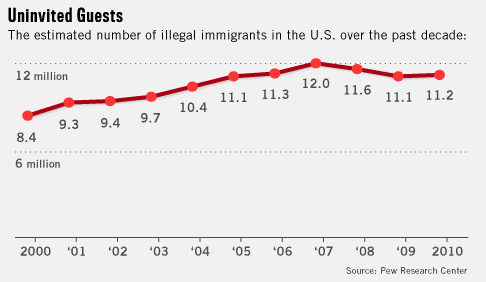
vital-stats-110204.gif

http://www.usnews.com/opinion/artic...-immigration-stabilizes-after-a-two-year-drop

I just found something from 2003:

The pace of recent U.S. economic
growth would have been impossible
without immigration. Since 1990, immigrants
have contributed to job growth in
three main ways: They fill an increasing
share of jobs overall, they take jobs in
labor-scarce regions, and they fill the
types of jobs native workers often shun.
The foreign-born make up only 11.3 percent
of the U.S. population and 14 percent
of the labor force. But amazingly,
the flow of foreign-born is so large that
immigrants currently account for a larger
share of labor force growth than natives

When employment is not growing—
largely the case since early 2001—immigration
naturally slows. The foreign-born
are both less apt to come and more
likely to leave when the U.S. economy is
doing poorly. Current Population Survey
data indicate that while the immigrant
population increased 6.1 percent between
2000 and 2001, it rose only 2
percent between 2001 and 2002.
http://www.dallasfed.org/research/swe/2003/swe0306a.pdf

It seems like we are seeing similar behavior now.

Few of things I was mainly interested in is how economy gets affected when immigration slows down during poor economic growth, how fast immigration jumps when there is positive growth. Do government immigration policies consider these immigration cycles? I read today in some article that all presidents believe that immigration policies are outdated however there hasn't been significant overhaul.
 
Last edited by a moderator:
Physics news on Phys.org
It makes sense to be honest. When times are bad, an American who is born and raised here pretty much has to stay. Someone who legally immigrated from another country far away has more options. If things don't work here, might as well go back home and see how that works out. It's an especially easy decision when you have family back in another country.

The drop in illegal immigration is probably coming from Mexican immigrants. It's getting harder and more dangerous to cross the border and jobs in America are hard to come by so it has probably gotten to the point that it's not worth it for many to try to come to America to send money back home.
 
Pengwuino said:
It makes sense to be honest. When times are bad, an American who is born and raised here pretty much has to stay. Someone who legally immigrated from another country far away has more options. If things don't work here, might as well go back home and see how that works out. It's an especially easy decision when you have family back in another country.

The drop in illegal immigration is probably coming from Mexican immigrants. It's getting harder and more dangerous to cross the border and jobs in America are hard to come by so it has probably gotten to the point that it's not worth it for many to try to come to America to send money back home.

I think high level of mobility is not only good for people themselves but also for everyone else as those people don't strain the system. Immigrants are also more flexible with what kind of jobs offered to them than natural citizens. I am not familiar with the US immigration policies but from very limited reading it seems like immigration policies are not taking much advantage of immigrant behaviors.

While natural Americans will have less options but there are people who migrate between states and more likely to adjust to the economic cycles than those who don't move at all.
 
Last edited:

Similar threads

  • · Replies 21 ·
Replies
21
Views
3K
  • · Replies 204 ·
7
Replies
204
Views
29K
  • · Replies 10 ·
Replies
10
Views
4K
  • · Replies 35 ·
2
Replies
35
Views
8K
  • · Replies 870 ·
30
Replies
870
Views
115K
  • · Replies 134 ·
5
Replies
134
Views
18K
  • · Replies 3 ·
Replies
3
Views
7K
Replies
2
Views
4K
  • · Replies 33 ·
2
Replies
33
Views
7K
Replies
19
Views
10K