connormcole
- 1
- 0
View attachment 4486
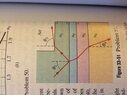
In the attached figure, light is incident at angle $${\theta}_{1} = 40.1^{\circ}$$ on a boundary between two transparent materials. Some of the light travels down through the next three layers of transparent materials, while some of it reflects upward and then escapes into the air. If $${n}_{1} = 1.30$$, $${n}_{2} = 1.40$$, $${n}_{3} = 1.32$$, and $${n}_{4} = 1.45$$, what is the value of (a) $${\theta}_{5}$$ in the air and (b) $${\theta}_{4}$$ in the bottom material?
I understand the concept at work here is Snell's law of refraction. I know that to calculate the angle $${\theta}_{5}$$ you start with $${n}_{air}\sin\left({{\theta}_{5}}\right) = {n}_{1}\sin\left({{\theta}_{1}}\right)$$, then simplify to $${\theta}_{5} = \arcsin\left({\frac{{n}_{1}}{{n}_{air}}\sin\left({{\theta}_{1}}\right)}\right)$$, $$\approx 56.9^{\circ}$$.
I'm not sure where to go from here though as this concept is still relatively new to me. Any help that can be offered would be greatly appreciated.
In the attached figure, light is incident at angle $${\theta}_{1} = 40.1^{\circ}$$ on a boundary between two transparent materials. Some of the light travels down through the next three layers of transparent materials, while some of it reflects upward and then escapes into the air. If $${n}_{1} = 1.30$$, $${n}_{2} = 1.40$$, $${n}_{3} = 1.32$$, and $${n}_{4} = 1.45$$, what is the value of (a) $${\theta}_{5}$$ in the air and (b) $${\theta}_{4}$$ in the bottom material?
I understand the concept at work here is Snell's law of refraction. I know that to calculate the angle $${\theta}_{5}$$ you start with $${n}_{air}\sin\left({{\theta}_{5}}\right) = {n}_{1}\sin\left({{\theta}_{1}}\right)$$, then simplify to $${\theta}_{5} = \arcsin\left({\frac{{n}_{1}}{{n}_{air}}\sin\left({{\theta}_{1}}\right)}\right)$$, $$\approx 56.9^{\circ}$$.
I'm not sure where to go from here though as this concept is still relatively new to me. Any help that can be offered would be greatly appreciated.
Attachments