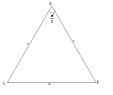
[sp]Half the angle at $P$ is $\dfrac{\pi}{14}$. The triangle is isosceles, so it follows that $\sin\Bigl(\dfrac\pi{14}\Bigr) = \dfrac{m/2}n = \dfrac m{2n}.$
If $\theta = \frac\pi{14}$ then $\sin(7\theta) = 1.$ But if $s = \sin\theta$ then $\sin(7\theta) = 7s - 56s^3 + 112s^5 - 64s^7$ (using the
Chebyshev polynomial $T_7(s)$). So the equation $\sin(7\theta) = 1$ can be written as $64s^7 - 112s^5 + 56s^3 - 7s + 1 = 0$. That can be factored as $$\begin{aligned} 0 &= 64s^7 - 112s^5 + 56s^3 - 7s + 1\\ &= (s+1)(64s^6 - 64s^5 - 48s^4 + 48s^3 + 8s^2 - 8s + 1) \\ &= (s+1)(8s^3 - 4s^2 - 4s + 1)^2.\end{aligned}$$ So if $\sin(7\theta) = 1$ but $s\ne-1$ then $8s^3 - 4s^2 - 4s + 1 = 0.$
Now put $s = \sin\bigl(\frac\pi{14}\bigr) = \frac m{2n}$ to see that $$ 0 = 8s^3 - 4s^2 - 4s + 1 = \frac{8m^3}{8n^3} - \frac{4m^2}{4n^2} - \frac{4m}{2n} + 1 = \frac{m^3 - m^2n - 2mn^2 + n^3}{n^3},$$ and therefore $m^3 - m^2n - 2mn^2 + n^3 = 0.$ Finally, multiply that by $m+n$ to see that $0 = (m+n)(m^3 - m^2n - 2mn^2 + n^3) = m^4 - 3m^2n^2 - mn^3 + n^4.$[/sp]