How Much Work Does Ryan Do Lifting and Carrying Potatoes?

  • Thread starter Thread starter LonelyElectron
  • Start date Start date
  • Tags Tags
    Energy
Click For Summary
SUMMARY

This discussion focuses on calculating work, power, and energy in physics problems involving lifting and carrying objects. Participants analyze two specific scenarios: lifting a 20 kg bag of potatoes and a 1480 kg car accelerating to 95 km/h. Key equations used include W = Fd for work and P = W/t for power. The conversation emphasizes the importance of correctly applying these formulas and understanding the relationship between energy units like kilowatt-hours and work.

PREREQUISITES
  • Understanding of Newton's laws of motion, specifically F = ma
  • Familiarity with work and energy equations: W = Fd and P = W/t
  • Basic knowledge of units of measurement in physics, including Joules and Watts
  • Concept of kinetic energy: K = ½mv²
NEXT STEPS
  • Study the derivation and application of the work-energy theorem in physics
  • Learn about the conversion between different energy units, particularly Joules and kilowatt-hours
  • Explore the concept of power in physics and its real-world applications
  • Investigate uniform acceleration and its implications in motion problems
USEFUL FOR

Students studying physics, educators teaching mechanics, and anyone interested in understanding the principles of work, energy, and power in practical scenarios.

LonelyElectron
Messages
18
Reaction score
1
Hey all! I have three questions below and was hoping someone could proof read, and offer some guidance for the last one... Any help is greatly appreciated!

Question 1:
1. Homework Statement

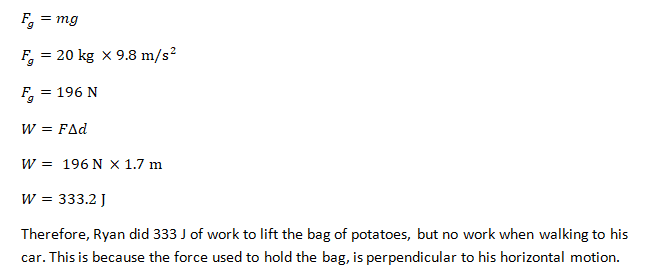
Ryan needs to carry a bag of potatoes to the car. Determine how much work Ryan has to do to lift a 20 kg bag of potatoes to his shoulder, 1.7 m above the floor, and how much work he does as he carries this bag of potatoes to his car, which is parked 45 m away? Show your work.

Homework Equations


F_g = mg
W = Fd

The Attempt at a Solution


51.png

Question 2:

Homework Statement


For a 1480 kg car that accelerates uniformly from a position of rest to a speed of 95 km/h in 6.0 s:
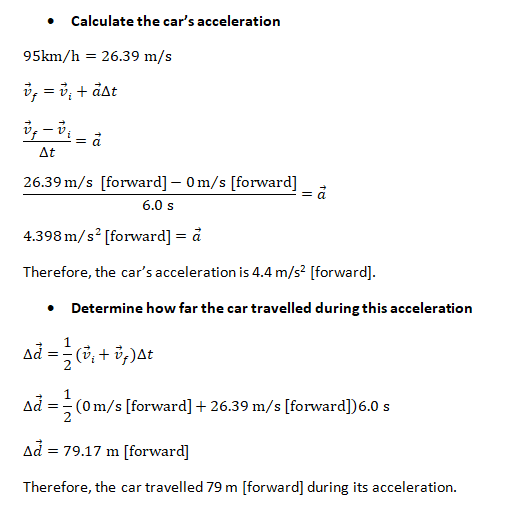
-calculate the car's acceleration
-determine how far the car traveled during this acceleration
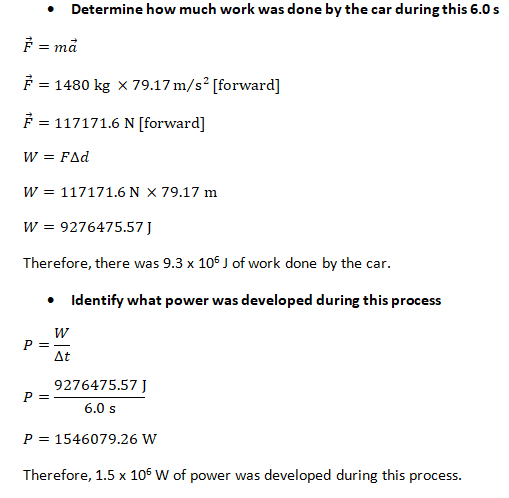
-determine how much work was done by the car during this 6.0 s
-identify what power was developed during this process

Homework Equations


F=ma
W=fd
v_f = v_i +at
d=1/2(v_i + v_f)t
P=W/t
The Attempt at a Solution


52 a.png

52 b.png


Question 3:

Homework Statement

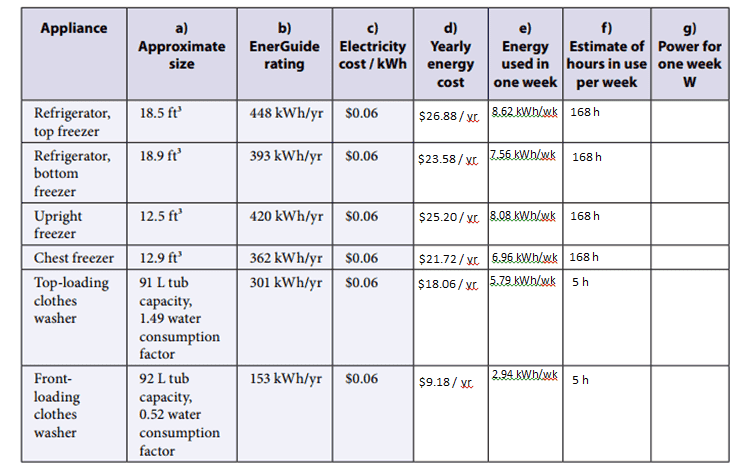
Fill in the empty columns of the following table.​

Homework Equations

No idea. I used common sense.​

The Attempt at a Solution

53.png
very lost as to how I can fill out the last column...
 

Attachments

  • 51.png
    51.png
    4.3 KB · Views: 705
  • 52 a.png
    52 a.png
    7.8 KB · Views: 702
  • 52 b.png
    52 b.png
    7.9 KB · Views: 664
  • 53.png
    53.png
    33.5 KB · Views: 629
Physics news on Phys.org
Power is expressed in Watts or Joules/s. It is the rate at which energy is generated or dissipated. In short, divide energy by time and you have power. Mind your units. Also, for future reference, please post unrelated questions on separate threads.
 
  • Like
Likes   Reactions: LonelyElectron
LonelyElectron said:
very lost as to how I can fill out the last column...
Well, you have kilowatt-hours per week. What is the relationship between kilowatt-hours and work?
 
  • Like
Likes   Reactions: LonelyElectron
Question 1 looks good.
Question 2, you did the first two right, but then when calculating the work you multiplied by the distance instead of the acceleration. So your calculation of the work done and the power are both wrong.

In the last column of the table, you have how much energy is used in one week. Since power is energy/time, you just need to divide the energy used in one week by the number of hours in a week.
 
  • Like
Likes   Reactions: LonelyElectron
Oh wow... Thanks for the fast replies! Okay, so for question 3, the power is the energy over time. I did the first question in the table and got P=8.62/168=0.051. That's kW because I had kWh as my power, right? So to make it into watts for the answer, I multiply by 1000, which gives me 51 W. Is that correct? As long as the process is right I think I can confidently get the rest :)

As for question 2, I am a little confused by the need for acceleration? The only equation I have been given for work thus far is W=Fd, or W =mgd. Am I missing something?
 
LonelyElectron said:
As for question 2, I am a little confused by the need for acceleration?
In question 2 you say F = ma but you multiply the mass by the 79.17 which is the number for the distance traveled, not the acceleration.

On edit: kW h/week is not an energy unit; kW h is.
 
  • Like
Likes   Reactions: LonelyElectron
kuruman said:
In question 2 you say F = ma but you multiply the mass by the 79.17 which is the number for the distance traveled, not the acceleration.

On edit: kW h/week is not an energy unit; kW h is.

Brilliant on your part! I can't believe I switched my values like that in number 2... Here is the updated. Look better?
52 b.png

As for kWh, not sure I understand. Physics doesn't seem to be my forte...
 

Attachments

  • 52 b.png
    52 b.png
    6.2 KB · Views: 615
Problem 2 agrees with my numbers. To complete the picture, note that you didn't have to go through the acceleration to get the answer. I the car acquires kinetic energy K = ½mv2 in time t, then the average power is P = (½mv2)/t. You get the same number.
LonelyElectron said:
As for kWh, not sure I understand. Physics doesn't seem to be my forte...
You don't really need to understand physics in order to understand kWh. If you understand money, it's enough. Say your weekly salary is $1,000.00. That's a rate of 1 k$/week. If someone asked you how much you make in a month, you would multiply the rate by the number of weeks in a month (= 4) and say (1 k$/week)*4 (week) = 4 k$. If, instead, you were asked how much you make in one working hour (1/40 of a working week), you would say (1 k$/week)*(1/40) week= 0.025 k$. Same thing with kW. The kWh is the amount of energy generated/consumed in one hour. It's an energy and therefore can be expressed in Joules by noting that there are 3600 seconds in one hour. Thus, 1 KWh = 1000 Wh =1000 (J/s)h = 1000(J/s)3600s = 3.6×10⁶ J = 3.6 MJ. So the energy cost of $0.06 per kWh means that one is paying only 6 cents to buy 3.6 million Joules or 600,000 J for a penny. What a deal!
 

Similar threads

  • · Replies 11 ·
Replies
11
Views
6K
  • · Replies 2 ·
Replies
2
Views
2K
Replies
10
Views
3K
  • · Replies 12 ·
Replies
12
Views
2K
Replies
5
Views
2K
  • · Replies 2 ·
Replies
2
Views
3K
  • · Replies 4 ·
Replies
4
Views
4K
Replies
6
Views
4K
Replies
6
Views
2K
  • · Replies 11 ·
Replies
11
Views
2K