Discussion Overview
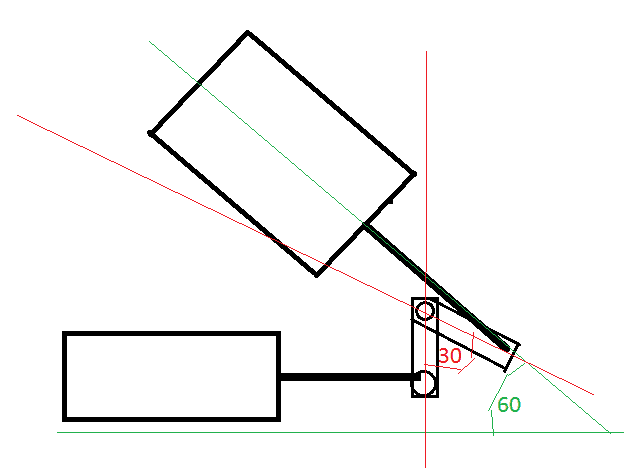
The discussion revolves around the timing of pistons in differently angled cylinders, specifically in the context of engine design, with a focus on a Stirling engine. Participants explore the relationship between crank offsets and piston phase angles, particularly when cylinders are mounted at angles to each other.
Discussion Character
- Exploratory
- Technical explanation
- Debate/contested
- Conceptual clarification
Main Points Raised
- One participant questions whether a 90-degree phase angle between two pistons requires a 90-degree or 30-degree crank offset when the cylinders are mounted at 60 degrees to each other.
- Another participant suggests that a 30-degree offset is necessary to achieve the desired 90-degree phase angle.
- Some participants express uncertainty about the implications of cylinder positioning on piston phase, with one arguing that the cylinder's position does not affect the pistons' phase.
- A participant mentions that the phase angle is typically set to 90 degrees in Stirling engines, but acknowledges that optimal angles may vary based on engine conditions.
- One participant emphasizes the importance of understanding terminology, noting that phase, block offset, and crank offset are distinct concepts.
- A later reply clarifies that the relationship between the pistons remains consistent regardless of cylinder positioning, maintaining a 90-degree lead/follow relationship.
- Another participant provides a detailed explanation of the mechanics of a Stirling engine, highlighting the significance of the 90-degree phase angle for optimal performance.
Areas of Agreement / Disagreement
Participants express differing views on the necessary crank offset for achieving the desired piston phase angle, indicating that multiple competing perspectives remain unresolved. While some agree on the importance of a 90-degree phase angle, others question the implications of cylinder positioning.
Contextual Notes
Participants note that the discussion may be hindered by unclear terminology and assumptions regarding engine geometry and timing definitions. There is also mention of varying optimal phase angles depending on engine conditions, which remains an open question.