How to calculate ΔK and da/dN from SENT fatigue test data

1 reply · 2K views · last reply
arehman1289
Messages
11
Reaction score
0
Hello Everybody,

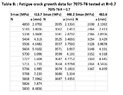
Im doing my lab report on Fatigue testing for a Single Edge Notched Tension (SENT) sample and need to plot ΔK vs da/dN for a series of a vs N readings at different R and maximum stress values (attached in the picture). I've just been given one equation for Ki and told that I need to use ASTM E647 for assistance (attached equation). However after hours of going through it I was unable to figure out how to get ΔK vs da/dN from the data and information. Any step by step help would be highly appreciated. Please please.

Thanks
 
Attachments
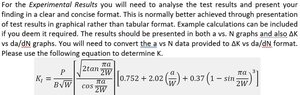
  • Typed instructions on analysing fatigue results, followed by the stress intensity factor equation K_I = P/(B√W) multiplied by the bracketed terms √(2tan(πa/2W)/cos(πa/2W)) and [0.752 + 2.02(a/W) + 0.37(1 − sin(πa/2W))^3].
    WhatsApp Image 2022-11-01 at 3.50.24 PM.jpeg
    41.3 KB · Views: 184
  • Table 8 of fatigue crack growth data for 7075-T6 at R = 0.7, listing Smax (MPa), N and a (mm) in three column groups for Smax 413.7, 448.2 and 482.6 MPa.
    WhatsApp Image 2022-11-01 at 3.50.40 PM.jpeg
    60.3 KB · Views: 176
There is a discussion of this starting on page 9-147 in MIL-HDBK-5H. That handbook has been superseded, but it is full of good information AND is available online. Just search MIL-HDBK-5H to find a copy. This figure summarizes two pages of step by step discussion that should help you.
Graph of crack length a against number of cycles N with data points rising in a curve, showing secant and tangent slope construction with the equation for da/dN at point i; the figure is titled Figure 9.3.5.2, analytical definition of crack-growth rate calculation.