How to measure the diameter of a shaft without a caliper?

Click For Summary

SUMMARY

The discussion focuses on methods to measure the diameter of a steel shaft without using a vernier caliper or micrometer. Common household tools such as a ruler, paper strips, thread, or tape can be used to measure the shaft's circumference, which is then divided by π (3.1416) to estimate the diameter. Advanced techniques involve wrapping a narrow shim or foil tape tightly around the shaft to minimize measurement errors caused by helix length and thickness of the wrapping material. Alternative suggestions include using end-wrenches, drill bits as gauges, or taking the shaft to a local machine shop for precise caliper measurement. The thread or tape method requires accounting for the thickness of the material and helix geometry, with formulas provided to improve accuracy.

PREREQUISITES

  • Understanding of circumference-to-diameter conversion using π (pi)
  • Basic geometry of helix and measurement error correction
  • Familiarity with using rulers and flexible measuring tapes
  • Knowledge of mechanical fitting tolerances for bearings and couplings

NEXT STEPS

  • Study the formula for helix length correction: D = (√((L/n)² - t²))/π - t
  • Learn to use narrow shim or foil tape for circumference measurement
  • Explore calibration techniques using pixel measurement from smartphone photos
  • Research standard shaft diameter gauges such as end-wrenches and drill bits

USEFUL FOR

Home mechanics, hobbyists, and DIY enthusiasts needing to measure shaft diameters without precision tools, as well as engineers and technicians seeking low-cost or improvised measurement techniques for mechanical components.

harveycannon
Messages
6
Reaction score
5
TL;DR
How to measure the diameter of a shaft without a caliper?
I'm working on a small mechanical project at home and need to determine the outside diameter of a steel shaft. Unfortunately, I don't have a vernier caliper or a micrometer.

Is there a reasonably accurate method to measure the shaft's diameter using common household tools?

I'm not looking for machine-shop precision, but I'd like to get close enough to identify the shaft size and order the correct bearing or coupling.

What method would you recommend, and what level of accuracy can I realistically expect?
 
  • Like
Likes   Reactions: OmCheeto
Engineering news on Phys.org
harveycannon said:
TL;DR: How to measure the diameter of a shaft without a caliper?

I'm working on a small mechanical project at home and need to determine the outside diameter of a steel shaft. Unfortunately, I don't have a vernier caliper or a micrometer.

Is there a reasonably accurate method to measure the shaft's diameter using common household tools?

I'm not looking for machine-shop precision, but I'd like to get close enough to identify the shaft size and order the correct bearing or coupling.

What method would you recommend, and what level of accuracy can I realistically expect?
Is there a way to use a piece of paper or tape with tick marks to measure the circumference of the shaft? Ideally, I recommend that you buy a caliper. That would make things easier.

This video shows how to measure rods:
 
  • Like
Likes   Reactions: BillTre, Astronuc, Lnewqban and 1 other person
harveycannon said:
TL;DR: How to measure the diameter of a shaft without a caliper?

I'm working on a small mechanical project at home and need to determine the outside diameter of a steel shaft. Unfortunately, I don't have a vernier caliper or a micrometer.

Is there a reasonably accurate method to measure the shaft's diameter using common household tools?

I'm not looking for machine-shop precision, but I'd like to get close enough to identify the shaft size and order the correct bearing or coupling.

What method would you recommend, and what level of accuracy can I realistically expect?
Maybe place the shaft on top of the best ruler you have and take a picture with your phone as perpendicular to the ruler as possible. Then zoom in and count the pixels across the shaft and calibrate those against the ruler.

Better yet, go buy or make some cookies. Take them plus your shaft to any local machine shop, auto repair, hardware store, etc. Give them the cookies and ask them to use their calipers to measure it for you. It's a common tool, many people have one. Maybe one of your neighbors?
 
  • Like
Likes   Reactions: Spinnor, hutchphd, harveycannon and 1 other person
DaveE said:
Maybe place the shaft on top of the best ruler you have and take a picture with your phone as perpendicular to the ruler as possible. Then zoom in and count the pixels across the shaft and calibrate those against the ruler.

Better yet, go buy or make some cookies. Take them plus your shaft to any local machine shop, auto repair, hardware store, etc. Give them the cookies and ask them to use their calipers to measure it for you. It's a common tool, many people have one. Maybe one of your neighbors?
I like your cookie advice. Cookies for a caliper. That is the literal definition of sweet talking people into doing stuff for you. A+ advice, man.
 
  • Like
Likes   Reactions: harveycannon
AlexB23 said:
Is there a way to use a piece of paper or tape with tick marks to measure the circumference of the shaft? Ideally, I recommend that you buy a caliper. That would make things easier.

This video shows how to measure rods:

Yes, that's a good workaround. Simply wrap a strip of paper around the shaft, mark where it overlaps, then lay it flat and measure the length with a ruler (https://ruler-online.net). Divide the circumference by π (3.1416) and got an estimated diameter. I really did not know that we could measure the diameter in this way. I know it's not a precise measurement, but it's nearly accurate. Thanks man.
 
  • Like
Likes   Reactions: Lnewqban and AlexB23
DaveE said:
Maybe place the shaft on top of the best ruler you have and take a picture with your phone as perpendicular to the ruler as possible. Then zoom in and count the pixels across the shaft and calibrate those against the ruler.

Better yet, go buy or make some cookies. Take them plus your shaft to any local machine shop, auto repair, hardware store, etc. Give them the cookies and ask them to use their calipers to measure it for you. It's a common tool, many people have one. Maybe one of your neighbors?
😂 Thanks! I came here looking for a measuring trick and left with a cookie-based negotiation strategy. Fair trade, I might just have to bake a batch now.
 
  • Haha
  • Like
Likes   Reactions: DaveE and AlexB23
End-wrenches and drill bits are good (commonly available) gauges for determining standard shaft diameters.
 
harveycannon said:
Yes, that's a good workaround. Simply wrap a strip of paper around the shaft, mark where it overlaps, then lay it flat and measure the length with a ruler (https://ruler-online.net). Divide the circumference by π (3.1416) and got an estimated diameter. I really did not know that we could measure the diameter in this way. I know it's not a precise measurement, but it's nearly accurate. Thanks man.
You're welcome. I wish you luck
 
harveycannon said:
I'm working on a small mechanical project at home and need to determine the outside diameter of a steel shaft. Unfortunately, I don't have a vernier caliper or a micrometer.

Is there a reasonably accurate method to measure the shaft's diameter using common household tools?
What is the approximate diameter of the shaft?

Do you have any wood clamps in your workshop?

1782485962127.webp

https://www.uline.com/Product/Detai...Ur2NK2Vx2QPK27Vi-UlityzKMDiHo1hYaAqX2EALw_wcB
 
  • Like
Likes   Reactions: BillTre and Astronuc
  • #11
AlexB23 said:
The shop you have linked here has had some scummy practices I will not mention here
Uline? I've used them for years, both at work and at home. Maybe DM me with the details...
 
  • #12
berkeman said:
Uline? I've used them for years, both at work and at home. Maybe DM me with the details...
Yup, I just did.
 
  • #13
What is the approximate diameter of the shaft?
1mm, 10mm or 100mm, it makes a big difference.

Maybe use an AF specified spanner/wrench as a gauge.
Or cut a gauge with slightly tapered jaws from sheet metal, mark the jaws with an ink pen, then rub it on the shaft and measure the distance between the closest rub marks on the taper.

To fit a bearing to a shaft you will need to remove things from one end of the shaft. You can then measure the diameter across the end with a ruler. You could also take the thing you removed to the bearing supplier who will measure the bore.
 
  • Like
Likes   Reactions: OmCheeto and AlexB23
  • #14
How about wrapping a piece of thread around the shaft 10 times, measuring the length of the thread, divide by 10, and divide again by 3.14.

I was going to recommend a second method: wrapping a flexible dollar store tape measure around the shaft 10 times in a spiral kind of way, and take two or three measurements. But my brain is so dollar store nowadays, I couldn't figure out the maths, so, 'never mind' on that idea.
 
  • #15
OmCheeto said:
How about wrapping a piece of thread around the shaft 10 times, measuring the length of the thread, divide by 10, and divide again by 3.14.

I was going to recommend a second method: wrapping a flexible dollar store tape measure around the shaft 10 times in a spiral kind of way, and take two or three measurements. But my brain is so dollar store nowadays, I couldn't figure out the maths, so, 'never mind' on that idea.
Wouldn't the thread travel at an angle like a corkscrew, as it has to avoid wrapping on itself? That would increase the length of the measurement.
 
  • #16
AlexB23 said:
Wouldn't the thread travel at an angle like a corkscrew, as it has to avoid wrapping on itself? That would increase the length of the measurement.
There are two effects, the length of a helix turn, which is of minor importance on big diameter shafts with small threads, and the thickness of the thread, wire, or film, which means you must subtract that thickness from the final diameter. The optimum method will depend on the diameter of the shaft.
 
  • Like
Likes   Reactions: AlexB23
  • #17
Baluncore said:
There are two effects, the length of a helix turn, which is of minor importance on big diameter shafts with small threads, and the thickness of the thread, wire, or film, which means you must subtract that thickness from the final diameter. The optimum method will depend on the diameter of the shaft.
So, what would the equation be for the circumference with helix turns given w (thickness or width of string), and n (number of windings)? And what would the measurement accuracy be?
 
  • #18
The helix measures the hypotenuse of a triangular wedge with a height of the thread diameter and a base of the (shaft + thread thickness). The error will be reduced by the cosine rule.

The length of the thread will be due to the middle of the thread lying above the shaft surface, that is an overestimate of the shaft diameter by one thread diameter.

Multiple turns will reduce the measurement error, but increase the thread diameter error.

If I had too, I would use a thin hard drawn piano wire, but it would be easier to grab a vernier calliper. Accurate measurements will make shaft temperature important.

A narrow shim or foil tape, wound next to itself, could be marked at a point where the two edges contact. That eliminates helix length, and minimises the thickness error.
 
  • #19
Baluncore said:
The helix measures the hypotenuse of a triangular wedge with a height of the thread diameter and a base of the (shaft + thread thickness). The error will be reduced by the cosine rule.

The length of the thread will be due to the middle of the thread lying above the shaft surface, that is an overestimate of the shaft diameter by one thread diameter.

Multiple turns will reduce the measurement error, but increase the thread diameter error.

If I had too, I would use a thin hard drawn piano wire, but it would be easier to grab a vernier calliper. Accurate measurements will make shaft temperature important.

A narrow shim or foil tape, wound next to itself, could be marked at a point where the two edges contact. That eliminates helix length, and minimises the thickness error.
Nice. I do not know how to use LATEX, but the equation would be this?

Variables
D = pipe diameter
n = # of windings
t = string thickness = pitch

Assumption: Circumference is calculated based upon centerline of string. Diameter being wrapped is D+t.

Formula
D = sqrt((L/n)^2-t^2)/pi - t
 
  • #20
harveycannon said:
I'm not looking for machine-shop precision, but I'd like to get close enough to identify the shaft size and order the correct bearing or coupling.
Consider also other dimensions or manufacturer of the machine.
Without a caliper, the difference of your measurement, between metric and non-metric could seem irrelevant, but it is not for the required adjustment bearing to shaft.
 
  • #21
AlexB23 said:
Nice. I do not know how to use LATEX, but the equation would be this?

Variables
D = pipe diameter
n = # of windings
t = string thickness = pitch

Assumption: Circumference is calculated based upon centerline of string. Diameter being wrapped is D+t.

Formula
D = sqrt((L/n)^2-t^2)/pi - t
This is how south my brain has gone. It took me over an hour to realize that your formula won't work as you would need 'calibrated diameter' string. Otherwise, like my ribbon solution, you end up with two unknown variables.

I spent at least two hours looking at my ribbon problem and decided that it might be 'mathematically' unsolvable, much like my wine barrel dipstick problem that perplexed me for about a decade or two.

I was going to make fun of someone earlier in the thread for suggesting the OP simply buy a caliper tool, as I ASSumed they are as expensive now as when I needed one 40+/- x years ago, but a minute of googling told me that they are nearly as inexpensive as a flexible tape measure: both are ≈$5 :oldsurprised:

harveycannon said:
TL;DR: How to measure the diameter of a shaft without a caliper?
Just buy a dollar store caliper tool. It may sit in your toolbox, unused for the next 40 years, but at least it's there.

ps. Another way of measuring the diameter of your rod would be to tape a blank white sheet of paper to a flat surface, place a mark on the end of your shaft, roll your rod over the paper in a linear fashion, marking on the paper each time your rod mark reaches the low point. This removes the unknown ribbon/string pitch/diameter variables. Just be careful that your shaft does not slip in the rolling process.
 
  • #22
OmCheeto said:
This is how south my brain has gone. It took me over an hour to realize that your formula won't work as you would need 'calibrated diameter' string. Otherwise, like my ribbon solution, you end up with two unknown variables.

I spent at least two hours looking at my ribbon problem and decided that it might be 'mathematically' unsolvable, much like my wine barrel dipstick problem that perplexed me for about a decade or two.

I was going to make fun of someone earlier in the thread for suggesting the OP simply buy a caliper tool, as I ASSumed they are as expensive now as when I needed one 40+/- x years ago, but a minute of googling told me that they are nearly as inexpensive as a flexible tape measure: both are ≈$5 :oldsurprised:


Just buy a dollar store caliper tool. It may sit in your toolbox, unused for the next 40 years, but at least it's there.

ps. Another way of measuring the diameter of your rod would be to tape a blank white sheet of paper to a flat surface, place a mark on the end of your shaft, roll your rod over the paper in a linear fashion, marking on the paper each time your rod mark reaches the low point. This removes the unknown ribbon/string pitch/diameter variables. Just be careful that your shaft does not slip in the rolling process.
What is calibrated diameter string? Isn't fishing line of a certain specific gauge accurate?

But yeah, OP might want to just buy a caliper. Putting in efforts to make cookies would not be worth it, now that I think about this.
 
  • #23
AlexB23 said:
What is calibrated diameter string? Isn't fishing line of a certain specific gauge accurate?

But yeah, OP might want to just buy a caliper. Putting in efforts to make cookies would not be worth it, now that I think about this.
Once again, my bad.
In the olden times, my impression was that fishing lines were measured in 'pounds', and not gauge.
But I do have a friend older than I, who I will see next week who has fished several thousand times more than I, and will ask her of this 'gauge' thing that you speak of.
Or maybe I'll call her in the morning.
 
  • Like
Likes   Reactions: AlexB23
  • #24
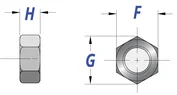
Find a nut that fits and look up id thread specs
1782546287325.webp
 

Attachments

  • finished-hex-nut-drawing.webp
    finished-hex-nut-drawing.webp
    12.6 KB · Views: 2
Last edited:
  • #26
There are few metric or imperial shaft sizes, so there are few bearing inside diameters. The outside diameters depend on bearing construction, so are more variable. The housing is machined to fit the bearing OD.

For example, without vernier callipers, it is hard to tell the difference between metric 45 mm shaft and a 1.75" shaft, or a 50 mm shaft and a 2" shaft.

0.75" is 19.05 mm, but 19 mm is not a metric standard, it would be 20mm.

Bearings have been standardised. If there is a bearing on the shaft, read the part number, then look that up in the data provided by any manufacturer. Just to make it interesting, some bearings have a metric shaft, but with an imperial OD.
 
  • Like
Likes   Reactions: Lnewqban and gmax137
  • #27
Harbor Freight has plastic composite digital calipers for $9.99. (They even have plastic manual-reading ones for $1.99!) Plenty accurate for your needs.
Calipers link
 
  • Like
Likes   Reactions: sophiecentaur and OmCheeto
  • #28
OmCheeto said:
...
Or maybe I'll call her in the morning.
Called her. She says she's never heard of 'gauge' rated fishing line.

AlexB23 said:
... Isn't fishing line of a certain specific gauge accurate?
A couple of googley inspired videos said; "No."
 
  • Like
Likes   Reactions: AlexB23
  • #29
Called her. She says she's never heard of 'gauge' rated fishing line

Fishing line stretches; i.e., diameter reduces/expands as square root of delta "L." See "shock lines" in fishing.
 
  • #30
As others note, such tools as calipers can be very cheap and easy to obtain. Without them I would try a simple woodworkers or builders 'square' on a flat surface, marking on the surface on either side inside the square then measuring that gap. An engineer's scribe (or sharpened nail) would mark more accurately than pen or pencil. (But I do have all those.)
1782604667814.webp
 
  • Like
Likes   Reactions: Astronuc and OmCheeto

Similar threads

Replies
17
Views
5K
  • · Replies 2 ·
Replies
2
Views
7K
  • · Replies 11 ·
Replies
11
Views
9K
  • · Replies 10 ·
Replies
10
Views
8K
  • · Replies 1 ·
Replies
1
Views
5K
  • · Replies 9 ·
Replies
9
Views
3K
  • · Replies 3 ·
Replies
3
Views
2K
Replies
20
Views
5K
  • · Replies 1 ·
Replies
1
Views
11K