How to calculate effective pump flow-rate across a filter?

Click For Summary
Calculating the effective flow-rate across a filter involves understanding the pump's nominal flow-rate under standard conditions and the impact of added resistance from the filter and connecting pipe. The inlet flow-rate will depend on the pump's suction strength and the resistance created by the filter and pipe. The filter's performance specifications, including pressure drop at various flow rates, are crucial for accurate calculations. Additionally, the system's design should consider the absence of restrictions at the outlet to ensure proper airflow. Understanding these factors will help in sizing the components effectively for the application.
Kaeros
Messages
2
Reaction score
0
My issue is related to the actual flow-rate I obtain when sampling air across a filtering membrane.
Each pump reports a nominal amount of air that it can draw in a certain amount of time (i.e.: flow-rate, like 10 liters per minute), but this is generally reported assuming normal temperature and pressure and with no "load" applied to the pump.

Let's assume now that I attach to the inlet of the pump 50 cm of a straight pipe with a known diameter (let's say 1 cm) and on top of that an open faced filter holder with a filter with given diameter (50 mm) and porosity (let's say 1 micron pore size).

Let's assume that we turn on the system at ground level in normal conditions (so that the air that the pump is sucking in through the filter is at 1 atm and 20 °C): what would be the actual flow-rate that I would measure with a flow-meter at the outlet of my pump? How can I compute that?
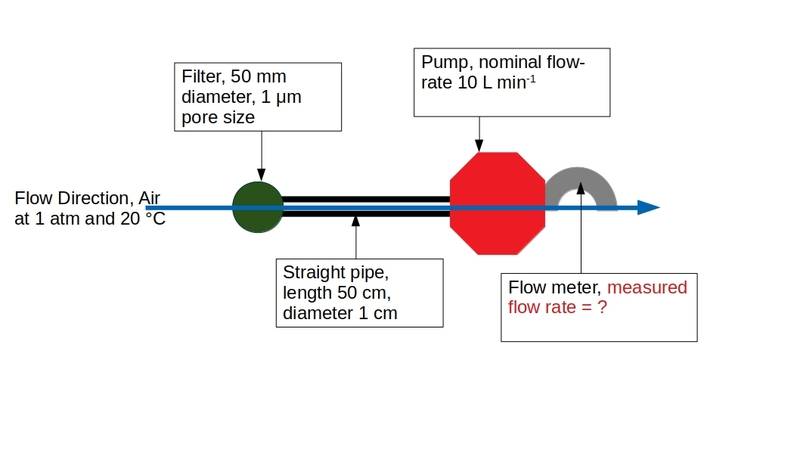
35kq61y.jpg
 

Attachments

  • 35kq61y.jpg
    35kq61y.jpg
    22.9 KB · Views: 1,556
Engineering news on Phys.org
Welcome to PF! And thanks for including the sketch - too often we don't get them. A few questions:

1. What is the inlet flow rate?
2. You call this a "pump", not a fan; is it pressurized at the outlet? To what pressure?
3. What is the outlet connected to? Are there restrictions there?
4. Is this a factory provided inlet filtration system?

Typically the inlet filter and pipe on an air compressor are sized by the factory to be large enough not to provide a "significant" flow restriction. But if they do not, or if you want to check, you can probably calculate it.

The filter should have an acutal performance specification you can get from the manufacturer: a specified pressure drop at a specified flow rate or range (curve). The pipe is short so there shouldn't be much static pressure drop along its length, but you can calculate drop through the assembly based on velocity pressure and orifice/fitting losses. Let's start with the clarifications first though because they will affect the methodology...
 
Dear Russ,

Thank you so much for your reply! I'll try to give the clarification you asked me, but please bear with me: I'm a biologist and these kind of physics/engineering problems and terms are not my bread.

1. Sorry, but I don't really understand this. At the pump inlet (i.e.: if you remove pipe and filter) you would have the nominal flow-rate of the pump since you are running it at standard conditions (20°C, 1 atm). At the system inlet (i.e.: before the filter)...that's part of the question: I do not know, it will depend on the combination between the pump "sucking" strength and the resistance given by the filter and the pipe. Does this at least partially reply to what you were asking?

2. I am actually trying to size the system in the sketch to build something that makes sense. To draw air through a filter I would generally use a vacuum pump (like a oilless diaphragm pump) that can reach some Pa/mbar of vacuum (still don't know how many, as I said, I'm still trying to size the system up, but for reference let's say something like this: https://www.makita.co.nz/products/model/DVP180).

3. No restrictions to the outlet. The outlet, in the actual application, might be connected to a flow meter (or some kind of mass-flow controller), but I can size this component on the basis of the pump, so let's assume no restrictions for the sake of simplicity (i.e.: the outlet just blows in standard atmosphere at 20°C, 1 atm).

4. Not exactly. Filters and filter holders are commercial (here's an example of the filters: https://www.merckmillipore.com/IT/it/product/MF-Millipore-Membrane-Filters,MM_NF-C152#specifications; and there are some filter holders: https://shop.pall.com/us/en/laborat...re-parts/open-face-filter-holders-zidgri78l6k), but the system itself, including the connection between the filter holders and the pump inlet, would be custom built. I am, in fact, trying to understand what are the constraints and the calculations I should make to understand exactly what to buy for this application.

From the filters manifacturer I can only get this information about the filters I am interested into: that if I apply a differential pressure of 0.7 bar (10 psi) to the filter, I will obtain a flow rate of 2 liters per minute per cm2 of filter.

Thank you again for your reply and I hope that the clarifications make any sense!

Regards!
russ_watters said:
Welcome to PF! And thanks for including the sketch - too often we don't get them. A few questions:

1. What is the inlet flow rate?
2. You call this a "pump", not a fan; is it pressurized at the outlet? To what pressure?
3. What is the outlet connected to? Are there restrictions there?
4. Is this a factory provided inlet filtration system?

Typically the inlet filter and pipe on an air compressor are sized by the factory to be large enough not to provide a "significant" flow restriction. But if they do not, or if you want to check, you can probably calculate it.

The filter should have an acutal performance specification you can get from the manufacturer: a specified pressure drop at a specified flow rate or range (curve). The pipe is short so there shouldn't be much static pressure drop along its length, but you can calculate drop through the assembly based on velocity pressure and orifice/fitting losses. Let's start with the clarifications first though because they will affect the methodology...
 
My idea is that I want to use immerse Whitetail Antlers in a fishtank to measure their volumetric displacement (the Boone and Crockett system is the current record measurement standard to place in a juxtaposition with) I would use some sight glass plumbed into the side of the tank to get the change in height so that I can multiply by the tank cross-section. Simple Idea. But... Is there a simple mechanical way to amplify the height in the sight glass to increase measurement precision...

Similar threads

  • · Replies 9 ·
Replies
9
Views
2K
Replies
1
Views
731
  • · Replies 9 ·
Replies
9
Views
2K
  • · Replies 6 ·
Replies
6
Views
3K
  • · Replies 14 ·
Replies
14
Views
2K
  • · Replies 15 ·
Replies
15
Views
3K
Replies
6
Views
4K
  • · Replies 8 ·
Replies
8
Views
2K
  • · Replies 3 ·
Replies
3
Views
2K
Replies
2
Views
7K