How to determine the tank volume and power requirement?

Click For Summary
SUMMARY

The discussion focuses on calculating the tank volume and power requirement for a 69 m³ tank that is filled and emptied every 60 seconds, resulting in a flow rate of 1.15 m³/s. The total volume exchanged in one day is approximately 100 million liters, which can be derived by multiplying the flow rate by the number of seconds in a day (86400 s). To determine the tank volume, one must understand hydraulic detention time (HDT), which is crucial for wastewater treatment processes. Additionally, the power requirement for pumps depends on the pressure loss within the tank, which was not provided in the discussion.

PREREQUISITES
  • Understanding of hydraulic detention time (HDT) and hydraulic retention time (HRT)
  • Basic knowledge of flow rate calculations
  • Familiarity with unit conversions between liters and cubic meters
  • Knowledge of pump power requirements and pressure loss calculations
NEXT STEPS
  • Research hydraulic detention time (HDT) and its significance in wastewater treatment
  • Learn about flow rate calculations and their applications in fluid dynamics
  • Study unit conversions, specifically between liters and cubic meters
  • Explore pump power requirements and how to calculate pressure loss in fluid systems
USEFUL FOR

Engineers, environmental scientists, and anyone involved in fluid dynamics or wastewater treatment processes will benefit from this discussion.

t0mm02
Messages
49
Reaction score
0
Homework Statement
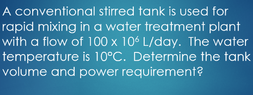
A conventional stirred tank is used for rapid mixing in a water treatment plant with a flow of 100 x 106 L/day. The water temperature is 10°C. Determine the tank volume and power requirement?
Relevant Equations
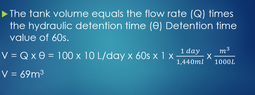
V = Q (flow rate) x θ (times the hydraulic detention time)
Hello everyone. I have to determine the tank volume and power requirement of a tank. The teacher has done it the following way, however, I don't understand the process.
 

Attachments

  • Untitled.png
    Untitled.png
    51.3 KB · Views: 229
  • eee.png
    eee.png
    46.5 KB · Views: 222
Physics news on Phys.org
The 69 m3 tank is filled and emptied every 60 seconds. This gives you 1.15 m3/s. Now, if you multiply 1.15 m3/s by 86400 s (one day) you get 99360 m3, very close to 100x106 liters. As for the power, you haven't given any data.
 
Gordianus said:
The 69 m3 tank is filled and emptied every 60 seconds. This gives you 1.15 m3/s. Now, if you multiply 1.15 m3/s by 86400 s (one day) you get 99360 m3, very close to 100x106 liters. As for the power, you haven't given any data.
How do you calculate the Volume though? I don't understand what he did on that picture to work it out.
 
What is the volume of a tank that, filled and emptied every 60 seconds, amounts to 100x106 liters in a day?
 
Poster has been reminded to show more effort in their schoolwork posts
Gordianus said:
What is the volume of a tank that, filled and emptied every 60 seconds, amounts to 100x106 liters in a day?
I have no idea, that is what I am asking you
 
Let's say the tank has volume ##V## and that every ##T= 60## seconds it is filled and emptied. You repeat this cycle 1440 times (the number of minutes in one day) and the total exchanged volume is 100x106 liters. Can you figure out the volume of the tank?
 
t0mm02 said:
How do you calculate the Volume though? I don't understand what he did on that picture to work it out.
Do you understand the concept of hydraulic detention time?
Imagine a river flowing into a lake and then continuing on downstream that lake.
The HDT in that case would be the time that it would take for that upstream river flow to completely fill that empty lake.

Copied from
https://baywork.org/wp-content/uploads/2016/05/Warm-Up-Ticket-Napa-Great-Shake.pdf

"Hydraulic detention time (HDT) also known as hydraulic retention time (HRT) is a measure of the average length of time that a compound (in this case wastewater) remains in a treatment tank or unit. Simply stated if you started to fill a tank with wastewater the detention time is the average amount of a time that a drop of that water will remain in the treatment tank before the tank fills and that drop of water flows out of it. This is important because as wastewater passes through a treatment tank it must stay in the tank for the necessary period of time in order to be adequately treated."

What your teacher did was converting liters to cubic meters and days to seconds, then calculating how much volume of water would flow into a container during 60 seconds at that given rate of flow.

Now, regarding power, they will need to tell you the pressure loss inside that tank, if they are referring to pump power.

Please, see:
https://www.engineeringtoolbox.com/pumps-power-d_505.html

As they give you the temperature of the water, you can estimate its density.
 

Similar threads

  • · Replies 26 ·
Replies
26
Views
2K
  • · Replies 10 ·
Replies
10
Views
3K
Replies
50
Views
7K
Replies
4
Views
3K
  • · Replies 13 ·
Replies
13
Views
2K
  • · Replies 14 ·
Replies
14
Views
3K
Replies
9
Views
3K
Replies
3
Views
1K
  • · Replies 18 ·
Replies
18
Views
4K
  • · Replies 1 ·
Replies
1
Views
3K