How to Find the Angular Speed of a Spool Using Energy Conservation?

Click For Summary

Homework Help Overview

The discussion revolves around finding the angular speed of a spool using the principle of conservation of energy. The problem involves a 3.00 kg bucket falling a distance of 4.40 m, with a string wrapped around the spool that does not slip as it unwinds.

Discussion Character

  • Exploratory, Conceptual clarification, Assumption checking

Approaches and Questions Raised

  • Participants explore the conservation of energy equation, questioning how potential energy and kinetic energy relate in the context of the falling bucket and rotating spool. There is discussion about identifying the source of energy and the forms of potential and kinetic energy involved.

Discussion Status

Participants are actively engaging with the problem, raising questions about the energy sources and forms of energy involved. Some guidance has been offered regarding the conservation of energy approach, and there is an ongoing exploration of the concepts of potential and kinetic energy.

Contextual Notes

Participants mention the challenge of the problem in the context of a larger set of practice problems assigned by a teacher, indicating a potential time constraint or pressure related to preparation for a test.

riseofphoenix
Messages
294
Reaction score
2
Use conservation of energy to determine the angular speed of the spool shown in the figure below after the 3.00 kg bucket has fallen 4.40 m, starting from rest. The light string attached to the bucket is wrapped around the spool and does not slip as it unwinds.
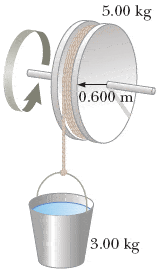
8-p-052.gif


I initially thought this would be a simple plug and chug problem but it turns out I was wrong...

This is where I kind of got stuck and so I kind of freestyled... -.-

initial = Iωfinal
(3)(0.6002)ω = (3)(4.402
1.8ω = 58.08ω

-.-
Help?
 
Physics news on Phys.org


Wait...aren't I supposed to do something like...

PEinitial + KEinitial = PEfinal + KEfinal


riseofphoenix said:
Wait...aren't I supposed to do something like...

PEinitial + KEinitial = PEfinal + KEfinal

Yup, that's the approach to take.

Start by identifying the source of energy for the system. How much energy is made available from that source? Where does it end up?


gneill said:
Yup, that's the approach to take.

Start by identifying the source of energy for the system. How much energy is made available from that source? Where does it end up?

The spool is the source of energy for the system?

It would be the Inertia equation no? Since it's rotating according to the image..

I = mr2


riseofphoenix said:
The spool is the source of energy for the system?

It would be the Inertia equation no? Since it's rotating according to the image..

I = mr2

A spool will spontaneously generate energy? I think you've solved the free energy problem! :smile:

No, the energy must come from some potential energy source. What's the source of potential energy that drives this system?


gneill said:
A spool will spontaneously generate energy? I think you've solved the free energy problem! :smile:

No, the energy must come from some potential energy source. What's the source of potential energy that drives this system?

The bucket?


riseofphoenix said:
The bucket?

What about the bucket will make energy available?


gneill said:
What about the bucket will make energy available?

The mass of the bucket and the water that's in it will pull the rope down which will make the spool turn.


riseofphoenix said:
The mass of the bucket and the water that's in it will pull the rope down which will make the spool turn.

Okay, so what form of potential energy is being exploited here? How much will be made available to the system, being converted to kinetic energy?
 
  • #10


gneill said:
Okay, so what form of potential energy is being exploited here? How much will be made available to the system, being converted to kinetic energy?

I have no idea :(
My teacher gave us 45 practice problems to do for the test and this one is only #14...

I tried doing...

mghfinal + (1/2)mv2final = mghfinal + (1/2)mv2final

(3)(9.8)(0) + (1/2)(3)(0)2 = (3)(-9.8)(4.40) + (1/2)(3)vf2

0 = -129.36 + 1.5v2
129.36/1.5 = v2
86.24 = v2
9.28 = v

"INCORRECT"
 
  • #11


There is one source of potential energy available here. Your "mgh" terms describe it. What form of potential energy is associated with "mgh"? What's the magnitude of the energy made available?

There are two forms of kinetic energy associated with the system when its in motion, what are they?
 
  • #12


gneill said:
There is one source of potential energy available here. Your "mgh" terms describe it. What form of potential energy is associated with "mgh"? What's the magnitude of the energy made available?

There are two forms of kinetic energy associated with the system when its in motion, what are they?

translational?
 
  • #13


riseofphoenix said:
translational?

That's one, but be more specific. What's the other?
 

Similar threads

  • · Replies 17 ·
Replies
17
Views
1K
Replies
7
Views
3K
  • · Replies 5 ·
Replies
5
Views
9K
Replies
5
Views
1K
Replies
13
Views
2K
  • · Replies 1 ·
Replies
1
Views
8K
Replies
5
Views
2K
  • · Replies 42 ·
2
Replies
42
Views
5K
  • · Replies 3 ·
Replies
3
Views
7K
  • · Replies 1 ·
Replies
1
Views
2K