How to Solve a Non-Homogeneous Equation and Draw Its Characteristic Curves?

  • Context: MHB 
  • Thread starter Thread starter evinda
  • Start date Start date
Click For Summary

Discussion Overview

The discussion revolves around solving the non-homogeneous equation $u_t + uu_x = 0$ with the initial condition $u(x,0) = x$ and drawing its characteristic curves. Participants explore the relationship between the solution and the characteristic curves, addressing the dependency of the solution on both variables, $x$ and $t$.

Discussion Character

  • Exploratory
  • Technical explanation
  • Mathematical reasoning

Main Points Raised

  • One participant proposes that the characteristic curves are given by the solutions of the ODE $\frac{dx}{dt} = u(x,t)$.
  • Another participant questions the assumption that $u(x,t)$ should only depend on $x$ and seeks clarification on this point.
  • There is a discussion about whether the solution $u(x,t)$ can be expressed solely in terms of $x$ and $t$, with some participants affirming that it is indeed a function of both variables.
  • Participants discuss the relationship $\frac{x(t)}{t+1} = c$ and its implications for drawing characteristic curves, with one suggesting it can be rewritten as $x(t) = ct + c$.
  • There is a confirmation that the functions $x(t)$ found are referred to as characteristic lines.
  • Participants express a desire to draw the characteristic lines and confirm the correctness of their understanding of the graphing process.

Areas of Agreement / Disagreement

Participants generally agree on the nature of the solution and the concept of characteristic lines, but there is some uncertainty regarding the dependency of the solution on the variables and how to graph the characteristic curves.

Contextual Notes

There are unresolved questions about the assumptions regarding the dependency of $u(x,t)$ and the specific method for graphing the characteristic curves.

evinda
Gold Member
MHB
Messages
3,741
Reaction score
0
Hello! (Wave)

I want to solve the non-homogeneous equation $u_t+uu_x=0$ with the initial condition $u(x,0)=x$. Also I want to draw some of the characteristic curves.

I have tried the following so far:

The characteristic curves for $u_t+uu_x=0$ are the curves that are given by the solutions of the ode $\frac{dx}{dt}=u(x,t)$.

We have that $\frac{d}{dt}[u(x(t),t)]=u_t+uu_x=0$ and so $u(x(t),t)=c$.

We consider the line that passes through the points $(x_0,0)$ and $(x,t)$.
The slope of the line is

$\frac{x-x_0}{t-0}=\frac{dx}{dt}=u(x,t)=u(x_0,0)=x_0$, thus $x-x_0=tx_0 \Rightarrow x_0=\frac{x}{t+1}$.

Then we would get that $u(x,t)=\frac{x}{t+1}$. But this cannot be right, since $u$ should be only a function of $x$.

So have I done something wrong? (Thinking)
 
Physics news on Phys.org
Hey evinda! (Smile)

Isn't $u(x,t)$ supposed to be a function of both x and t?
What's the reason that it would only depend on x? (Wondering)
 
I like Serena said:
Hey evinda! (Smile)

Isn't $u(x,t)$ supposed to be a function of both x and t?
What's the reason that it would only depend on x? (Wondering)

I thought so, since $u(x(t),t)=c$. So is the solution that I found right? (Thinking)
 
evinda said:
I thought so, since $u(x(t),t)=c$. So is the solution that I found right? (Thinking)

Yes, your solution is correct.
And a level curve of the solution depends on both x and y. (Nod)
 
I like Serena said:
Yes, your solution is correct.
And a level curve of the solution depends on both x and y. (Nod)

Ok... But do we have to take into consideration that $\frac{x(t)}{t+1}=c$ when drawing the characteristic curves ? If so, how? (Thinking)
 
evinda said:
Ok... But do we have to take into consideration that $\frac{x(t)}{t+1}=c$ when drawing the characteristic curves ? If so, how? (Thinking)

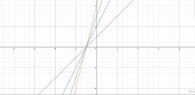
We can rewrite it as $x(t)=ct+c$, can't we?
That is a straight line for each value of c that we pick. (Thinking)
 
I like Serena said:
We can rewrite it as $x(t)=ct+c$, can't we?
That is a straight line for each value of c that we pick. (Thinking)

The functions $x(t)$ that we find are called characteristic lines, right? (Thinking)

Now, I saw that I am supposed to draw some of the characteristic lines. (Nerd)

View attachment 8162

So the above is a desired graph, isn't it? (Thinking)
 

Attachments

  • graph5.JPG
    graph5.JPG
    85.4 KB · Views: 114
evinda said:
The functions $x(t)$ that we find are called characteristic lines, right? (Thinking)

Now, I saw that I am supposed to draw some of the characteristic lines. (Nerd)

So the above is a desired graph, isn't it? (Thinking)

Yep. All good. (Nod)
 
I like Serena said:
Yep. All good. (Nod)

Nice, thank you! (Smirk)
 

Similar threads

  • · Replies 6 ·
Replies
6
Views
2K
  • · Replies 2 ·
Replies
2
Views
3K
Replies
2
Views
2K
  • · Replies 14 ·
Replies
14
Views
2K
  • · Replies 7 ·
Replies
7
Views
3K
  • · Replies 2 ·
Replies
2
Views
2K
  • · Replies 5 ·
Replies
5
Views
2K
  • · Replies 1 ·
Replies
1
Views
2K
  • · Replies 8 ·
Replies
8
Views
2K
  • · Replies 7 ·
Replies
7
Views
2K