I face some difficulties to find the domain

Click For Summary
SUMMARY

The discussion focuses on determining the domains of various mathematical functions, specifically problems 46, 47, and 51. For problem 46, the domain is established as x ≥ 0 for the function f(x) = √x, while for problem 47, the domain is not all real numbers due to the function's undefined points. The analysis of problem 51 involves solving the inequality y² - 2y - 3 ≥ 0, which requires factoring and understanding the conditions for the product of factors to be non-negative.

PREREQUISITES
  • Understanding of mathematical functions and their domains
  • Knowledge of inequalities and how to solve them
  • Familiarity with square root functions and their restrictions
  • Ability to factor quadratic expressions
NEXT STEPS
  • Study the properties of square root functions and their domains
  • Learn how to solve inequalities involving quadratic expressions
  • Explore the concept of undefined points in rational functions
  • Practice factoring polynomials and analyzing their roots
USEFUL FOR

Students studying algebra, educators teaching mathematical functions, and anyone looking to improve their understanding of domains in mathematics.
r-soy
Messages
170
Reaction score
1
I face some difficulties to find the domain

Now i put my questions and please help me to answer it

i try solve it

questions.JPG


answer 1.JPG


answer 2.JPG


thanks
 
Physics news on Phys.org
It can sometimes take several hours for attachments to be approved, so for quicker responses, it's best to type your questions out so that we can see them right away.
 
I think attachments are approved now >> :smile:
 
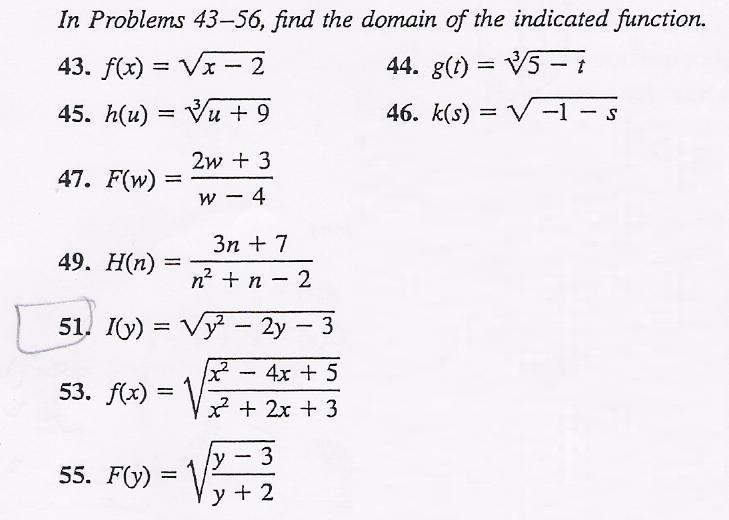
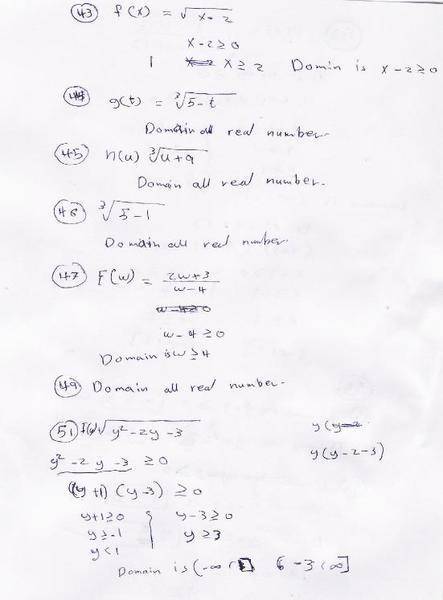
The domain of problem 46 is not all real numbers. For √x, domain is x≥0. Use that for √(-1-s).

The domain of 47 is larger than just w≥4; perhaps you were still thinking about domains with square roots. Try thinking about the domain of 1/x, or where it is undefined, and then think about the domain of (2x+3)/(w-4) again.

I can't quite make out your answer for the domain of 51, but it doesn't look right. But let's look at what you have with (y + 1)(y - 3)≥0. You know where the parabola crosses the x-axis and that it opens upward since the leading coefficient is positive. What part(s) of the graph will be above the x-axis, or ≥0?
 
Last edited:
As Bohrok said, if the domain was all real numbers for √(-1-s), it would be incorrect. Say s is equal to 2. -1-2 = -3. √-3 is an imaginary number. You want to make sure whatever is under the square root bracket is equal to 0 or more.
 
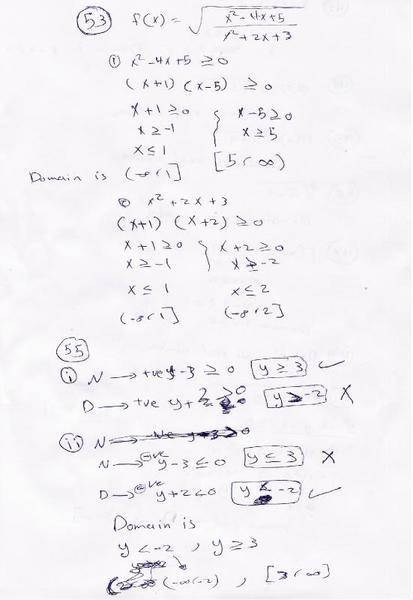
53. x^2-4x+5 and x^2+2x+3 can't be factor the way you did.
 
bohrok said:
The domain of problem 46 is not all real numbers. For √x, domain is x>0. Use that for √(-1-s).
The domain for f(x) = √x is x >= 0.
 
Mark44 said:
The domain for f(x) = √x is x >= 0.

I hit the wrong two-key combination instead of Ctrl-V. :redface: Corrected.
 
46 )
1-s ≥ 0
-s ≥ - 1

47) i think domain all real numer

51 ) please i want the answer


help me .>
 
  • #10
r-soy said:
46 )
1-s ≥ 0
-s ≥ - 1
No. Start with -1 -s ≥ 0
You should end up with an inequality that involves s, not -s. Review the rules for working with inequalities if needed.
r-soy said:
47) i think domain all real numer
No. There is one real number that isn't in the domain of this function.
r-soy said:
51 ) please i want the answer
For this function to be defined, it must be that y2 -2y - 3 ≥ 0.
Factor the left hand side into two linear factors. For the product of the two factors to be ≥ 0, both factors have to be ≥ 0, or both have to be <= 0. Each case will produce its own set of numbers.
r-soy said:
help me .>
 

Similar threads

  • · Replies 10 ·
Replies
10
Views
2K
  • · Replies 11 ·
Replies
11
Views
3K
  • · Replies 23 ·
Replies
23
Views
2K
  • · Replies 15 ·
Replies
15
Views
2K
  • · Replies 7 ·
Replies
7
Views
2K
  • · Replies 14 ·
Replies
14
Views
4K
  • · Replies 7 ·
Replies
7
Views
2K
Replies
6
Views
2K
  • · Replies 9 ·
Replies
9
Views
2K
  • · Replies 0 ·
Replies
0
Views
877