a lone fishy
- 20
- 1
Hi everyone,
1. Homework Statement

1) centripetal acceleration = v^2 / R
2) centripetal acceleration = 4 pi^2 R / T^2
3) average velocity = displacement / time[/B]
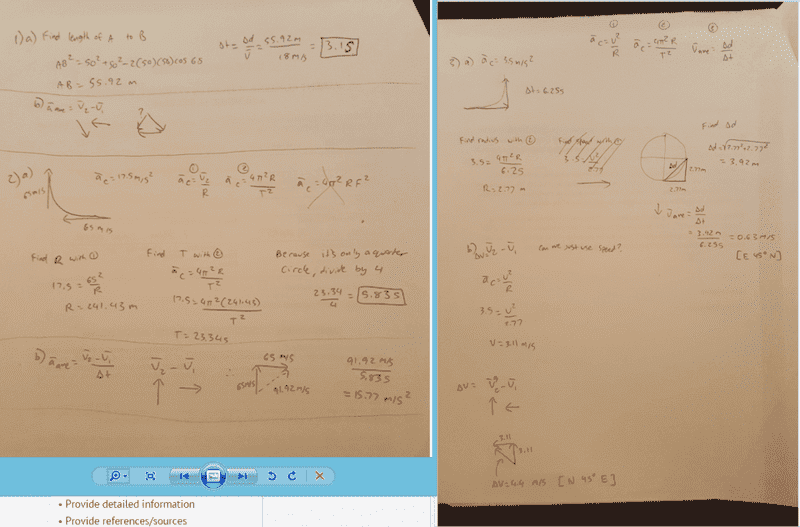
For #1a I first found the displacement of A to B. And then divided that by the speed to get time. However I feel like I am doing it wrong. Perhaps we need to find the centripetal acceleration first using equation 1 and then use equation 2 to find time. But then that would give the time of going around the entire circle. A bit torn on what do for 1a
For #1b I'm not sure where to put the angle. We just need to find the change in velocity and then divide it by the time we found in 1a. I just can't seem to pin point which angle I need to use and where I have to put it.
[/B]
For #2a I used equation 1 to find the radius. And then used equation 2 to find the time. Since we're only dealing with a quarter of a circle, I divided the time by 4. I believe I did #2a correctly
For #2b I found the the change of velocity and then divided it by the time we found in 2a. I don't think I found the change of velocity correctly
For #3a I first found the radius with equation 2. And then I found the displacement with pythagorean theory. Now that we have displacement, I divided it by the given time to get the average velocity
For #3bI got a little confused. To find the change in velocity, we need to do v2 - v1 however we don't know any velocities so I just went with speed which I believe is incorrect. I used equation 1 to find speed and then found the change in velocity using speed.
I attached my solution attemps below. Thank You !
1. Homework Statement
Homework Equations
1) centripetal acceleration = v^2 / R
2) centripetal acceleration = 4 pi^2 R / T^2
3) average velocity = displacement / time[/B]
The Attempt at a Solution
For #1a I first found the displacement of A to B. And then divided that by the speed to get time. However I feel like I am doing it wrong. Perhaps we need to find the centripetal acceleration first using equation 1 and then use equation 2 to find time. But then that would give the time of going around the entire circle. A bit torn on what do for 1a
For #1b I'm not sure where to put the angle. We just need to find the change in velocity and then divide it by the time we found in 1a. I just can't seem to pin point which angle I need to use and where I have to put it.
[/B]
For #2a I used equation 1 to find the radius. And then used equation 2 to find the time. Since we're only dealing with a quarter of a circle, I divided the time by 4. I believe I did #2a correctly
For #2b I found the the change of velocity and then divided it by the time we found in 2a. I don't think I found the change of velocity correctly
For #3a I first found the radius with equation 2. And then I found the displacement with pythagorean theory. Now that we have displacement, I divided it by the given time to get the average velocity
For #3bI got a little confused. To find the change in velocity, we need to do v2 - v1 however we don't know any velocities so I just went with speed which I believe is incorrect. I used equation 1 to find speed and then found the change in velocity using speed.
I attached my solution attemps below. Thank You !
 !
!