Is bioelectricity considered more physics or biology?

4 replies · 15K views · last reply
BeablossomR_
Messages
1
Reaction score
3
Homework Statement
You can model a neuron membrane as an electrical system where ion movement creates current, and the membrane stores charge similar to a capacitor. Analyze whether understanding neuron signaling is better approached through physics-based models or biological mechanisms.
Relevant Equations
Ohm’s Law: V = IR
Current: I = dQ/dt
Capacitance: Q = CV
RC time constant: τ = RC
Hi everyone,

I’ve been trying to understand bioelectricity, especially how neurons transmit signals, and I’m not sure whether it’s better approached from a physics or biology perspective.

From a physics point of view, I’ve seen it compared to basic electrical systems, while biologically it involves ion channels and membrane behavior. I’m trying to connect the two without getting too lost in either side.

For those who have studied this before, do you think it’s more helpful to think of it in terms of physics concepts, biology concepts, or a mix of both?

Also, how do you usually bridge that gap when learning it?
 
BeablossomR_ said:
For those who have studied this before, do you think it’s more helpful to think of it in terms of physics concepts, biology concepts, or a mix of both?
I would say both. The physics aspects show how things work in detail, but an awareness of the biology shows why the physics is applied where it is in their biological manifestations and how it fulfills biological needs. Once the large scale (biological) process is identified, you can build explanatory mechanisms up from the physics to explain particular biological phenomena.

I have always liked the approach of superimposing a schematic cell with the equivalent electrical elements you mentioned. This can also show how different regions of large cells can propagate signals like action potentials.
Things are often shown like this:
Equivalent circuit model of a cell membrane: parallel branches for Na+, Cl- and K+ each with a conductance G, a battery E and a current arrow i, plus a capacitor Cm and a current source.

but this is only a small patch of the cell's membrane.
A large number of these little patches would have to be put together to model larger parts of a neuron. Here is a simple example:
Equivalent circuit diagram of a section of axon membrane: a ladder of resistors and parallel R_m and C_m elements between Outside and Inside rails, labelled R_o and R_j, drawn over a cylindrical membrane.

More complex situations involve branch points, changes in diameter, and changes in the molecular circuit components from place to place. This is even further complexified by considering the many possible synaptic connections with other cells.

Bioelectricity is a term that also includes some other aspects of biological functioning.
The main thing with the functioning of neurons involve the membrane potential (the charge across the cell membrane) and how it can change (by altering the membrane potential in different cellular regions like the cell body, axons or dendrites). These are local changes in little regions of the cell that can cause physiological changes (like release of synaptic vesicles). The membrane potential changes can be transmitted to neighboring regions by various methods (like a propagating change of an axon potential). This only involves negligible current flow to different parts of the cell. In addition, electrochemistry (a physiological term for trans-membrane electrical properties like action potentials) is also important in how kidneys work to remove wastes from the blood, but retain electrolytes and water.

An alternative way bioelectricity is used is where actual current flow (probably ion flows) go in and out of different regions. Different methods are used to study these phenomena and they are connected to different biological events. Current flow out of amputated limbs are often observed. Some connect them with success or failure of limb regeneration. Whole body current flow has also be linked with body plan establishment in planarians. Sensitive probes have also been able to detect current flows coming out of cut axons.
 
Attachments
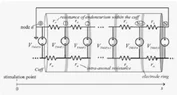
  • Circuit schematic of a nerve cuff model: a row of repeated RC-style segments with resistors labelled r_a, voltage sources labelled V_TMAP, nodes numbered 0 to N, a cuff outline, electrode ring, and stimulation point marked at 0 along axis s.
    Screenshot 2026-06-09 at 1.48.47 PM.webp
    16.8 KB · Views: 23
  • Like
  • Informative
Likes   Reactions: Astronuc, 256bits, Ibix and 1 other person
Mentor Update: Unfortunately the newbie OP has turned out to be a spammer using AI to create this spam setup thread. Fortunately, the reply by @BillTre is excellent, and this thread will remain open provisionally without the OP.
 
  • Like
  • Wow
Likes   Reactions: Astronuc, symbolipoint, pinball1970 and 4 others
When I first saw bioelectricity, I immediately thought of electric eels, which is a different form of 'electricity' from neurons.

How do eels produce electricity?​

“Electric eels are like living batteries,” explains Dr Rupert Collins, our Senior Curator of Fishes. “They have stacks of modified muscle cells called electrocytes that have both a positive and a negative side. When the cells are triggered, it discharges an electrical impulse into the surrounding water.”
Electric eels have three special organs that help them create electricity. These are known as the main organ, the Hunter’s organ and the Sach’s organ. These organs take up about 80% of the eel’s body and allow them to produce electric impulses of different strengths, which perform different functions.

The main organ and part of the Hunter’s organ produce strong electric shocks that can ward off predators or stun prey. The Sach’s organ and the other half of the Hunter’s organ produce weak electric impulses. Electric eels use these to navigate, seek out prey and signal one another for courtship during the breeding season.

Electrophorus varii can produce the most powerful electrical shocks. They can generate up to 860 volts of electricity – nearly four times the voltage of a standard UK plug socket.
https://www.nhm.ac.uk/discover/how-do-electric-eels-work.html
https://en.wikipedia.org/wiki/Electric_eel#Electrophysiology
Electric eel anatomy: first detail shows stacks of electrocytes forming electric organs. Second detail shows an individual cell with ion channels and pumps through the cell membrane; A nerve cell's terminal buttons are releasing neurotransmitters to trigger electrical activity. Final detail shows coiled protein chains of an ion channel.
It is a rather fascinating group of creatures.

See also - https://www.acschemmatters-digital....?articleId=1428640&app=false#articleId1428640


In the broader sense, biology is a subset of chemistry, which is a subset of physics (behavior of the physical world is physics). However, we have treated physics, chemistry and biology as separate subjects/disciplines, but biology is basically chemistry applied to 'living' systems.

We have subjects such as physical chemistry and chemical physics, and there is a Journal of Physical Chemistry Chemical Physics
https://pubs.rsc.org/cp
https://en.wikipedia.org/wiki/Physical_Chemistry_Chemical_Physics