Is Global Warming or Ivory Trade Uncovering More Mammoth Secrets?

  • Thread starter Thread starter Andre
  • Start date Start date
  • Tags Tags
    Discovery
Click For Summary

Discussion Overview

The discussion revolves around the implications of global warming and ivory trade on the discovery and analysis of mammoth remains, particularly focusing on a recently found baby woolly mammoth. Participants explore the potential for scientific insights from these discoveries while also addressing the ethical concerns surrounding ivory collection.

Discussion Character

  • Exploratory
  • Debate/contested
  • Conceptual clarification

Main Points Raised

  • Some participants suggest that global warming is revealing more ice age secrets through the discovery of well-preserved mammoth remains, while others argue that the increase in finds is comparable to historical rates from the 1940s.
  • There is concern about the impact of ivory trade on paleontological sites, with some participants noting that while ivory collectors may damage finding locations, they also contribute to significant discoveries.
  • One participant raises a question about the age of the baby mammoth, speculating on its potential for revealing mysteries, while another expresses curiosity about the circumstances of its death.
  • Discussion includes a claim about the preservation of soft tissue in mammoth and dinosaur bones, suggesting implications for DNA extraction and potential future scientific endeavors.

Areas of Agreement / Disagreement

Participants express mixed feelings about the role of global warming and ivory trade in mammoth discoveries, indicating that multiple competing views remain. There is no consensus on the ethical implications of ivory collection or the primary factors driving the discoveries.

Contextual Notes

Some statements rely on assumptions about the relationship between global warming and mammoth finds, and there are unresolved questions regarding the specific impacts of ivory trade on paleontological research.

Who May Find This Useful

Readers interested in paleontology, climate change effects on archaeology, ethical considerations in natural resource exploitation, and the intersection of science and commerce may find this discussion relevant.

Andre
Messages
4,296
Reaction score
73
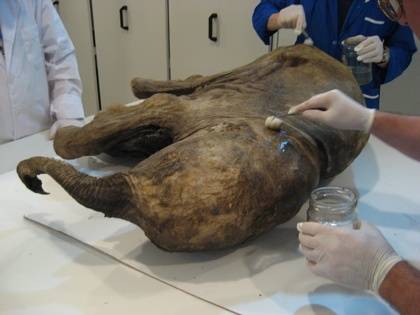
About the most recent http://www.farnorthscience.com/2007/07/25/news-from-alaska/baby-mammoth-undergoes-tests/, the little baby:
mammoth1.jpg


it is said:

Global warming may expose even more secrets of the ice age. The well-preserved remains of a four-month-old baby wooly mammoth recovered from melting permafrost in Siberia last spring will now undergo sophisiticated testing and analysis at University of Michigan for testing.

However, if you go there, the first thing that comes into mind is not 'global warming' that has increased the recent mammoth finds as http://www.nature.com/nature/links/041021/041021-8.html are roughly comparable to the 1940s, it's simply business. Ivory.

A few years ago http://www.american.edu/ted/elephant.htm[/URL] swarmed the areas and they are are collecting tons of tusks, with very mixed feelings of the paleontologists, since they ruin the finding places but they also do spectacular discoveries like this, in places in which previously nobody was interested in. There is a lot more to be expected.

http://www.sciencemag.org/cgi/content/short/290/5499/2062 tells me that this particular mammoth baby is about 30,000 years old. Waiting for the scientific publication.
 
Last edited by a moderator:
Biology news on Phys.org
Andre said:
About the most recent spectacular mammoth find, the little baby:
Cute little calf, oh but what mysteries will she reveal?

That's very sad about the ivory profiteers of Siberia. So for them, it's somewhat like a cash cow , a means to put food on their table. They don't feel any shame or guilt in plundering the remains of animals from antiquity.
 
Very interesting, Andre! How soon do the baby males begin to develop tusks?
 
According to Michio Kaku of String Theory fame, mammoth and dinosaur bones contain soft tissue suitable for DNA extraction. Incredibly the DNA is much better preserved in bones that it is in hair and the like. So be weary if you hear about a rash of breakins into dinosaur museums. Jurassic park here we come!
 
Its so tiny, I wonder how it died.
 

Similar threads

Replies
5
Views
5K