Is there an analytic solution to this system of equations?

Click For Summary
SUMMARY

This discussion centers on the symbolic and numerical solutions to a system of equations involving variables a and m. The equations are derived from a specific mathematical model, with numerical approximations yielding a ≈ 0.092409 and m ≈ 22.2674. The participants conclude that while an analytical solution is not feasible, numerical methods such as those implemented in WolframAlpha can provide approximations. The discussion emphasizes the importance of recognizing when a problem lacks an analytic solution and the necessity of numerical techniques for resolution.

PREREQUISITES
  • Understanding of non-linear equations
  • Familiarity with numerical approximation methods
  • Knowledge of logarithmic functions and their properties
  • Basic proficiency in using computational tools like WolframAlpha
NEXT STEPS
  • Study numerical methods for solving non-linear equations
  • Learn about the properties of logarithmic functions in mathematical modeling
  • Explore advanced techniques in numerical analysis, such as Newton-Raphson method
  • Investigate the use of computational tools for symbolic and numerical solutions
USEFUL FOR

Mathematicians, engineers, and students interested in solving complex systems of equations, particularly those who are exploring numerical methods and computational tools for analytical challenges.

END
Messages
36
Reaction score
4
I have the following system of equations with variables ##a,m##, and I'm wondering—can this system be solved symbolically/analytically?

\begin{align}
m &= 100 + \frac{ \left( 200 \frac{\ln{\frac{1}{2}}}{26.8} \right) }{\left(\dfrac{\ln{\frac{1}{2}}}{26.8} + a \right)}
\\ \\
50 &= me^{-a\left( 19.9 \right)}- \frac{ \left( 200 \frac{\ln{\frac{1}{2}}}{26.8} \right) \exp{ \left(\dfrac{\ln{\frac{1}{2}}}{26.8} \cdot 19.9 \right) }}{\left(\dfrac{\ln{\frac{1}{2}}}{26.8} + a \right)}
\end{align}

(What are some ways to recognize that a problem does or does not have an analytic solution?)

For this specific example, I understand the answers can be numerically approximated to

\begin{align}
a &\approx 0.092409
\\
m &\approx 22.2674
\end{align}

Via such numerical methods as a graph:
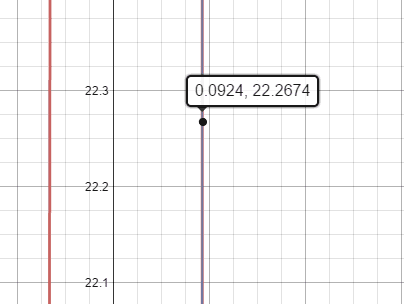
L9sjZ.png


or other computational device such as WolframAlpha [(link to this problem). For this specific problem, WolframAlpha only provided a numerical approximation.

Note: The variables in the WolframAlpha link are ## a, n ## respectively
 
Physics news on Phys.org
If you replace the factor ln(0.5)/26.8 with K and use x and y for a and m you get for the first equation:

y = 100 + 200K/(x+K)

and for the second you get:

50/e^19.9 = y - 200Ke^K/(x+K)

which rearranges to:

y = 50/e^19.9 + 200e^K/(x+K)

From here you can set the equations equal to each other and solve for x noting that x=/= -K
 
Last edited:
I don't see an analytical solution. For a numerical solution, consider the following:

With
\begin{align*}
m &= 100 + 200 \cdot \frac{\beta}{\beta+a} \\
50 &= m \cdot e^{-19.9a} - 200 \cdot \frac{\beta}{\beta+a} \cdot e^{19.9 \cdot \beta}
\end{align*}
Where \beta = \ln(1/2) / 26.8 \approx -0.02586.

Multiply the second equation by \exp{(19.9 \cdot a)}
\begin{equation*}
50 \cdot e^{19.9 \cdot a} = m - 200 \cdot \frac{\beta}{\beta + a} \cdot e^{19.9 \cdot \beta} \cdot e^{19.9 \cdot a}
\end{equation*}

Let w= \beta + a and substitute first equation into second to yield
\begin{equation*}
c \cdot e^{19.9 \cdot w} = \left[100 + 200 \cdot \frac{\beta}{w}\right] - 200 \cdot \frac{\beta}{w} \cdot e^{19.9 \cdot w}
\end{equation*}
where c = 50 \cdot e^{-19.9 \cdot \beta} \approx 83.6558.

This is a non-linear scalar equation in one parameter w. A numerical solution will be necessary. Before we go down that path, re-scale and introduce a non-parametric variable for w. Let \alpha = a / \beta, \zeta = w / \beta = 1 + \alpha and re-formulate into F(\zeta) = 0.

\begin{equation*}
F(\zeta) = 0 = 100 \cdot \left[ \left(\gamma + \frac{2}{\zeta}\right) \cdot e^{\lambda \cdot \zeta} - \left(1 + \frac{2}{\zeta}\right) \right]
\end{equation*}
where \gamma = c / 100 and \lambda = 19.9 \cdot \beta \approx -.51469.

This could be solved numerically, but we don't know the magnitude or an applicable domain bracket that contains a (ie, \zeta). If we look at the above equation for F, we see it is equivalent to
\begin{equation*}
F(\zeta) = 100 \cdot \left[
\left(1 + \frac{2}{\zeta}\right) \cdot \left(e^{\lambda \cdot \zeta} -1\right) - \mu \cdot e^{\lambda \cdot \zeta}\right]
\end{equation*}
where \mu = 1 - \gamma \approx .167.

If we ignored the last term, we would underestimate F (since \mu > 0 and the exponential is positive). But if we did, we would see that two conditions could result in F= 0:

First: \exp{(\lambda \cdot \zeta)} - 1 = 0. This would imply \zeta = 0 or a = -\beta \approx 0.02586. The scaled error term in F, which is the last term in the expression above, is E = -\mu \cdot e^{\lambda \cdot \zeta} = -\mu = -0.167. However, this is probably not a good idea since we have the 1/\zeta term which contradicts this solution.

Second: 1 + 2 / \zeta = 0. This would imply \zeta = -2 or a = -3 \cdot \beta \approx 0.07759. The scaled error term in F is now E = -\mu \cdot e^{-2 \cdot \lambda} \approx -0.456. That's probably a safer bet. However, since we underestimate F, we should probably bump up this value somewhat (ie, decrease \zeta somewhat away from -2).

Selecting \zeta = -3 yields a scaled value (1/100) \cdot F(-3) \approx 0.4301. We have now bracketed the root. A suggested initial value for an iteration routine would be \zeta^{(0)} \approx -2.5 (ie, a^{(0)} = 0.09052).
 
  • Like
Likes   Reactions: jedishrfu
TheoMcCloskey said:
I don't see an analytical solution. For a numerical solution, consider the following:

Thank you for the in-depth explanation to a numerical approach, TheoMcCloskey! The technique you outlined is just beyond my current mathematical level of understanding, but it's educating to see a technique like that in action, and it's definitely brought up some points to research.

Does your approach have a specific name? I can't wait to study these concepts in the future.
 

Similar threads

  • · Replies 1 ·
Replies
1
Views
10K
  • · Replies 7 ·
Replies
7
Views
2K
  • · Replies 1 ·
Replies
1
Views
2K
  • · Replies 6 ·
Replies
6
Views
2K
  • · Replies 2 ·
Replies
2
Views
1K
Replies
6
Views
2K
  • · Replies 4 ·
Replies
4
Views
11K
  • · Replies 3 ·
Replies
3
Views
2K
  • · Replies 9 ·
Replies
9
Views
5K
  • · Replies 1 ·
Replies
1
Views
10K