High School Is this a complex number at the second quadrant?

Click For Summary
SUMMARY

The discussion centers on the evaluation of the expression ##\pi+\arctan{(2)}## and its classification as a complex number in the second quadrant. Participants clarify that ##\pi+\arctan{(2)}## is a real number, approximately equal to 4.25, and does not fall within the range of the principal argument, which is restricted to ##-\pi < \theta \leq \pi##. The correct argument for the complex number ##w = -2 + i## is determined to be ##\arg(-2 + i) = \pi - \arctan \frac{1}{2}##, confirming that the initial assumption about the quadrant was incorrect.

PREREQUISITES
  • Understanding of complex numbers and their representation in the Argand plane.
  • Familiarity with the concept of principal argument and its restrictions.
  • Knowledge of the arctangent function and its properties.
  • Ability to convert between polar and rectangular coordinates.
NEXT STEPS
  • Study the properties of complex numbers in the Argand plane.
  • Learn about the principal value of the argument and its implications in complex analysis.
  • Explore the arctangent function and its role in determining angles in different quadrants.
  • Practice converting complex numbers between polar and rectangular forms using tools like GeoGebra.
USEFUL FOR

Mathematics students, educators, and anyone interested in deepening their understanding of complex numbers and their applications in various mathematical contexts.

mcastillo356
Gold Member
Messages
655
Reaction score
359
TL;DR
I am quite sure, but I don't manage with Geogebra. It involves the value of the ##\arg(w)## in the interval ##-\pi<\theta\leq{\pi}##, called the principal argument of ##w## and denote it ##\mbox{Arg(w)}##
Hi, PF, so long, I have a naive question: is ##\pi+\arctan{(2)}## a complex number at the second quadrant? To define a single-valued function, the principal argument of ##w## (denoted ##\mbox{Arg (w)}## is unique. This is because it is sometimes convenient to restric ##\theta=\arg{(w)}## to an interval of length ##2\pi##, say the interval ##0\leq{\theta}<2\pi##, or ##-\pi<\theta\leq{\pi}##. This last one is which I am concerned with.
PS: I post without preview :frown:
Regards!
 
Mathematics news on Phys.org
mcastillo356 said:
Hi, PF, so long, I have a naive question: is ##\pi+\arctan{(2)}## a complex number at the second quadrant?
No, it is a real number about equal to 4.25.
 
  • Informative
Likes mcastillo356
Hi, PF

If ##a<0## and ##b>0##, are we at the second quadrant, therefore ##\arg{(a+bi)}=\pi+\arctan{(b/a)}##?.
If so, ##\pi+\arctan{(2)}## should fall at the second one. I'm quite sure of it. But then, which is the complex number that has ##\pi+\arctan{(2)}## as the principal value of the argument?

My attempt: ##w=-2+i##. But here comes the problem: ##\displaystyle\frac{1}{-2}\neq{2}##, so the statement ##\arg{(a+bi)}=\pi+\arctan{(b/a)}## must be false. The question is that is a true statement. The solution is, in my personal opinion, that the moduli ##|-2+i|=\sqrt{5}##, and the ##\mbox{Arg}## ought to be, ##\pi+\arctan{-2}##.

Regards!
 
mcastillo356 said:
If ##a<0## and ##b>0##, are we at the second quadrant, therefore ##\arg{(a+bi)}=\pi+\arctan{(b/a)}##?
Yes.

mcastillo356 said:
If so, ##\pi+\arctan{(2)}## should fall at the second one. I'm quite sure of it.
No. If ##a<0## and ##b>0## then ## \frac b a \ne 2 ##.

mcastillo356 said:
But then, which is the complex number that has ##\pi+\arctan{(2)}## as the principal value of the argument?
As already discussed ##\pi+\arctan{(2)} \approx 4.25##. Is this between ## -\pi \text{ and } \pi ##?

mcastillo356 said:
My attempt: ##w=-2+i##. But here comes the problem: ##\displaystyle\frac{1}{-2}\neq{2}##, so the statement ##\arg{(a+bi)}=\pi+\arctan{(b/a)}## must be false. The question is that is a true statement. The solution is, in my personal opinion, that the moduli ##|-2+i|=\sqrt{5}##, and the ##\mbox{Arg}## ought to be, ##\pi+\arctan{-2}##.
I don't really understand any of that, but ## \arg(-2 + i) = \pi - \arctan \frac 1 2 ##.
 
  • Like
Likes mcastillo356
pbuk said:
No. If ##a<0## and ##b>0## then ## \frac b a \ne 2 ##.
Oops!
pbuk said:
As already discussed ##\pi+\arctan{(2)} \approx 4.25##. Is this between ## -\pi \text{ and } \pi ##?
Not at all
pbuk said:
I don't really understand any of that, but ## \arg(-2 + i) = \pi - \arctan \frac 1 2 ##.
Need to revisit my background in complex numbers. Thanks for your attention, hope we will keep in touch. Regards!
 
pbuk said:
I don't really understand any of that, but ## \arg(-2 + i) = \pi - \arctan \frac 1 2 ##.
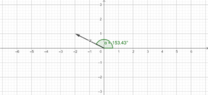
Understood. Let's see if my drawing agrees with your quote. ##\pi-\arctan\frac 1 2 ##, could be ##\mbox{Arg}## of ##w=(-2+i)##, ##\pi## counterclockwise, and ##\arctan \frac 1 2## clockwise?
geogebra-export (4).png
I don`t manage with ##\pi+\arctan(-2)##. I've tried with a Casio fx-82MS, pretending to switch polar to rectangular coordinates: I won't bore the forums with my effort; I just declare that my attempt is ##\pi+\arctan(-2)=-0.1\mbox{radians}##.
I post with no preview
Regards!
PS: Edited. Reason: Mistake when describing the Geogebra file.
 
Last edited:
pbuk said:
I don't really understand any of that,
Neither me; how many days have I taken? :smile:
pbuk said:
but ## \arg(-2 + i) = \pi - \arctan \frac 1 2 ##.
Thank you very much!
Greetings.
 
Hi, PF, write to say how misled was I when saying that the ##\mbox{Arg}## corresponding to ##w=(-2 +i)## was ##\pi + \arctan(-2)=-60.29\;\mbox{degrees}##. Actually placing ##w## at the fourth quadrant :oldlaugh:
 

Similar threads

  • · Replies 13 ·
Replies
13
Views
6K
  • · Replies 12 ·
Replies
12
Views
3K
  • · Replies 1 ·
Replies
1
Views
2K
  • · Replies 2 ·
Replies
2
Views
5K
  • · Replies 1 ·
Replies
1
Views
6K
  • · Replies 5 ·
Replies
5
Views
4K
  • · Replies 23 ·
Replies
23
Views
4K
Replies
8
Views
3K
  • · Replies 1 ·
Replies
1
Views
5K
Replies
3
Views
5K