Is This Integral Divergent as t Approaches Infinity?

  • Context: MHB 
  • Thread starter Thread starter ozgunozgur
  • Start date Start date
  • Tags Tags
    Calculus
Click For Summary

Discussion Overview

The discussion revolves around the convergence of integrals as the variable approaches infinity, specifically focusing on various integrals and their evaluations. Participants explore different methods for solving these integrals, including the use of substitution and integration by parts, while addressing potential divergence issues.

Discussion Character

  • Exploratory
  • Technical explanation
  • Mathematical reasoning
  • Debate/contested

Main Points Raised

  • Some participants suggest graphing functions to better understand the integrals involved.
  • There are multiple approaches to calculating the volume of solids of revolution using the washer method, with varying levels of detail in the calculations.
  • Concerns are raised about the convergence of specific integrals, with some participants referencing external tools like Wolfram Alpha (W|A) to support their claims.
  • Participants discuss the evaluation of improper integrals, particularly focusing on limits and the behavior of functions as they approach infinity.
  • There are questions about the correctness of written solutions, with requests for clearer presentations of steps and reasoning.
  • Some participants express uncertainty about the validity of their solutions and seek confirmation from others.

Areas of Agreement / Disagreement

There is no consensus on the convergence of the integrals discussed. Some participants assert that certain integrals do not converge, while others question the correctness of these claims and seek further clarification.

Contextual Notes

Participants express difficulty in following some of the written work, indicating potential issues with clarity and presentation. There are also unresolved mathematical steps and assumptions regarding the limits and behavior of the integrals as they approach infinity.

Who May Find This Useful

This discussion may be useful for students and practitioners interested in integral calculus, particularly those exploring convergence issues and methods for evaluating improper integrals.

ozgunozgur
Messages
27
Reaction score
0
I have 48 hours and i am bad, i am sorry but i want to understand how it is
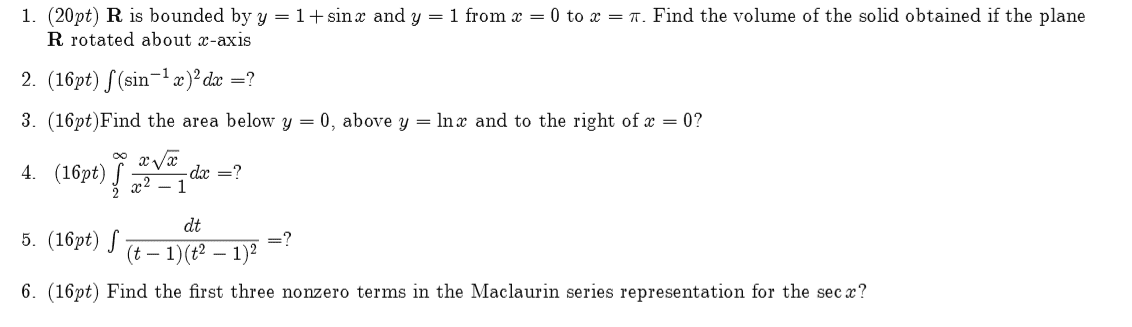
midexam.png
 
Last edited by a moderator:
Physics news on Phys.org
Hello, and welcome to MHB! :)

In the future please make a thread for each problem so the resulting discussion doesn't become convoluted.

1.) I would begin by graphing \(\bf R\):

[DESMOS]{"version":7,"graph":{"viewport":{"xmin":-1.8085517789155598,"ymin":-1.5211465278179266,"xmax":7.28542398140094,"ymax":3.317103784924743}},"randomSeed":"83cba124e944e215fecf206fe002fd2a","expressions":{"list":[{"type":"expression","id":"1","color":"#c74440","latex":"f=1+\\sin\\left(x\\right)\\left\\{0\\le x\\le\\pi\\right\\}","hidden":true},{"type":"expression","id":"2","color":"#388c46","latex":"1\\le y\\le f"}]}}[/DESMOS]

I would use the washer method here for the volume of an arbitrary element:

$$dV=\pi(R^2-r^2)\,dx$$

Can you identify the outer radius \(R\) and the inner radius \(r\) of the arbitrary washer above?
 
Physics news on Phys.org
Mark, this does look like a test. I'd wait for the 48h before replying.
 
Thanks, now I have a solution. So iis that true?

https://ibb.co/g7nRs7D

https://i.ibb.co/b3fKp3r/20200602-022640.jpg
 
Last edited by a moderator:
Continuing where I left off, we have:

$$dV=\pi((1+\sin(x))^2-(1)^2)\,dx=\pi(\sin^2(x)+2\sin(x))\dx$$

Using a double-angle identiy for cosine: we may state:

$$\cos(2x)=1-2\sin^2(x)\implies \sin^2(x)=\frac{1-\cos(2x)}{2}$$

And so we may write:

$$dV=\frac{\pi}{2}(4\sin(x)-\cos(2x)+1)\,dx$$

Hence, adding up all the washers, we find:

$$V=\frac{\pi}{2}\int_0^{\pi} 4\sin(x)-\cos(2x)+1\,dx$$

Let's let:

$$u=x-\frac{\pi}{2}\implies du=dx$$

$$V=\frac{\pi}{2}\int_{-\frac{\pi}{2}}^{\frac{\pi}{2}} 4\cos(u)+\cos(2x)+1\,dx$$

Using the even-function rule, we have:

$$V=\pi\int_{0}^{\frac{\pi}{2}} 4\cos(u)+\cos(2x)+1\,dx=\pi\left[4\sin(u)+\frac{1}{2}\sin(2u)+u\right]_{0}^{\frac{\pi}{2}}=\pi\left(4+\frac{\pi}{2}\right)=\frac{\pi}{2}(8+\pi)$$

It looks like you were on the right track, but you neglected to distribute \(\pi\) to your additional integral.

For the second problem, it looks like you are using integration by parts, but your work is hard to read. I'll let someone else jump into help with that. :)
 
Thanks, This is question 5, can you write me?
 
Is this solution true?
 
Regarding question 3, ln(1) = 0, so you need to find −∫10ln(x)dx−∫01ln⁡(x)dx.
An indefinite integral is xln(x)−xxln⁡(x)−x. Can you finish the question now?

According to W|A, the integral in question 4 doesn't converge. Did you type it correctly?
 
In questipn 3, integral x(lnx-1) 1(0-1) - 0(ln0-1) = -1
In question 4, the integral does not converge.
One side is endless when it is solved as a normal integral.

Please help to solve step by step :/
 
ca385868a75a4265a2a2816595471743.png


Hello again, is this true?
 
  • #10
3. I would observe that the area in question may be found from:

$$A=\int_{-\infty}^0 e^x\,dx$$

This is an improper integral, and so I would write:

$$A=\lim_{t\to-\infty}\left(\int_t^0 e^x\,dx\right)=\lim_{t\to-\infty}\left(e^0-e^t\right)=1\quad\checkmark$$
 
  • #11
MarkFL said:
3. I would observe that the area in question may be found from:

$$A=\int_{-\infty}^0 e^x\,dx$$

This is an improper integral, and so I would write:

$$A=\lim_{t\to-\infty}\left(\int_t^0 e^x\,dx\right)=\lim_{t\to-\infty}\left(e^0-e^t\right)=1\quad\checkmark$$
Can you help me for question 4? This is my last question, is that true?
 
  • #12
According to W|A the definite integral given in #4 does not converge.

$$I=\int_2^{\infty}\frac{x\sqrt{x}}{x^2-1}\,dx$$

Using your substitution:

$$u=\sqrt{x}\implies du=\frac{1}{2\sqrt{x}}\,dx\implies dx=2u\,du$$

We then have:

$$I=2\int_{\sqrt{2}}^{\infty}\frac{u^4}{u^4-1}\,du=2\int_{\sqrt{2}}^{\infty}1+\frac{1}{u^4-1}\,du$$

And then using partial fractions, we may write:

$$I=\frac{1}{2}\int_{\sqrt{2}}^{\infty} 4+\frac{1}{u-1}-\frac{1}{u+1}-\frac{2}{u^2+1}\,du$$

Do you agree so far?
 
  • #13
MarkFL said:
According to W|A the definite integral given in #4 does not converge.

$$I=\int_2^{\infty}\frac{x\sqrt{x}}{x^2-1}\,dx$$

Using your substitution:

$$u=\sqrt{x}\implies du=\frac{1}{2\sqrt{x}}\,dx\implies dx=2u\,du$$

We then have:

$$I=2\int_{\sqrt{2}}^{\infty}\frac{u^4}{u^4-1}\,du=2\int_{\sqrt{2}}^{\infty}1+\frac{1}{u^4-1}\,du$$

And then using partial fractions, we may write:

$$I=\frac{1}{2}\int_{\sqrt{2}}^{\infty} 4+\frac{1}{u-1}-\frac{1}{u+1}-\frac{2}{u^2+1}\,du$$

Do you agree so far?
Yes, please write all of steps, sir.
 
  • #14
I'm having trouble following your written work. Can you neatly show how you would proceed?
 
  • #15
MarkFL said:
I'm having trouble following your written work. Can you neatly show how you would proceed?
I did not solve that question, I just put it on paper. I thought I was writing legibly. :/
 
  • #16
My next step would be to write the improper integral as:

$$I=\frac{1}{2}\lim_{t\to\infty}\left(\int_{\sqrt{2}}^{t} 4+\frac{1}{u-1}-\frac{1}{u+1}-\frac{2}{u^2+1}\,du\right)$$

Can you give the anti-derivative we would use in our application of the FTOC on the definite integral in the limit?
 
  • #17
MarkFL said:
My next step would be to write the improper integral as:

$$I=\frac{1}{2}\lim_{t\to\infty}\left(\int_{\sqrt{2}}^{t} 4+\frac{1}{u-1}-\frac{1}{u+1}-\frac{2}{u^2+1}\,du\right)$$

Can you give the anti-derivative we would use in our application of the FTOC on the definite integral in the limit?

Is 4u + ln|u+1| - ln|u-1| + 2arctan(u) result?
if t --&gt is infinity;
= 4t - 4kok(2) + ln|(t+1)/(kok(2)+1)| - ln|(t-1)/(kok(2)+1)| + 2arctan(t) - 2arctan(kok(2))

is t a divergent integral since it approximates to infinity?
 
  • #18
ozgunozgur said:
Is 4u + ln|u+1| - ln|u-1| + 2arctan(u) result?
if t --&gt is infinity;
= 4t - 4kok(2) + ln|(t+1)/(kok(2)+1)| - ln|(t-1)/(kok(2)+1)| + 2arctan(t) - 2arctan(kok(2))

is t a divergent integral since it approximates to infinity?

No, be careful with your signs...
 

Similar threads

  • · Replies 5 ·
Replies
5
Views
2K
  • · Replies 3 ·
Replies
3
Views
2K
  • · Replies 1 ·
Replies
1
Views
2K
  • · Replies 11 ·
Replies
11
Views
6K
  • · Replies 3 ·
Replies
3
Views
2K
  • · Replies 12 ·
Replies
12
Views
3K
Replies
4
Views
2K
  • · Replies 4 ·
Replies
4
Views
2K
  • · Replies 20 ·
Replies
20
Views
3K
  • · Replies 5 ·
Replies
5
Views
2K