Is this plane correctly drawn?

  • Context: High School 
  • Thread starter Thread starter momentum
  • Start date Start date
  • Tags Tags
    Plane
Click For Summary

Discussion Overview

The discussion revolves around the correct representation of the plane (2,0,0) in a 3D coordinate system, particularly in the context of crystallography. Participants explore the nature of this plane, its properties, and how to visualize it accurately.

Discussion Character

  • Exploratory
  • Technical explanation
  • Conceptual clarification
  • Debate/contested

Main Points Raised

  • Some participants suggest that (2,0,0) represents a point rather than a single plane, leading to confusion about its representation.
  • Others argue that (2,0,0) corresponds to an infinite set of parallel planes, prompting questions about how these planes are defined and visualized.
  • A participant inquires about the specific nature of the plane, asking if it is parallel to the yz-plane and requesting more context for the drawing.
  • There is a discussion about the mathematical representation of planes in crystallography, with references to unit cells and periodicity.
  • Some participants express confusion regarding the notation and the meaning of the division in the context of crystallography.
  • Clarifications are made regarding the relationship between the planes and the unit cell, with some participants attempting to derive the crossings of the axes for specific planes.

Areas of Agreement / Disagreement

Participants generally agree that (2,0,0) is not a single plane but rather a set of planes. However, there is disagreement and confusion about the specifics of how these planes are defined and visualized, as well as the mathematical notation used in crystallography.

Contextual Notes

The discussion highlights limitations in the initial problem specification, as participants seek additional information to clarify the nature of the plane and its representation. There are also unresolved questions regarding the mathematical derivation of the plane crossings and the implications of periodicity in crystallography.

momentum
Messages
111
Reaction score
0
Hi,
I was trying to draw a plan 2,0,0 in X,Y,Z co-ordinate system

Is it correctly drawn ?
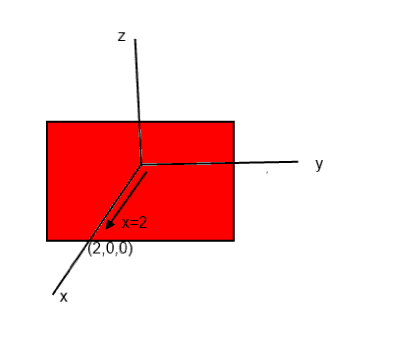
2017-05-07_1229.png


I think ...I'm wrong in drawing this plane

I think I'm wrong because each point in this plane has non zero y & z value...they are not having y=0& z=0 everywhere all the time although x=2 everywhere on this plane...so my drawing to plane (2,0,0) is wrong.

Could you please correct my analysis ?
If I'm wrong then what is correct way to draw the plane (2,0,0) ?
 
Mathematics news on Phys.org
momentum said:
Hi,
I was trying to draw a plan 2,0,0 in X,Y,Z co-ordinate system

Is it correctly drawn ?

View attachment 199625

I think ...I'm wrong in drawing this plane

I think I'm wrong because each point in this plane has non zero y & z value...they are not having y=0& z=0 everywhere all the time although x=2 everywhere on this plane...so my drawing to plane (2,0,0) is wrong.

Could you please correct my analysis ?
If I'm wrong then what is correct way to draw the plane (2,0,0) ?

(2,0,0) is a point on 3D space.You draw x=2 plane
 
Hi, you must specify better your plane because there are infinity planes by a point ##(2,0,0)##. Do you want the plane passed by ##(2,0,0)## and parallel to the plane ##yz##?
Ssnow
 
I agree we're missing some information here. Can you give us some more information? The problem specification in full, or some context around why you're trying to do this?
 
I'm trying to draw a crystal structure plane (200)

I'm not sure ..how to draw that
 
I did wonder if that was it.

(2,0,0) is not a single plane; rather it's an infinite set of parallel planes. The planes ##(n_x,n_y,n_z)## are the set of planes whose ith member crosses the x-axis at ##i/n_x##, working in units where the unit cell's edges are of length 1. Similarly for y and z.

Does that help?
 
Last edited:
Ssnow said:
there are infinity planes by a point (2,0,0).
what do you mean by this ? can you show me how they look like ?
I just want to visualize it.
 
Ibix said:
I did wonder if that was it.

(2,0,0) is not a single plane; rather it's an infinite set of parallel planes. The planes ##(n_x,n_y,n_z)## are the set of planes whose ith member crosses the x-axis at ##i/n_x##, working in units where the unit cell's edges are of length 1. Similarly for y and z.

Does that help?

very much confusing...would it be possible to post an example with related to this ?
 
momentum said:
very much confusing...would it be possible to post an example with related to this ?
Pick an ##i##, say ##i=1##. What are ##n_x##, ##n_y## and ##n_z## in your case? Therefore, where does the ##i##th plane cross each of the axes? What does "at infinity" mean in practice?

Edit: I'm presuming you know what a unit cell is?
 
  • #10
Ibix said:
Pick an ##i##, say ##i=1##. What are ##n_x##, ##n_y## and ##n_z## in your case? Therefore, where does the ##i##th plane cross each of the axes? What does "at infinity" mean in practice?
okay..let me try that

i=1 i.e 1st plane
Ibix said:
What are nxnxn_x, nynyn_y and nznzn_z in your case

its 2,0,0

Ibix said:
Therefore, where does the iiith plane cross each of the axes?

1/2 , 1/0 , 1/0
=>
.5 , infinite , infinite

so I conclude its one plane which passes through at x=.5 and crosses y & z at infinite i.e parallel to YZ

But you said
Ibix said:
(2,0,0) is not a single plane; rather it's an infinite set of parallel planes.

I'm getting confused more.
 
  • #11
Yes - you've worked out one of the planes correctly. Now repeat for all ##i=\ldots, -2, -1, 0 , 1, 2,\ldots## and you have the complete set of planes. Of course, since this is crystallography and everything repeats periodically you'd only be interested in the ##i## that gives a plane that passes through the unit cell. Outside that you are just repeating yourself.

Do remember that unit cells may not have all sides the same length.
 
  • #12
okay ...that looks fine.

one more question :

Ibix said:
The planes (nx,ny,nz)(nx,ny,nz)(n_x,n_y,n_z) are the set of planes whose ith member crosses the x-axis at i/nxi/nxi/n_x, working in units where the unit cell's edges are of length 1.

Is it a theorem ..if so what it is called ?
It would be interesting to know how it is derived where the plane crosses the axis.
 
  • #13
one more question ..

Ibix said:
Yes - you've worked out one of the planes correctly. Now repeat for all ##i=\ldots, -2, -1, 0 , 1, 2,\ldots## and you have the complete set of planes.

all this happening in a specific unit cell ? i.e are we considering in this example i=...-2, -1, 0 , 1, 2... for a given unit cell ? is it correct ?
 
  • #14
In your example there are only two planes in the unit cell, corresponding to ##i=0,1##. The ##i=2## plane is in the same place in the next unit cell along as the ##i=0## plane is in this one. I don't think there's any kind of theorem here. It's just a shorthand notation for a set of planes that uses the natural periodicity of a crystal to save on the writing. Usually the interest is that the crystal can be cut along planes (cleavage planes) and you can just say "this crystal cleaves along the (1,1,1) plane", or whatever.
 
  • #15
okay...thats nice...I understand .

But ...
Ibix said:
I don't think there's any kind of theorem here

I don't understand how do you arrive at this part
Ibix said:
whose ith member crosses the x-axis at i/nxi/nxi/n_x
that division ...thats not clear.
 
  • #16
It's just what crystallographers mean by the (2,0,0) plane. They mean the set of planes parallel to the y-z plane spaced by half the llength of the x side of the unit cell. It's just a convenient notation for a concept that is useful in crystallography. It isn't something you can derive from anywhere - it's just something you need to learn.
 

Similar threads

  • · Replies 13 ·
Replies
13
Views
3K
  • · Replies 10 ·
Replies
10
Views
3K
  • · Replies 8 ·
Replies
8
Views
3K
  • · Replies 8 ·
Replies
8
Views
2K
  • · Replies 2 ·
Replies
2
Views
2K
Replies
9
Views
1K
Replies
15
Views
2K
  • · Replies 12 ·
Replies
12
Views
3K
  • · Replies 8 ·
Replies
8
Views
3K
  • · Replies 1 ·
Replies
1
Views
2K