calvinrose
- 7
- 4
- TL;DR
- Application of acoustical resistance: You don't need to attach foam or tape to your drum heads to kill or lessen the overtones.
Hi All, I considered filing a patent for this invention, but instead decided to publish it so people could use it to advance the state-of-the-art in drums.
You don't need to add tape or pillows to your drum heads to muffle the overtones. Using tape or pillows also kills the strike of the stick or pedal and kills the fundamental tone of the drum head.
All you need to do is attach some OPEN CELL FOAM (not closed cell!) on the inside of your drum rims about 1/8" away from the drum head (no need for the foam to touch the drum head!). The thicker the open cell foam, the more the overtones will be muted. 1" thick open cell foam should work pretty well, but experiment with it.
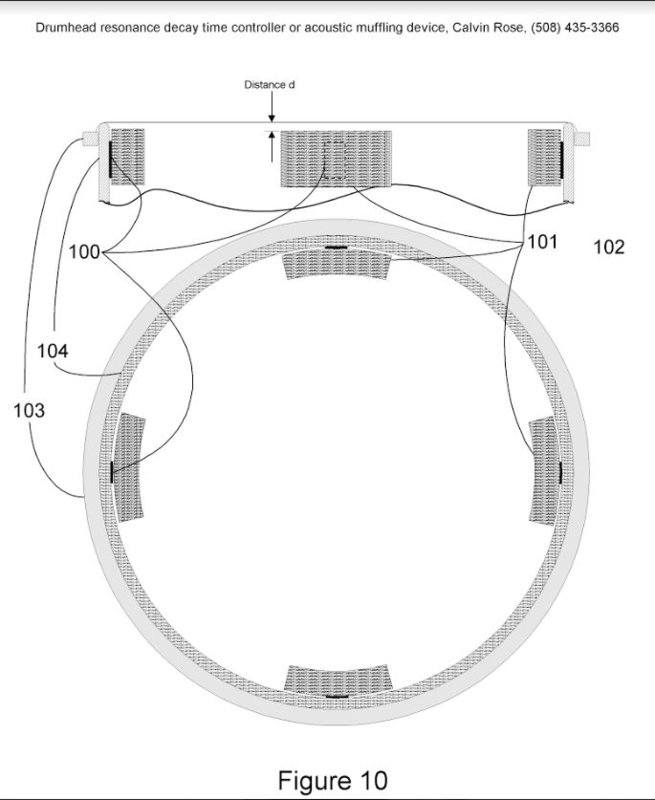
I've attached a picture from the patent application I didn't file so you can see how this might be applied. The distance "d" in the picture should be about 1/8" to be effective. You can make the open cell foam go all the way around the rim if you like instead of just in 4 places as shown in the picture.
Two of the benefits of this method (beside the fact that it's cool ) is 1) It allows the impact of the drum stick or bass pedal mallet to not be attenuated in any way; and 2) It kills the overtones without dampening the fundamental tone of the drum head.
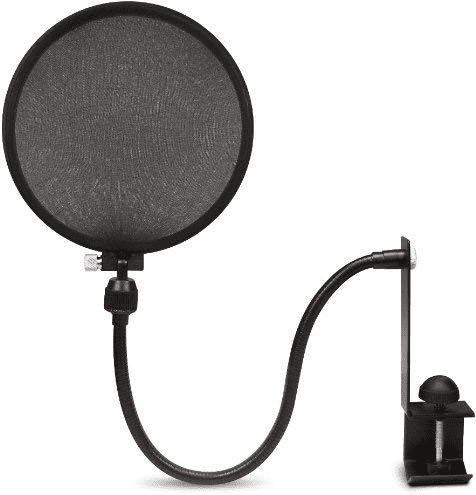
If you want to convince yourself this works without taking your drums apart, just take a microphone Pop Filter like the one shown in the image below and place it about 1/8" to 1/4" above an un-muted drum head.
You don't need to add tape or pillows to your drum heads to muffle the overtones. Using tape or pillows also kills the strike of the stick or pedal and kills the fundamental tone of the drum head.
All you need to do is attach some OPEN CELL FOAM (not closed cell!) on the inside of your drum rims about 1/8" away from the drum head (no need for the foam to touch the drum head!). The thicker the open cell foam, the more the overtones will be muted. 1" thick open cell foam should work pretty well, but experiment with it.
I've attached a picture from the patent application I didn't file so you can see how this might be applied. The distance "d" in the picture should be about 1/8" to be effective. You can make the open cell foam go all the way around the rim if you like instead of just in 4 places as shown in the picture.
Two of the benefits of this method (beside the fact that it's cool
) is 1) It allows the impact of the drum stick or bass pedal mallet to not be attenuated in any way; and 2) It kills the overtones without dampening the fundamental tone of the drum head.If you want to convince yourself this works without taking your drums apart, just take a microphone Pop Filter like the one shown in the image below and place it about 1/8" to 1/4" above an un-muted drum head.