Landau's Derivation of Lorentz Transformations: Questions Answered

Click For Summary
SUMMARY

Landau's derivation of the Lorentz transformations emphasizes the invariance of the interval in spacetime, defined by the equation ##s^2=c^2(t_2-t_1)^2-(x_2-x_1)^2##. The discussion clarifies that a parallel displacement of a coordinate system refers to arbitrary translations that do not affect the interval. It is established that the origins of two coordinate systems can coincide through translation, but this does not imply that they remain coincident over time. The conversation also highlights the significance of gauge freedom in general relativity and the implications of spacetime transformations.

PREREQUISITES
  • Understanding of Lorentz transformations and spacetime intervals
  • Familiarity with Minkowski space and its properties
  • Knowledge of gauge freedom in general relativity
  • Basic concepts of Poincaré transformations
NEXT STEPS
  • Study the derivation and implications of Lorentz transformations in special relativity
  • Explore the properties and applications of Minkowski space
  • Investigate gauge freedom and its role in general relativity
  • Learn about Poincaré transformations and their significance in physics
USEFUL FOR

Students and professionals in physics, particularly those focused on relativity, theoretical physics, and mathematical physics, will benefit from this discussion.

Luke Tan
Messages
29
Reaction score
2
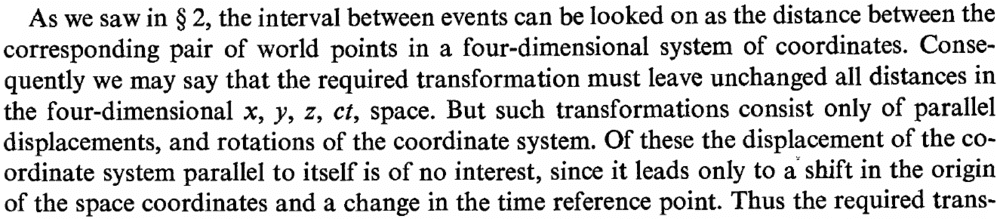
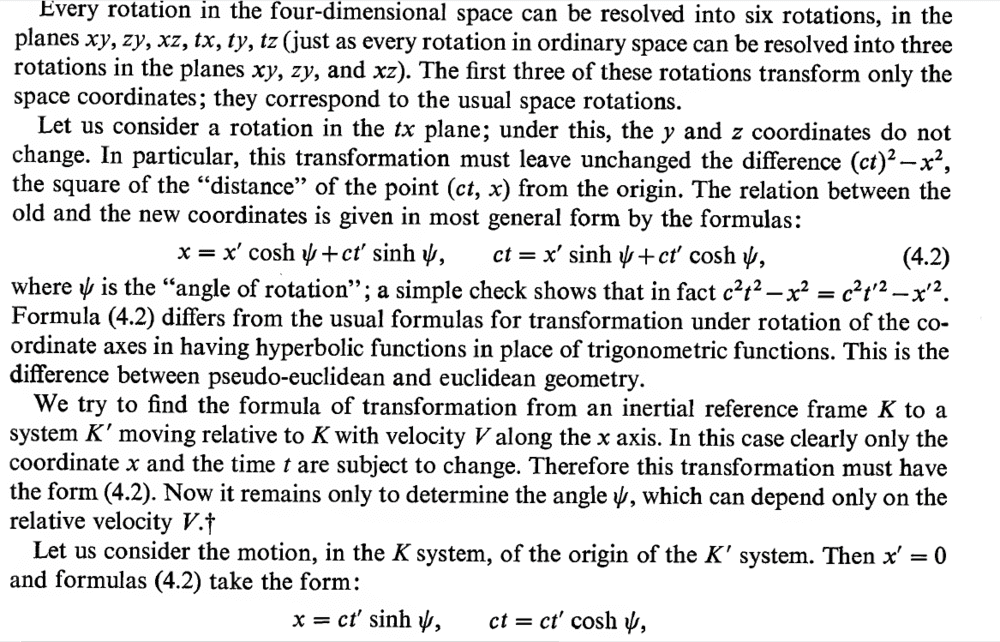
In his book, Landau derives the Lorentz transformations using the invariance of the interval, and I have some questions about it that I would like to clarify
Screenshot_639.png

1. What is a parallel displacement of a coordinate system?

Does it refer to moving along any axis?

I don't see how any arbitrary translation of the origin will change the interval between any two events
Screenshot_640.png

2. Does this assume that the origins of the two coordinate systems coincide?

The interval between two events is ##s^2=c^2(t_2-t_1)^2-(x_2-x_1)^2##

For this to reduce to ##s = c^2t^2-x^2## this requires that ##x_1## is zero. However, considering that ##x_1## and ##t_1## are the coordinates of the origin, this would imply that in his equations he has assumed that the origin of both systems coincide.

While I understand that this is correct at some instant, would this not become inaccurate as time passes and the origin of one coordinate system moves away?

Any help would be appreciated
Thanks!
 
Physics news on Phys.org
Luke Tan said:
1. What is a parallel displacement of a coordinate system?
It appears to be any translation - so excludes a translation and scaling (since ticks on some axes wouldn't move in parallel lines).
Luke Tan said:
2. Does this assume that the origins of the two coordinate systems coincide?
I think so, yes. But we may freely translate our coordinate systems so that this is true.
Luke Tan said:
While I understand that this is correct at some instant, would this not become inaccurate as time passes and the origin of one coordinate system moves away?
This is the origin of a coordinate system in spacetime - it's a specified place and time. It doesn't move, any more than "in my back garden at 11am last Tuesday" moves.
 
Last edited:
  • Like
Likes   Reactions: WWGD
Luke Tan said:
1. What is a parallel displacement of a coordinate system?

Does it refer to moving along any axis?

I don't see how any arbitrary translation of the origin will change the interval between any two events

It refers to just adding arbitrary constants to each coordinate so, in effect, a translation. His point is exactly that it is trivial that such translations leave the interval invariant so he will not discuss that explicitly.
Luke Tan said:
While I understand that this is correct at some instant, would this not become inaccurate as time passes and the origin of one coordinate system moves away?
To underscore @Ibix point, the coinciding origin refers to the spacetime origin, not the spatial origin (which is a frame dependent world line).
 
  • Like
Likes   Reactions: Ibix
Well, the space-time translations may be "trivial" in the sense of the transformation, but as a symmetry it implies the conservation laws for energy and momentum, which is not quite that unimportant, I'd say ;-))).
 
vanhees71 said:
Well, the space-time translations may be "trivial" in the sense of the transformation, but as a symmetry it implies the conservation laws for energy and momentum, which is not quite that unimportant, I'd say ;-))).
Of course not, trivial does not mean unimportant or uninteresting.
 
In general relativity, the spacetime coordinates xa are not tied to a metric interpretation, i.e. they are dimensionless. Because of this, their meaning is tied to the solutions represented on them. Without the metric tensor gabdxadxb, these coordinates have no meaning. The location of an event is not determined simply by a choice of coordinates, but also a choice of gauge. In special relativity, the coordinates are defined by the properties of a particular solution called Minkowski space, so they are given in meters and seconds.

Consider a sheet of paper on which a map is drawn. The map can be deformed and moved on the page. The points of the sheet of paper have no meaning independent of the map. The map corresponds to the gravitational field, and the sheet of paper corresponds to the coordinates. The freedom to deform and move the map is a gauge freedom. The sheet of paper is an artifact of this gauge freedom, and has no real meaning other than to facilitate the description of the map drawn on it. The smooth deformations of the map are called diffeomorphisms. Because of the fact that these deformations of the map represent the same physical situation, whatever physical laws the gravitational field satisfies must be invariant under these diffeomorphisms. The simplest formulation of laws will be 'generally covariant' in this sense, because the gauge symmetries must be reflected in the physical symmetries, i.e. acceleration is also in some sense a 'linear transformation' in the sense that a frame accelerated with respect to an inertial frame is also an inertial frame due to the equivalence principle.

Imagine a bucket of water which rotates. The edges of the water surface will rise. This, according to Newton, must be ascribed to the rotation with respect to 'absolute space'. Newtonian mechanics involves the idea of an acceleration d2x/dt2 with respect to this absolute space. In relativity, this so-called 'absolute space' is nothing but the particular spacetime solution we happen to live in. The idea of acceleration with respect to 'abosolute space' is replaced by the idea of an acceleration with respect to the gravitational field.
 
Last edited:
  • Skeptical
Likes   Reactions: weirdoguy
PrashantGokaraju said:
In general relativity, the spacetime coordinates xa are not tied to a metric interpretation, i.e. they are dimensionless.
This is wrong. While you certainly can have dimensionless coordinates in GR, many of the coordinates will not be dimensionless. Consider the r and t coordinates of the Schwarzschild metric as an example. The metric tensor is important in terms of physical interpretation, but this in no way stops coordinates from having physical dimension. (That x = 2 m has absolutely no meaning without knowing the metric is a separate issue.)
PrashantGokaraju said:
In special relativity, the coordinates are defined by the properties of a particular solution called Minkowski space, so they are given in meters and seconds.
Absolutely nothing stops me from imposing dimensionless coordinates on Minkowski space. I can use ##\xi = x/R## and ##\tau = t/T## for some constants R and T. Those coordinates will be dimensionless. (Of course R and T will show up in the metric in those coordinates, but I did not change the fact that I am still in Minkowski space.)
 
  • Like
Likes   Reactions: weirdoguy, vanhees71 and Ibix
The coordinates in general relativity do not have any significance independent of the gravitational field. If you have two world lines which coincide at a point, the location of that point is not a gauge invariant concept in general relativity. Because of the gauge invariance of general relativity, the equations of motion for the gravitational field cannot have any dynamical meaning. The solutions are 'off-shell'
 
Last edited:
Orodruin said:
It refers to just adding arbitrary constants to each coordinate so, in effect, a translation. His point is exactly that it is trivial that such translations leave the interval invariant so he will not discuss that explicitly.
To underscore @Ibix point, the coinciding origin refers to the spacetime origin, not the spatial origin (which is a frame dependent world line).
Yes, but in a galilean transformation we consider that the origin is translating spatially, so why should we consider the origin to always coincide in a lorentz transformation?

Galilean transformations preserve spatial distances, but that doesn't mean that galilean transformations are spatial rotations.

By analogy, why are spacetime transformations different?
 
  • #10
Luke Tan said:
Yes, but in a galilean transformation we consider that the origin is translating spatially, so why should we consider the origin to always coincide in a lorentz transformation?
Because the full group that include space snd time translations is called Poincaré transformations. Normally only Lorentz transformations are considered because translations do not add any conceptual difficulty. It is trivial that they also conserve the spacetime interval.
 

Similar threads

  • · Replies 101 ·
4
Replies
101
Views
7K
  • · Replies 6 ·
Replies
6
Views
1K
  • · Replies 5 ·
Replies
5
Views
2K
  • · Replies 33 ·
2
Replies
33
Views
3K
  • · Replies 123 ·
5
Replies
123
Views
8K
  • · Replies 5 ·
Replies
5
Views
2K
  • · Replies 24 ·
Replies
24
Views
3K
  • · Replies 9 ·
Replies
9
Views
3K
  • · Replies 20 ·
Replies
20
Views
2K
  • · Replies 9 ·
Replies
9
Views
2K