Laplace transform of sin(t) using integration by parts

3 replies · 2K views · last reply
williamcarter
Messages
153
Reaction score
4
Moved from a technical forum, so homework template missing
Dear PF members.
I am requesting again your help as I keep struggling with the LaPlace transformation.
I have this exercise to do(please see below)

Printed exercise listing four Laplace transform problems, with item (d) sin(t) circled in blue ink, alongside items (a) 1, (b) 5t and (c) e^(-6t).


We know that L[f(t)]= integral from 0 to infinity of f(t)*e^(-st) dt
thus in our case, L[f(t)]= integral from 0 to infinity of sin(t)*e^(-st) dt

I tried doing it by parts twice, however I can't reach their answer.Please look below
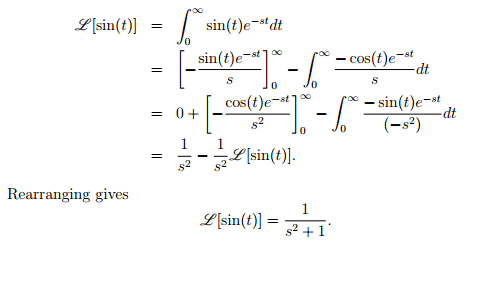
Worked integration by parts of the Laplace transform of sin(t), ending with L[sin(t)] = 1/(s^2 + 1) after rearranging the repeated integral terms.

Could you please show me how to solve it?

Thank you in advance.
 
Which part are you struggling with? Isn't your second attachment already the worked-out solution?
 
  • Like
Likes   Reactions: williamcarter
williamcarter said:
Dear PF members.
I am requesting again your help as I keep struggling with the LaPlace transformation.
I have this exercise to do(please see below)
View attachment 109363

We know that L[f(t)]= integral from 0 to infinity of f(t)*e^(-st) dt
thus in our case, L[f(t)]= integral from 0 to infinity of sin(t)*e^(-st) dt

I tried doing it by parts twice, however I can't reach their answer.Please look below
View attachment 109364
Could you please show me how to solve it?

Thank you in advance.

It is against PF rules for us to "show you how to solve it". At most, we can offer hints. However, since you have already done all the work, I can tell you that your final answer is correct.

Furthermore, the way you did it is one of the ways I would have done it; the other way would have been to write ##\sin(t) = (e^{it} - e^{-it})/(2i)## and integrate the two terms separately.
 
  • Like
Likes   Reactions: williamcarter