LaTex: eqnarray numbering eqs as 1a, 1b, 1c

  • Topic: LaTeX 
  • Thread starter Thread starter Saladsamurai
  • Start date Start date
  • Tags Tags
    Latex
Join the discussion
Registration is free. Start your own thread to ask a follow-up.
1 reply · 32K views · last reply
Saladsamurai
Messages
3,009
Reaction score
7
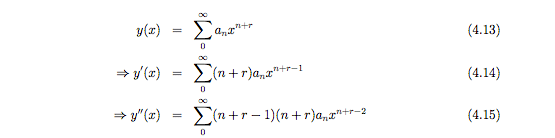
Hi folks, I am making some great progress in LaTeX, however this is something I am having trouble finding. I think that I am just unsure of what keywords to search. I have the following equation array:

Code:
\begin{eqnarray}
 y(x) &=& \sum_0^{\infty}a_nx^{n+r}     \label{eqn: frobenius 6}\\
 \Rightarrow y'(x) &=& \sum_0^{\infty}(n+r)a_nx^{n+r - 1}	\label{eqn: frobenius 7}  \\
 \Rightarrow y''(x) &=& \sum_0^{\infty}(n+r-1)(n+r)a_nx^{n+r - 2}	\label{eqn: frobenius 8} 
 \label{eqn: frobenius 8}
\end{eqnarray}

which produces the following
Three rendered LaTeX equations numbered (4.13) to (4.15): y(x) = sum from 0 to infinity of a_n x^(n+r); then y'(x) = sum of (n+r) a_n x^(n+r-1); then y''(x) = sum of (n+r-1)(n+r) a_n x^(n+r-2).


Instead of numbering each equation as a new number, I would like it to say (4.13a), (4.13b),(4.13c).

I know this is possible; I am just unsure of the syntax.

Any thoughts? Thanks!
 
Physics news on Phys.org
What you want is subequations. You should also use the align environment instead of eqnarray, as it has better spacing -- see the links in this http://tex.stackexchange.com/questions/196/eqnarray-vs-align" .

Code:
\begin{subequations}
\begin{align}
 y(x) &= \sum_0^{\infty}a_nx^{n+r}     \label{eqn: frobenius 6}\\
 \implies y'(x) &= \sum_0^{\infty}(n+r)a_nx^{n+r - 1}	\label{eqn: frobenius 7}  \\
 \implies y''(x) &= \sum_0^{\infty}(n+r-1)(n+r)a_nx^{n+r - 2}	\label{eqn: frobenius 8} 
\end{align}
\end{subequations}

produces the attached image (it didn't render on physics forums properly, so I used http://docs.latexlab.org/ ).
 
Attachments
  • Three typeset equations numbered 1a to 1c: y(x) = sum from n=0 to infinity of a_n x^(n+r); then y'(x) = sum of (n+r) a_n x^(n+r-1); then y''(x) = sum of (n+r-1)(n+r) a_n x^(n+r-2), each line preceded by an implication arrow.
    072f982c1744825462e1b99193d57e1e-1.png
    2 KB · Views: 2,116
Last edited by a moderator: