Law of Supply vs Law of Remuneration

  • Thread starter Thread starter Bipolarity
  • Start date Start date
  • Tags Tags
    Law Supply
Click For Summary
SUMMARY

The discussion centers on the Law of Supply and the Law of Remuneration, highlighting their apparent contradictions. The Law of Supply states that an increase in price leads to an increase in supply, suggesting that higher wages would incentivize workers to work more hours. Conversely, the Law of Remuneration posits that higher wages allow workers to maintain their income while working fewer hours, thus prioritizing leisure. Participants conclude that both laws can coexist but apply under different circumstances, particularly influenced by the income and substitution effects.

PREREQUISITES
  • Understanding of basic economic principles, including supply and demand.
  • Familiarity with labor economics concepts such as the income and substitution effects.
  • Knowledge of utility maximization in economic theory.
  • Ability to interpret mathematical expressions related to economics, such as derivatives.
NEXT STEPS
  • Research the income and substitution effects in labor economics.
  • Study the concept of utility maximization and its implications on labor supply.
  • Examine the relationship between wage rates and hours worked in different employment types.
  • Explore the mathematical modeling of labor supply, including derivatives and their economic interpretations.
USEFUL FOR

Economics students, labor market analysts, and professionals in human resources or workforce management will benefit from this discussion, particularly those interested in the dynamics of wage changes and labor supply decisions.

Bipolarity
Messages
773
Reaction score
2
If prices increase, supply will increase. This is the Law of Supply. So if your hourly wage were suddenly increased, then according to this law, you'd be willing to work more hours because each of those hours suddenly offers you more income. Because the higher wage has made working more valuable, you decide to work more hours.

But consider this: if your hourly wage were increased, you are now able to make the same amount of money working fewer hours. You exploit this to your advantage, and decide to work fewer hours, spending the rest on leisure, since you still make the same total salary as before. This is the Law of Remuneration.

The two laws are both logical yet they contradict one another, thus they cannot be both right at the same time. Which law is correct and why?

I've been studying this for a while and it turns out that both laws are right, but at different times.
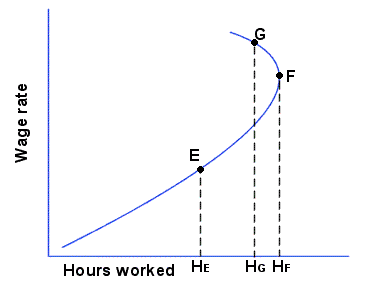
Labour_supply_small.png


But why? What is the point at which the laws neutralize each other?

BiP
 
Last edited:
Physics news on Phys.org
Bipolarity said:
If prices increase, supply will increase. This is the Law of Supply. So if your hourly wage were suddenly increased, then according to this law, you'd be willing to work more hours because each of those hours suddenly offers you more income. Because the higher wage has made working more valuable, you decide to work more hours.

But consider this: if your hourly wage were increased, you are now able to make the same amount of money working fewer hours. You exploit this to your advantage, and decide to work fewer hours, spending the rest on leisure, since you still make the same total salary as before. This is the Law of Remuneration.

The two laws are both logical yet they contradict one another, thus they cannot be both right at the same time. Which law is correct and why?

I've been studying this for a while and it turns out that both laws are right, but at different times.
Labour_supply_small.png


But why? What is the point at which the laws neutralize each other?

BiP
There is no such thing as a "law of supply". It's "supply and demand". Reference to a "law of supply" is BS.

Even this website contradicts itself although it states
(Economists do not really have a “law” of supply, though they talk and write as though they do.)

http://www.econlib.org/library/Enc/Supply.html

Sigh, so much garbage on the internet.
 
Last edited:
Evo said:
There is no such thing as a "law of supply". It's "supply and demand". Reference to a "law of supply" is BS.

Even this website contradicts itself although it states

http://www.econlib.org/library/Enc/Supply.html

Sigh, so much garbage on the internet.

OK then mathematically why is it that
\frac{dS}{dY} change sign at some value of Y where Y is the wage rate and S is the number of hours worked?

BiP
 
Bipolarity said:
OK then mathematically why is it that
\frac{dS}{dY} change sign at some value of Y where Y is the wage rate and S is the number of hours worked?

BiP
The number of hours worked is dictated by the employer, not the employee. There is no such thing as a "Law of remuneration". Please post a link to a reputable source.
 
Evo said:
The number of hours worked is dictated by the employer, not the employee. There is no such thing as a "Law of remuneration". Please post a link to a reputable source.

I do not have links sorry as I use a textbook. My text uses the term to describe the situation in labor economics where \frac{dS}{dY} is negative. It is "Introductory Economics" by the British author G.F. Stanlake. Chapter 3 of the fifth edition describes this law. In any case my question is not so much about the terminology but rather I am looking for an explanation of why the sign of \frac{dS}{dY} changes at a critical value of Y.

It has something to do with utility maximization but I do not understand why. For instance, if you increase the hourly wage, then the marginal utility of working can only increase, thus hours worked can only be expected to increase. I see no reason for the marginal utility of working to decrease as the wage rate goes up.

BiP
 
Bipolarity said:
I do not have links sorry as I use a textbook. My text uses the term to describe the situation in labor economics where \frac{dS}{dY} is negative. It is "Introductory Economics" by the British author G.F. Stanlake. Chapter 3 of the fifth edition describes this law. In any case my question is not so much about the terminology but rather I am looking for an explanation of why the sign of \frac{dS}{dY} changes at a critical value of Y.

It has something to do with utility maximization but I do not understand why. For instance, if you increase the hourly wage, then the marginal utility of working can only increase, thus hours worked can only be expected to increase. I see no reason for the marginal utility of working to decrease as the wage rate goes up.

BiP
This is absolute nonsense in the real world, it just doesn't work that way. You do realize that most professionals are salaried and don't get paid by the hour? If you are an hourly worker, then your employer decides how many hours you work.

I don't find anything anywhere that backs up what you say, so perhaps you have misunderstood what the author is saying.
 
Last edited:
Bipolarity said:
If prices increase, supply will increase. This is the Law of Supply. So if your hourly wage were suddenly increased, then according to this law, you'd be willing to work more hours because each of those hours suddenly offers you more income. Because the higher wage has made working more valuable, you decide to work more hours.

But consider this: if your hourly wage were increased, you are now able to make the same amount of money working fewer hours. You exploit this to your advantage, and decide to work fewer hours, spending the rest on leisure, since you still make the same total salary as before. This is the Law of Remuneration.

The two laws are both logical yet they contradict one another, thus they cannot be both right at the same time. Which law is correct and why?

I've been studying this for a while and it turns out that both laws are right, but at different times.
Labour_supply_small.png


But why? What is the point at which the laws neutralize each other?

BiP

If changes are gradual, would you ever get to the top part of the curve? At the far right point of the curve the marginal cost of labour is infinite. Production stops when marginal cost equals marginal revenue. The second point I think is what Evo is alluding to. A person’s hourly rate may depend on the amount of hours they work. A company may not be willing to pay a part time employee as much because the company may want to fully utilize office resources. For instance, say office space was short. The company would have to consider how practical it was for part time employees to share a desk. Your scenario is plausible I think if someone’s skills are very hard for the company to come by. In that case then maybe they would be more willing to hire them on a part time basis.
 
Bipolarity said:
I see no reason for the marginal utility of working to decrease as the wage rate goes up.

BiP

In most cases I think it is not the work that brings the utility but what a person gains from the work. For instance: wages, purpose, social relations, etc. When calculating marginal utility don’t use hours worked as your dependent variable.
 
Bipolarity said:
If prices increase, supply will increase. This is the Law of Supply. So if your hourly wage were suddenly increased, then according to this law, you'd be willing to work more hours because each of those hours suddenly offers you more income. Because the higher wage has made working more valuable, you decide to work more hours.

But consider this: if your hourly wage were increased, you are now able to make the same amount of money working fewer hours. You exploit this to your advantage, and decide to work fewer hours, spending the rest on leisure, since you still make the same total salary as before. This is the Law of Remuneration.

The two laws are both logical yet they contradict one another, thus they cannot be both right at the same time. Which law is correct and why?

I've been studying this for a while and it turns out that both laws are right, but at different times.
Labour_supply_small.png


But why? What is the point at which the laws neutralize each other?

BiP

They aren't laws but income and substitution effect. Check
 
Last edited by a moderator:

Similar threads

  • · Replies 5 ·
Replies
5
Views
673
  • · Replies 3 ·
Replies
3
Views
3K
  • · Replies 4 ·
Replies
4
Views
1K
Replies
12
Views
5K
  • · Replies 2 ·
Replies
2
Views
2K
  • · Replies 4 ·
Replies
4
Views
8K
  • · Replies 65 ·
3
Replies
65
Views
14K
  • · Replies 1 ·
Replies
1
Views
2K
  • · Replies 2 ·
Replies
2
Views
2K
Replies
9
Views
2K