Lewis H Ryder: Cartesian to Polar Coord Transformations

Join the discussion
Ask a follow-up here, or get your own question answered by working scientists, mathematicians and engineers — people, not an autocomplete.
Real named experts · corrections over time · the nuance an AI answer skips
2 replies · 2K views
Ayoub Tamin
Messages
12
Reaction score
2
TL;DR
I had a problem understanding an example in the page 60-61 In Lewis's Ryder's Book
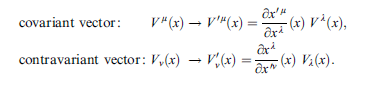
The example is about the transformation between the cartesian coordinates and polar coordinates using the definition
Sans titre.png

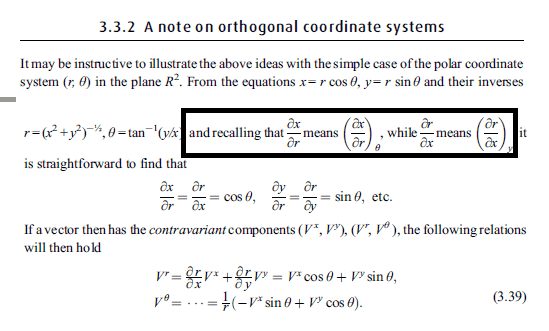
In lewis Ryder's solution, I got confused in this specific line
Sans titre1.png

I really can't see how is that straightforward to find?
 
Physics news on Phys.org
I'm reasonably sure you're overthinking this (although there is a sign typo in his definition of ##r##: his "##-1/2##" exponent should be "##1/2##").

Your boxed section is just the definition of partial derivative. I.e., ##\frac{\partial x}{\partial r}## means the derivative of ##x## by ##r##, with ##\theta## treated as a constant. So... $$\frac{\partial x}{\partial r} ~=~ \frac{\partial (r \cos\theta)}{\partial r} ~=~ \cos\theta \, \frac{dr}{dr} ~=~ \cos\theta ~,$$and $$\frac{\partial r}{\partial x} ~=~ \frac{\partial (x^2+y^2)^{1/2}}{\partial x} ~=~ \frac{1}{2} (x^2+y^2)^{-1/2} (2x) ~=~ x/r ~=~ \dots$$(Can you complete the last step?)
 
  • Love
Likes   Reactions: Ayoub Tamin
strangerep said:
I'm reasonably sure you're overthinking this (although there is a sign typo in his definition of ##r##: his "##-1/2##" exponent should be "##1/2##").

Your boxed section is just the definition of partial derivative. I.e., ##\frac{\partial x}{\partial r}## means the derivative of ##x## by ##r##, with ##\theta## treated as a constant. So... $$\frac{\partial x}{\partial r} ~=~ \frac{\partial (r \cos\theta)}{\partial r} ~=~ \cos\theta \, \frac{dr}{dr} ~=~ \cos\theta ~,$$and $$\frac{\partial r}{\partial x} ~=~ \frac{\partial (x^2+y^2)^{1/2}}{\partial x} ~=~ \frac{1}{2} (x^2+y^2)^{-1/2} (2x) ~=~ x/r ~=~ \dots$$(Can you complete the last step?)
Oh you are absolutely righ, I overthinked that haha and yes i can complete the last step ^^ thanks for your help I appreciate it